Terms read 26 October 2026 Counted in 2026
100% deposit bonus: six rungs, and £15.00 standing at the fourth
Two sums of £25.00 are in play and the ladder carries just the one. A reader puts in £25.00 of their own and a pound-for-pound match adds £25.00 of bonus credit, which enters the requirement at its stated value because credit has not been near a game. Ten times staked over costs £10.00, £15.00 survives, and three rungs then hold that figure without moving it and can each take all of it.
How many steps six Open, deposit, stake £250.00 over, be checked, claim, be settled. The first gate somebody else holds the fourth Documents are weighed by a party answering to no published clock. Standing when it is reached £15.00 Three fifths of the bonus, with the deposit counted nowhere near it.
| What has to happen | Who takes this step | What it leaves standing | Printed where |
|---|---|---|---|
| An account is opened | the reader | £25.00, or nought unopened | the offer’s own headline |
| A deposit is funded | the reader | £25.00, or nought unfunded | the offer’s own headline |
| £250.00 is staked over | the house’s arithmetic | £15.00 | the published British ceiling |
| Identity is checked | the cashier | £15.00, or nought unverified | a licence condition, not a term |
| A payment is asked for | the reader | £15.00, or nought unasked | the cashier’s withdrawal form |
| The cashier settles | the cashier | £15.00, or nought unpaid | nothing published behind this |
| What six rungs leave | two gates the cashier holds | £15.00 | this page |
1
Two sums of £25.00, with the ladder pricing one
A pound-for-pound match on £25.00 produces two figures of the same size and the two are different objects. One is a reader’s own money, already theirs and already spendable. The other is credit a cashier has created, spendable only once a condition has been satisfied.
This site holds them apart and never totals them. A deposit forms no part of what a bonus is worth, and adding the pair would give £50.00, a figure describing neither the gift nor the money at risk. The instrument above prices the £25.00 of credit. The deposit sits on the second rung as a thing that has to happen, with the bonus figure carried across it untouched.
Read that way, a match looks different from the way it reads on a banner. Nobody has handed a reader £50.00 to play with in any sense this site can price, because half of the £50.00 was already theirs and could have been staked or withdrawn with no offer in existence. What arrives is £25.00 of credit with a condition tied to it.
The deposit still costs something, and the cost is not nothing. Twenty-five pounds moves out of somewhere a reader controls and into an account a cashier controls, and most of this page is about how long it stays there and who decides when it may leave. That quantity is separate from the £15.00 at the foot of the ladder and this guide does not blend them.
The same reasoning accounts for the first two rungs taking nothing. Opening an account moves no part of the bonus. Funding the deposit moves no part of it either, the bonus being the thing under measurement. Both rungs are on the ladder because the chain halts without them, and both carry £25.00 forward unchanged.
So the column opens at £25.00 and stays there for two rungs. That is uncommon on this site, where the second rung is where money first goes on more chains than any other, and it follows from the form this offer takes rather than from anything generous in it.
A figure can be put on the deposit’s share of what sits in the account. A reader puts in £25.00 and the bonus on offer is £25.00, so half of what sits in the account at the start came from the reader. Of the £50.00 in that account, £10.00 is expected to go to the requirement and the £15.00 that survives is bonus. Nothing above prices the deposit’s own survival, and nothing on this site can, because no term read for it says what becomes of a deposit while a requirement is outstanding.
One practical note for a reader holding a banner. A percentage on a match describes the relation between two figures and not the value of either. A hundred per cent of £25.00 is £25.00; a hundred per cent of £5.00 would be £5.00; and the figure that decides what the offer is worth is the deposit the reader chooses to make. The percentage is a multiplier waiting for a number.
2
The credit enters the requirement at £25.00, not £24.00
£25.00 of credit goes into the requirement at £25.00. No share comes off it first. That is the most consequential line on this page and it is worth being exact about why.
A share comes off a count of rounds because rounds have to be played before anything can be withdrawn, and playing them hands back a fraction of what is staked. What reaches a balance is the count multiplied by a round’s price and by that fraction. Credit skips all three operations. It is created as money and sits at the figure the headline named.
Apply a return to it anyway and the error is small and systematic. Four per cent off £25.00 would put £24.00 into the requirement, and three fifths of £24.00 is £14.40 against the £15.00 printed here. Sixty pence on a twenty-five pound bonus reads like rounding. It is four per cent of the answer, it leans the wrong way, and it would be wrong on every row of the ladder rather than on one.
Which is why this chain has no rung for rounds turning. Nothing stands between the deposit and the requirement: no reel takes a share of credit before the staking begins, because the credit has not been through a reel. Six rungs, and exactly one of them costs anything.
It does not follow that credit beats rounds, and this page makes no such claim. It follows that credit is a different calculation with one deduction fewer in it, and that setting a match beside a bundle of rounds at the same headline figure means setting two differently derived quantities side by side.
The same point can be put as a test anybody can apply to a headline. If the offer hands over a count of something that has to be played, a share comes off before the requirement starts. If it hands over a sum of money, no share comes off and the requirement works on the whole figure. The form of the gift decides the arithmetic, and the percentage on the banner decides nothing about it at all.
One more consequence for anybody checking the sums. Everything below rests on three numbers: £25.00 of credit, a requirement of ten, with four pence lost in each pound staked. No count of rounds is needed to rebuild the £15.00, no price per round, no reel return. That makes this the most checkable chain under this heading.
3
Ten pounds gone at the third rung
The requirement measures itself against £25.00, and ten is the multiple. A licensed requirement stops at ten, with technical and software licences the only exceptions off the rule sheet, claim 91 off the rule sheet, claim 93. The staking comes to £250.00, ten balances over and it has to be done before any credit may leave.
Read £25.00 as B, ten as W and full weight for the share: E = B × (1 − W × (1 − RTP) ∕ g) answers £15.00. The requirement itself is defined as a total of wagers to be reached off the rule sheet, claim 92, and nothing in the definition touches how long the reaching may take.
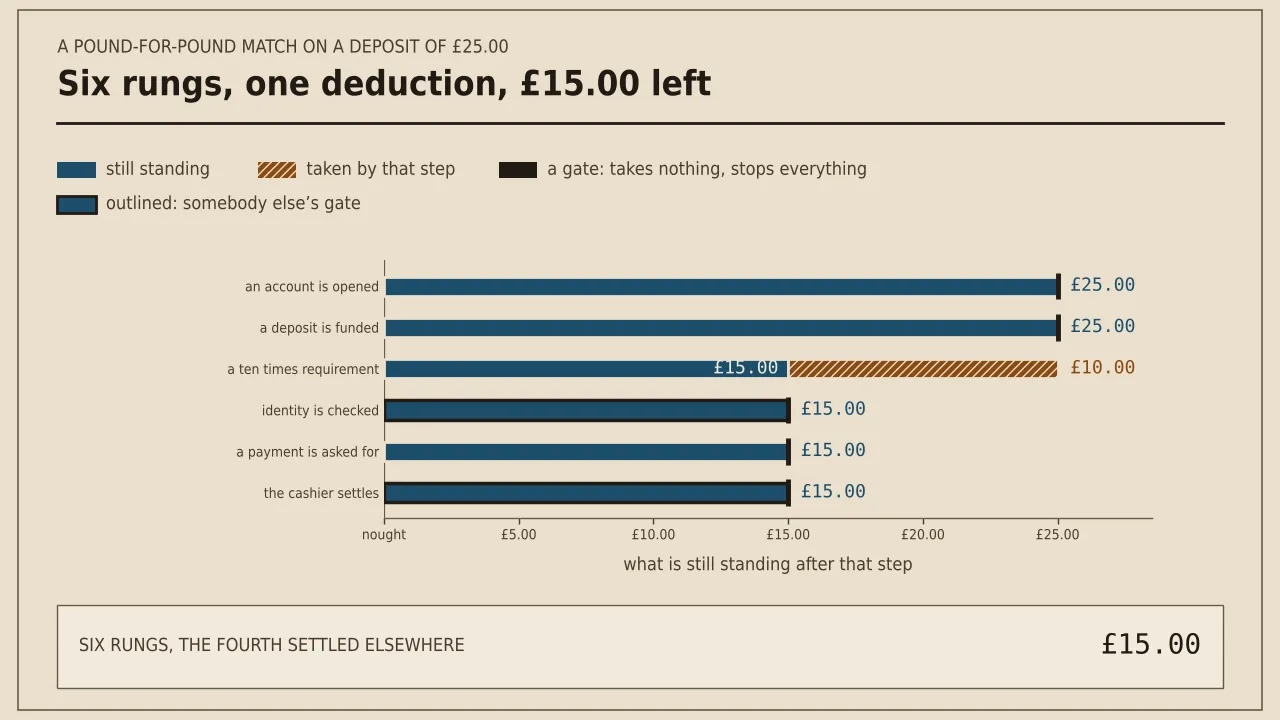
£10.00 of the £25.00 of credit goes on the requirement, two fifths of the bonus and the only deduction anywhere on this chain
One deduction, on one rung. Not a slice off the top and a charge at the end: a single £10.00, with two rungs above it that take nothing and three below it that take nothing. By the shape of the column this is the plainest chain in the section, and the plainness is where the risk hides rather than where it goes away.
The figure to argue with is the £250.00 and not the ten. Ten sounds modest. Two hundred and fifty pounds of staking against the twenty-five pounds of credit that caused it sounds like what it is, and the relation is fixed: credit taken at its stated value always asks ten times itself in staking at this multiple, whatever percentage sits on the banner.
Spread the £10.00 over the staking that produces it and the rate is constant. Two hundred and fifty pounds goes through a reel at four pence lost in each pound, which is £10.00, and there is no point in the exercise where the rate changes. No accelerating charge, no fee at the end, and no rung on the ladder that quietly adds one. That constancy is why a single row can carry the whole deduction.
Push the multiple and the credit empties. Four pence in each pound staked means twenty-five passes over £25.00 account for the whole bonus, so the expectation reaches nought at twenty-five times. Multiples of sixty have been seen in the market off the rule sheet, claim 94, and sixty against £25.00 pushes the same expression under nought: nobody owes that, and the sum is reporting that £25.00 will not outlast the exercise.
4
Two thousand five hundred rounds, at one floor or the other
Something has to carry the £250.00 and a 10p round is assumed here for counting purposes. Two thousand five hundred rounds, then. This ladder shows six of them, with the third taken two and a half thousand times.
The counts are printed apart. Six tells one chain from another. Two thousand five hundred tells a reader what the third rung costs in attention. Neither estimates the other and they are never added.
A casino bonus can be cleared on more than one kind of game, so two floors are published rather than one. A slot cycle waits 2.5 seconds for its successor off the rule sheet, claim 107. Other casino games, peer-to-peer poker aside, wait five off the rule sheet, claim 108, a requirement whose date is 17 January 2025 off the rule sheet, claim 114. Nothing may be set running by itself in either case off the rule sheet, claim 115.
Multiply both out. At 2.5 seconds, two thousand five hundred rounds cannot be finished inside one hour and forty-four minutes. At five seconds the figure is three hours and twenty-eight minutes. Where a reader clears the requirement decides which applies, and no banner about a match mentions that the choice exists.
Both numbers are floors and neither forecasts anything. The multiplication belongs to this page and the seconds are published. What the pair establishes is that £250.00 of staking occupies somewhere between two and four hours at best, and that the £10.00 it costs is spread across that time thinly enough to be imperceptible.
Divide to see how thinly. Two thousand five hundred rounds divide £10.00 between them at two fifths of a penny apiece. Nobody notices two fifths of a penny. Two and a half thousand of them come to two fifths of the bonus.
One row on the instrument stands for £250.00 rather than two thousand five hundred rows. A row holds one condition; the rounds are the quantity attached to it; and that quantity belongs in a paragraph where both numbers can be seen at once.
5
The fourth rung, where £15.00 waits on a reading
£15.00 arrives at the fourth rung undiminished. A document check stands there and takes nothing, so the sum goes through whole or stays put. Above it every figure was arithmetic anybody could repeat. From it down, none is.
A licensed account is identified before it gambles anything off the rule sheet, claim 10, and an incentive does not excuse that off the rule sheet, claim 18. A licensee also has to tell a customer, before any deposit is taken, what documents may be wanted and when off the rule sheet, claim 12. So on a licensed chain this rung would have been settled above the first one, and a reader would have known in advance what it was going to ask for.
The exit carries the same condition. Documents asked for only at the payout are turned away off the rule sheet, claim 11, laundering checks sit at the start off the rule sheet, claim 15, and a payment stalled for want of them can amount to a breach off the rule sheet, claim 16.
Beyond the licence nothing settles the rung, its timetable or its appetite. Blocked payments and limits beyond reach are what the published account carries off the rule sheet, claim 135, and beside them unfair play, lost money and nowhere to complain off the rule sheet, claim 134.
Three rungs sit below the requirement and only one of them is the reader’s. A claim can be lodged at any hour and left for a month, and £15.00 sits patiently through it. Verification and settlement sit on the other side of the counter altogether, and those two carry the whole figure.
The arithmetic at this rung has only two outcomes and that is worth saying plainly. No part of £15.00 is ever paid. What stands at the bottom of this chain carries £15.00 and nought and nothing in between, which is a different kind of exposure from the £10.00 above it. The £10.00 was a known share of a known balance removed by sums that choose nothing.
Notice what the deposit does at this point, since it is what a match adds to the picture. A reader who fails the fourth rung has not only lost £15.00 of bonus. The £25.00 that went in is in the same account, behind the same desk. This guide prices the bonus because the bonus is what the offer supplied, and what becomes of a deposit sitting behind a desk that answers to no British condition is a question nothing read for this page settles.
So the finding is the fourth rung and not the third. The £10.00 that went at the third went as arithmetic working through, with nobody choosing it. The fourth rung is a choice, and £15.00 is the figure in front of whoever is about to make it.
6
Three silences, against £15.00 and against £25.00
£15.00 is where a published ceiling and the form of this offer leave the bonus. Three further things bear on the chain, nothing published settles any of them, and one of the three bears on the deposit rather than the bonus.
The first bears hardest on a match of any size. Whether a requirement that reaches a deposit on top of a bonus is caught has never been published in either direction off the rule sheet, claim 104. The ceiling is written about bonus funds off the rule sheet, claim 92. So this page draws the requirement against £25.00 of credit and says plainly that a term reaching the deposit too would put £500.00 of staking behind the same offer, twice the figure on the ladder, with no published rule broken anywhere.
That is the largest unpriced quantity here and it is worth seeing in rounds. £500.00 at 10p is five thousand rounds rather than two thousand five hundred, and between three and a half and seven hours at the two published floors. Nothing would have moved the ten printed on the term, not by a decimal point.
The second concerns a roof over the bonus winnings. Nothing published limits what an incentive may win off the rule sheet, claim 105, and the rule against capping a withdrawal covers a deposit balance off the rule sheet, claim 34, so a cap on the credit and a free hand over the deposit can hold at once. Having no figure to work with, the ladder shows no such rung, and £15.00 is what the sums produce rather than a sum anybody has promised.
The third is weighting. A contribution of thirty pence in the pound was the figure respondents brought forward off the rule sheet, claim 96, and nothing was done about contribution of that kind off the rule sheet, claim 97. At thirty pence the £250.00 of credit this requirement needs sits behind £833.33 of staking. Give the expression a share of thirty per cent and the answer turns negative, which reports that £25.00 is unlikely to see the staking through rather than that anybody owes anything.
Three gaps, then, and all three push one way. Every one of them would take something off £15.00 or add something to the £250.00, and none can be given a figure from any source this publisher may cite. £15.00 is therefore an upper bound on what a reader keeps rather than a middle estimate of it, and printing it as the latter would mean supplying three numbers nobody has published.
A clause with money behind it belongs beside those three. £170,000 is on record as the price of a term keeping back a free hand over accounts off the rule sheet, claim 83, the penalty carrying 3 July 2025, and the condition it breached was about fair and open dealing off the rule sheet, claim 84. Fined, and not void: no source says so off the rule sheet, claim 86. Laid across this chain it moves no figure and can close the whole thing at the cashier’s choosing.
Two rungs stay off deliberately. A claiming deadline is among the things a promotion owes a reader off the rule sheet, claim 62, and so is a minimum payment, but neither figure came out of the reading for this page and this ladder carries nothing it cannot price.
7
£15.00, £25.00, and no British licence over either
Every figure above is the kindest reading the published rules will support, and the kindness is borrowed from conditions that attach to a licence. Nothing here is licensed in Great Britain at all.
Matches of this kind go in front of British readers from beyond any Great Britain licence. Of the duties such a licence imposes, three bear on the deposit rather than on the bonus, which is what makes them worth pricing here. Payment is the first. Credit cards may not be used to pay a licensee for gambling off the rule sheet, claim 21, a bar in place since 14 April 2020 and covering remote licences throughout off the rule sheet, claim 22, so the £25.00 on this chain is funded under no such restriction. The limit is the second. A licensed system offers deposit limits at account level across a day, a week and a month off the rule sheet, claim 26, with any increase held behind a waiting period of a day at least and any reduction applied at once off the rule sheet, claim 29. Nothing of that shape governs a £25.00 deposit here. Exclusion is the third: a British licensee has to be in the national scheme off the rule sheet, claim 181, whose terms disclaim any power over operators outside it off the rule sheet, claim 183. That is the consequence, and nowhere on this site is a procedure set out.
A fourth duty belongs in the same list although it bears on the last two rungs rather than on either sum. A licensed complaint runs to eight weeks at most off the rule sheet, claim 39, has to be taken for six monthsafter the incident off the rule sheet, claim 40, and its close names an adjudicator the regulator has approved off the rule sheet, claim 42. The regulator declines the role of ombudsman in its own words off the rule sheet, claim 46. Inside the licence, then, £15.00 ends at an adjudicator. Beyond it, no source consulted here sets out any route whatever.
Two of those three would have changed what a reader could do rather than what the ladder says. Without the limit rules the £25.00 going in answers to no published ceiling and no published waiting period, so the quantity at risk is bounded by nothing except a reader’s own restraint. Without the card bar the funding route is unconstrained as well.
There is one more figure worth printing before the licence is dealt with, because it bounds the whole page. A reader who walks this chain perfectly, stakes the £250.00, satisfies every rung and is paid in full is £15.00 better off for an evening of pressing, having had £25.00 of their own money sitting behind somebody else’s desk throughout. That is the quantity to weigh, and no banner carrying a percentage prints it.
A good deal more has been published about this market than the word unregulated allows. A notice dated 20 January 2025 names what can be missing from such a site, and compulsion is the common feature of what it names: each item is required of somebody licensed and of nobody else. It records that self-excluded customers are often the people such sites go after off the rule sheet, claim 130.
A fact in the other direction belongs here or the page tilts. The statute makes the provider the offender and writes no offence for a customer off the rule sheet, claim 3. Protection is what disappears out there. Six rungs on a pound-for-pound match, the fourth settled elsewhere, £15.00 of bonus standing at it, and a £25.00 deposit in the same account with nothing on this page able to speak for it.
Asked at the booth
- How much of a pound-for-pound match on £25.00 survives
- Twenty-five pounds of bonus credit enters the requirement whole, £10.00 goes to the staking, and £15.00 survives it.
- Why is the deposit not added to the bonus
- Because a reader already owned it. Adding the two would give £50.00, which describes neither the gift nor the sum at risk, so the ladder prices the credit alone.
- What does putting a return on the credit cost
- Sixty pence. £24.00 would enter the requirement and £14.40 would come out, against the £15.00 the correct arithmetic gives.
- How much staking stands behind £15.00
- Two hundred and fifty pounds. At the 10p used here for counting that is two thousand five hundred rounds.
- How long does that take
- Between one hour forty-four minutes and three hours twenty-eight, depending on whether the staking is done on slots or on other casino games.
- Which rung does the page report
- The fourth, the document check, with £15.00 standing. It is the first rung whose answer comes from the far side of the counter.
- Could the requirement reach the deposit as well
- Nothing published says either way. A term of that kind would put £500.00 of staking behind the same offer and would break no published rule.
- Does a British licence cover any of this
- No. Three duties of one were priced above against the £25.00 deposit: the credit-card bar, the deposit-limit rules, and membership of the exclusion scheme.