Terms read 26 October 2026 Counted in 2026
Visa casino: seven rungs, and rung two is the issuing bank’s
Seven things have to go the right way before a matched offer paid for by card becomes money, and the first that is not the reader’s own is rung two. Fifteen pounds at an equal match sets £15.00 of credit at the head of the column, out of which £9.00 is expected to outlast the play-through. Rung two is an authorisation. A bank that has never seen the offer answers it in a fraction of a second, moves no money either way, and the entire £15.00 is riding on the answer.
How many steps seven One outside company and one cashier, between them taking four of them. The first gate somebody else holds rung two The issuing bank authorises the payment, or declines without giving reasons. Standing when it is reached £15.00 All of it, rung two falling before the play-through begins.
| What has to happen | Who takes this step | What it leaves standing | Printed where |
|---|---|---|---|
| An account is opened | the reader | £15.00, or nought unopened | the offer’s own headline |
| The card is authorised | the issuing bank | £15.00, or nought declined | nothing published behind this rung |
| The matched credit lands | the cashier | £15.00, or nought withheld | nothing published behind this rung |
| Ten times is played through | the house’s arithmetic | £9.00 | the published British ceiling |
| Identity is checked | the cashier | £9.00, or nought unverified | licence condition 17.1.1 |
| A payment is asked for | the reader | £9.00, or nought unasked | the cashier’s withdrawal form |
| The card is refunded | the cashier | £9.00, or nought unpaid | nothing published behind this rung |
| What seven rungs leave | four gates, two deciders | £9.00 | this page |
1
Seven rungs, and why a card makes one fewer than a wallet
Seven is the count on this key. It is one short of the eight a wallet produces, and the single rung of difference is the only thing a method of payment really tells a reader: how many strangers are standing in the chain, and at which end.
That comparison is not a verdict, and it only works because the figures on either side of it are held still. Fifteen pounds at an equal match, a ninety-six per cent return, ten times through: change any of the three and every money figure moves while the rung count sits exactly where it is. So this guide reports the seven first, treats £15.00 and £9.00 as the arithmetic that makes the seven legible, and resists the temptation to lead with a sum that depends on a choice this publisher made rather than on anything about plastic.
Ownership of the seven runs as follows. Rung one and rung six belong to the reader: an account gets opened, and later a payment gets asked for. Rung two is the issuing bank’s. Rungs three, five and seven are the cashier’s: the credit landing, the identity being checked, the money going back to the card. Rung four has no owner, being arithmetic. Four of the seven move nothing and can still end the chain, and two of those four are settled by somebody the reader has no standing with. How the column itself works is set out on its own page.
The missing eighth rung sits at the far end. On a card the money going out is pushed by the cashier back to the card that paid, and the bank’s part in that is a posting rather than a judgement. A wallet, by contrast, has a balance of its own and has to agree to receive. So the card version of this chain has one fewer company able to refuse the money, and also one fewer company with any interest in whether it arrives.
Read that trade honestly and it is not obviously a trade in the reader’s favour. Seven rungs with three of them the cashier’s is a chain in which the party that owes the money also controls most of the chain. Eight rungs with two held by a payments company is longer and more distributed. Neither arrangement is published anywhere this publisher may cite, so neither is recommended on this page; the count is the whole of what is being reported.
Two further variants would make the count go up rather than down. Paying in by card and asking to be paid somewhere else splits rung seven into two and brings a third company in. Paying in by a card issued against credit rather than against a balance changes nothing in this count and a great deal in what a British licensee may accept, which is a separate key and a separate page. Both variants are longer. Nothing read for this page shortens a chain by adding a company to it.
One point of vocabulary before the figures, because it bears on who decides what. The bank at rung two is the reader’s bank. It is not the cashier’s bank, it has no contract with the cashier that this publisher has seen, and it is answering a question whose subject is the cashier and not the account holder. That asymmetry is what the third part of this guide is about.
2
£15.00 of credit, and the £9.00 that is expected to outlast it
Fifteen pounds pays in and £15.00 of credit comes with it on an equal match. The fifteen that was paid belongs to the reader and stays out of the column; the matched £15.00 is what has been promised, and a promise is what a count of rungs is a count of.
Both numbers are declared on this page rather than read off a term. The size of a card deposit is nobody’s published minimum, and the single citable statement about the wider offshore market is that it yields no distribution of multiples, caps or values at all off the rule sheet, claim 159. The shape of the pairing does have a source: bonus to staking stays at ten to one however loud the headline percentage gets, in the regulator’s own worked figures off the rule sheet, claim 103.
£150.00 is what rung four asks for in staking, ten times the credit, ten being the ceiling over a licensee since 19 January 2026 off the rule sheet, claim 91. Four per cent of £150.00 is £6.00, the return being put at ninety-six per cent by this publisher as a general industry figure and taken off no machine. So E = B × (1 − W × (1 − RTP) ∕ g) puts £9.00 at the bottom of the column, and £6.00 is the only money the chain loses to anything other than a decision.
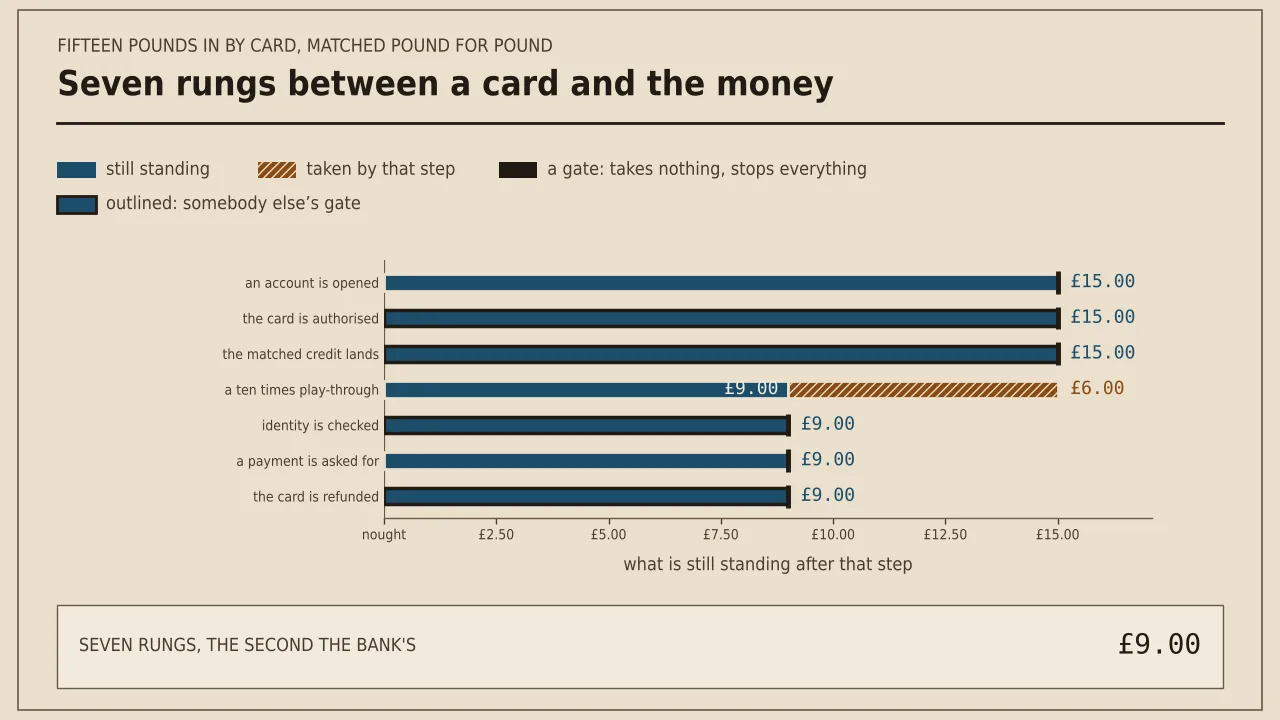
£6.00 of the £15.00 goes at rung four, and the six rungs around it leave the figure exactly as they found it
Two counts fall out of this and neither should be reported as the other. The chain is seven rungs long. One of those rungs is £150.00 of staking. Effort lives in the £150.00 and risk lives in the seven, and a reader is entitled to both numbers rather than to whichever one flatters the offer.
Nothing in the count depends on the fifteen. Seven pounds fifty of credit would leave £4.50 after the same obligation, and the chain would still be seven rungs with rung two still the bank’s. A key that names a way of paying therefore yields one firm result: money scales, and chains do not.
3
Rung two: what a bank is asked, and what it is never told
£15.00 is standing on rung two, and rung two is a yes or a no to a single question: may fifteen pounds go from this account to this merchant. The answer comes back without reasons, in less time than it takes to read the question, and it is the earliest moment on the chain at which the reader has stopped being in charge.
Three things are true of the party answering, and together they are the finding. It knows the reader, holds the account and can be telephoned. It has not seen the offer, the terms, the £150.00 or the obligation, and has no opinion about whether £15.00 of credit is a good bargain. And the rule it applies cannot be looked up by the reader in anything this site is permitted to cite, a bank’s own payment conditions being outside the two sheets this publisher works from.
That is the gap this heading of the site was built to measure, and plastic shows it at its simplest. Rules do exist along the rail. They bind whoever contracted with the rail. An offshore cashier’s contracts are invisible from here, so a published rule and an honoured rule are two different things with nothing in the record joining them. Hence the blank in the fourth column at rung two, which is not laziness but the only entry the material supports.
One consequence of that asymmetry deserves saying out loud, because readers picture a refusal the other way about. Somebody declined at rung two asks what they did wrong, and the question is pointed at the wrong party: the account was never the subject of the enquiry. Fifteen pounds was offered to a named merchant and a judgement was formed about the merchant. The reader is the one who finds out, and the only one with nowhere to take it.
Something else happens at rung two besides a yes, and it is worth a paragraph because no rung records it. Fifteen pounds moving creates a record at the cashier’s end, and what that record contains, how long it is kept and who else sees it are four questions this guide cannot answer from anything citable. Secure payment systems appear on the regulator’s list of what unlicensed sites are often missing, beside age checks and the tools a person uses to stop off the rule sheet, claim 134. No figure comes out of that, so the third column is untouched by it. It belongs beside rung two all the same, rung two being where a reader passes over something other than money.
Set against that, the one thing rung two does guarantee is that the reader’s own bank has seen the transaction and can be asked about it. That is the single advantage the card version of this chain has over every other route counted under this heading, and it is an advantage about information rather than about money: the fifteen pounds is gone either way, and what remains is a record in a place the reader can reach.
What rung two costs is nothing. A decline leaves fifteen pounds in the account and no chain at all, so the column carries £15.00 across the rung rather than some fraction of it. That is also why the finding on this page is rung two rather than rung four: rung four takes £6.00 and nobody chose it, while rung two takes nothing and somebody did.
Where a decline comes from a block the bank itself has in place, or from a registration with the national exclusion scheme, the consequence is the same and the consequence is all this page prints: the chain stops at rung two with the promise untouched. No way past that is described anywhere on this domain. Anybody for whom that is unwelcome rather than a relief will find the helpline printed further down this page.
4
Rung five at position five, and condition 17.1.1
£9.00 is waiting at rung five and the cashier takes that rung when it chooses. The interesting thing is not the rung but its position, because a British licence would have made position five impossible.
Condition 17.1.1 settles the position for a licensee: the check belongs ahead of any play off the rule sheet, claim 10, and what might be asked for has to be explained before a deposit rather than after one off the rule sheet, claim 12. Laid over this chain, rung five moves above rung one, where nothing has been promised and nothing is at stake on it.
The same condition shuts the exit. A request for money is not the moment a demand may first arrive, where there was a chance to make it earlier off the rule sheet, claim 11, and that duty is put to players as a bar on making proof the price of being paid off the rule sheet, claim 15. Money held up for want of such material can put a licensee in breach off the rule sheet, claim 16.
So a licence would have broken this page’s order twice over. Rung five would already be behind the reader, and keeping the £9.00 at rung six while papers were sought would be the breach just cited. Away from the licence neither sentence reaches anybody. No reading taken for this guide fixes the place of a check at an unlicensed cashier, its contents, or the time it may take, and none of the three is invented here.
Two cautions on the sources, of the kind a sourced page owes its reader. The consumer-facing guide drawn on above is some years older than the condition it summarises, and the live wording is the condition’s off the rule sheet, claim 17. And no list of acceptable documents is prescribed; examples are offered and the choice is left to the business off the rule sheet, claim 16. A reader on a licensed chain thus knows the timing and not the contents. On this chain neither is known.
The honest summary of rung five is therefore short. It is a rung that costs nothing, holds £9.00, and sits in a position a licence would not have allowed, at a time nobody has published, asking for documents nobody has listed. Four unknowns on one rung is the most this guide finds anywhere on the chain, and the rung is still only the third most interesting one on the page, because rung two is decided by a party with no interest in the offer and rung four is the only rung that takes money.
One figure is worth putting against rung five, because it is the one place where this page can price a silence. £9.00 is what the check holds up. If the check never happens, £9.00 stays where it is and the chain does not advance; if it happens and fails, £9.00 stays where it is and the chain ends. The two outcomes are a long way apart for the reader and identical in the third column, which is exactly why a rung of this kind is counted rather than discounted.
5
Fifteen pounds against £150.00, and who is doing the counting
Fifteen pounds is one payment at rung two. It is also a tenth of £150.00, and £150.00 has a published meaning: a licensee whose customer reaches that much in net deposits over a month has owed a light-touch check since the February of 2025, the figure before then having been £500 off the rule sheet, claim 48. Ten payments the size of rung two would arrive there inside a month.
Two things follow and both are about this chain rather than about that rule. The first is that a licensed cashier would have had to notice the tenth payment, which tells a reader precisely what an unlicensed one has undertaken to notice, namely nothing at all. The second is that the deeper assessments behind that threshold are still a pilot, are not running live, and are stated not to touch a credit rating in either form off the rule sheet, claim 49, so a reader weighing the two sides of a licence is not weighing a credit record against convenience.
A second duty of that family lands on rung one and rung two together. A cap of the customer’s own choosing has to be put up at registration or at the first payment off the rule sheet, claim 23, and having one has to be the default, with refusing it something the customer actively does off the rule sheet, claim 31. Nothing read for this guide says the cashier at rung three provides such a thing, so a reader wanting a fifteen pound monthly ceiling would be leaning on a facility nothing obliges.
A licensed cap also runs at two speeds, and that is the detail worth having: coming down is immediate, going up takes a day’s pause and then a second deliberate act off the rule sheet, claim 29. Fifteen pounds a month can be cut to five this afternoon and cannot become fifty until tomorrow.
None of that is a rung, and the reason is worth one sentence. A reader is above a threshold or below it with nothing at all to do about it, so no rung is owed to one. What a threshold buys this page is a unit: £150.00 against a fifteen pound payment prices a licence in pounds a month rather than in adjectives.
Two more units of the same sort are worth setting down while the arithmetic is to hand, because both of them are about rung one and rung two rather than about the offer. A licensed cap may be set across twenty-four hours, seven days or one month at the narrowest, those three being the published minimum on offer off the rule sheet, claim 26, and the facility itself has to sit a short way from the deposit screen rather than down a corridor of clicks off the rule sheet, claim 28. Fifteen pounds a week would therefore be a settable figure on a licensed chain. On this one no such figure is settable, because nothing read for the page describes the facility existing.
Overlapping caps come with a worked example in the regulator’s own material, and the example is usable rather than decorative. The tighter of two caps governs, so a daily ten pounds beneath a weekly hundred yields seventy pounds a week and not a hundred off the rule sheet, claim 27. Lay the same logic over this chain and a reader who wanted fifteen pounds to be the whole month’s exposure would need the month’s cap and not the day’s, because a daily fifteen multiplies out to a figure thirty times the size of the payment at rung two.
6
Rung seven, and the company that does not appear at it
Rung seven closes the chain and the cashier owns it. £9.00 is standing, and what has to happen is that the cashier sends that sum to the card it came in on. No new company joins, which is the arithmetic of seven rather than eight, and the absence deserves examining rather than welcoming.
One contingency makes the seven into eight and it is common enough to count. Where the card that paid at rung two no longer exists by the time rung seven arrives, the £9.00 has nowhere to be sent along the route it came by, so a second destination has to be nominated and whoever holds that destination has to accept it. That is one reader rung and one outside rung added to a chain already seven long, and nothing read for this page says whether a cashier permits the substitution at all. The eight rungs the wallet page counts and the eight rungs this contingency produces are not the same eight, which is worth saying because a count is only useful if it is a count of something nameable.
What no licence puts anywhere near rung seven is a clock. No reading taken for this guide fixes how long a refund to plastic may take, for a licensee or for anybody else, so no duration appears here and none is guessed at. The rung is counted and left at that, which is the honest treatment of a step whose only published property is that somebody else takes it.
What a licence does put near rung four is a scope rule worth reading twice. The ten times ceiling spares two licence types, the technical and the software, and covers the licensed remote casino market entire while reaching nothing past its edge off the rule sheet, claim 93. So the £6.00 taken at rung four is a figure borrowed from a regime this chain is not inside, used because no gentler figure has a source.
With no ceiling of its own published anywhere, the £9.00 at the foot of this column stays an arithmetical expectation and becomes nobody’s undertaking. One sentence holds the whole lesson of a payment key: a method decides which way money travels and decides nothing about whether there is any money to send.
So the shorter chain has taken out a party rather than a risk. At rung seven of a wallet chain somebody outside the cashier has to be satisfied before £9.00 moves. At rung seven here nobody is, and the only party able to hold the money is also the only one who owes it. A reader choosing between the two should weigh that rather than the count, because on this occasion the shorter chain is the one with fewer people in it who might say no and fewer people in it who might say yes.
7
Seven rungs, and not a licensee among them
Every figure on this page sits at the kindest setting a source supports, and the kindness has a single origin: conditions attached to a British licence. Nobody on this chain holds one, which is why those readings were available and why none of them binds the cashier.
The cashier behind a card offer of this shape is licensed, if at all, somewhere other than Great Britain, and two rungs of the seven can be priced against what one would have required. Rung five is the plainer case: identity is owed ahead of play, so the rung belongs above rung one rather than five rungs down with £9.00 resting on it off the rule sheet, claim 10, and a request for money is not the moment to begin asking off the rule sheet, claim 11. Rung four is the second: £6.00 is what the multiple takes, and ten is where a licensee’s multiple stops off the rule sheet, claim 91, which makes £6.00 a borrowed kindness rather than an obligation. The national exclusion register deserves a line of its own as well: a licence condition from the March of 2020 for anybody taking business from British residents, with whole customer bases to be checked against it daily from that April off the rule sheet, claim 182, and a chain carrying no licensee is a chain no such check runs across. That is the consequence, and this site prints the consequence and nothing further.
One check costs a minute and has nothing to do with plastic. The regulator publishes searchable and downloadable registers of licensed businesses, personal licences, premises and regulatory actions off the rule sheet, claim 53. What a reader holds against a claim is an entry: whether the activities and the domains recorded for a licensee are the ones a site says it has off the rule sheet, claim 88. A card mark beside a payment box is not that check. It describes a route, and routes say nothing about who is standing at the end of one.
The register also comes with a caution the regulator supplies by leaving something out. Its register page bears no date and explains nothing about how to read an entry, including what an active status means, so anybody relying on it should record the day they looked and should not attribute to the regulator a reading it has not published off the rule sheet, claim 54.
And one fact that cuts against the rest, because a count is not an argument. The offence of providing gambling facilities unlicensed falls on the provider, with no answering offence written for the customer off the rule sheet, claim 3, and the requirement follows the operator wherever it sits, being immaterial whether facilities are provided inside or outside the United Kingdom off the rule sheet, claim 4. Cover rather than liberty is the thing mislaid away from a licence, and this guide has put a rung against each piece of it: where the check stands, what caps the multiple, what a monthly total would have triggered, and which register the chain is outside of off the rule sheet, claim 168. Seven rungs, rung two answered by a bank inside a second, and £9.00 at the foot of the column waiting on three decisions that this guide can oblige nobody to take.
Asked at the booth
- Why does plastic make a shorter chain than a wallet
- One outside company instead of two. A wallet has to agree to receive money back; a card is refunded by the cashier without anybody else agreeing.
- Which rung stops being the reader’s first
- Rung two, the authorisation, with £15.00 of credit riding on an answer the issuing bank gives in under a second.
- Why treat an authorisation as a step at all
- Nothing goes on without it, and the party giving it has never read the offer, the terms or the £150.00 of staking attached to the credit.
- What does £15.00 of credit come down to
- £9.00, after £150.00 has been staked at the ninety-six per cent return this page declares. £6.00 is the whole of the loss.
- Who settled on fifteen pounds
- This publisher, on this page. No source anywhere fixes a smallest card payment, so the money scales with that choice and the rung count does not.
- Would a licence have left the check at rung five
- It would not. Condition 17.1.1 wants identity settled ahead of any play, which lifts that rung clear of the whole chain.
- What can a reader read about rung two beforehand
- Nothing this site may quote. The conditions a bank applies to a payment lie outside the two sheets behind these pages.
- Does fifteen pounds a month trigger anything
- Not on its own. Ten payments of that size would reach the £150.00 monthly level a licensed cashier has to check at, and no such counter runs here.