Terms read 26 October 2026 Counted in 2026
Slots sign up bonus: £7.20 standing at the fourth of six rungs
Every published standard written for a reel bears on this one key, and not one of them reaches the chain below. £12.50 is the face: a hundred and twenty-five rounds priced at 10p. Pressed through at 96 pence in the pound they come to £12.00. A ten times condition keeps £4.80 and £7.20 travels to the fourth rung, where a person answers in place of a sum.
How many steps six Open an account, turn the rounds, stake £120.00, be checked, ask, be paid. The first gate somebody else holds the fourth A check with no published list and no published clock. Standing when it is reached £7.20 Three fifths of the £12.00 the rounds are expected to give back.
| What has to happen | Who takes this step | What it leaves standing | Printed where |
|---|---|---|---|
| An account is opened | the reader | £12.50, or nought unopened | the offer’s own count |
| A hundred and twenty-five rounds turn | the house’s arithmetic | £12.00 | this publisher’s assumed return |
| £120.00 is staked over | the house’s arithmetic | £7.20 | the published British ceiling |
| Identity is checked | the cashier | £7.20, or nought unverified | a licence condition, not a term |
| A payment is asked for | the reader | £7.20, or nought unasked | the cashier’s withdrawal form |
| The cashier settles | the cashier | £7.20, or nought unpaid | nothing published behind this |
| What six rungs leave | two answers from behind the counter | £7.20 | this page |
1
A hundred and twenty-five rounds, priced at 10p
A count and a price make up a rounds offer. One hundred and twenty-five is the count. Ten pence is the price, declared by this publisher because no published rule values a given round off the rule sheet, claim 89.
Multiply the two and £12.50 appears, which is a face and not a balance. A round is a chance to play rather than a coin in a hand, so the account shows nothing until all hundred and twenty-five have been pressed.
£12.00 is what shows afterwards, on 96 pence in the pound. The missing 48p is this page’s second declaration, and it is an assumption about a build that nobody here has to constrain.
Say both before doing any arithmetic, which is the only honest order. Try 5p instead and the face halves to £6.25. Try 95 pence in the pound and £11.875 lands. Neither substitution damages the method and both change every figure.
Opening the account takes nothing, which is why the first rung carries £12.50 across unaltered. It is on the ladder because there is no chain without it, not because it costs anybody a penny.
Where a round’s winnings sit, as between bonus money and cash, has never been settled off the rule sheet, claim 90. Money landing as bonus funds falls under the ten times ceiling; the round itself is unaddressed. The third rung is therefore marked as a ceiling borrowed rather than a ceiling owed.
No rung carries a deadline. A limit on the time for claiming is treated as significant by the advertising code off the rule sheet, claim 62, and no figure for one came out of the reading, so the ladder shows no rung instead of showing an empty one.
A hundred and twenty-five rounds, ten pence apiece, £12.50 of face and £12.00 landing. That is the position before a condition is read, and two multiplications rebuild all of it.
2
Ten times, and the £4.80 it costs
A condition measures itself against £12.00 rather than against £12.50, because what never arrived cannot be staked. A requirement may not pass ten times under a British licence off the rule sheet, claim 91, the ceiling bearing the date 19 January 2026, and the only licence types left out are the technical and software ones off the rule sheet, claim 93.
£120.00 of staking is ten times £12.00. Put B at £12.00 and W at ten, nothing divided: E = B × (1 − W × (1 − RTP) ∕ g) gives £7.20. A requirement is defined as wagers reaching a value that is stated off the rule sheet, claim 92, and that is all the definition contains.
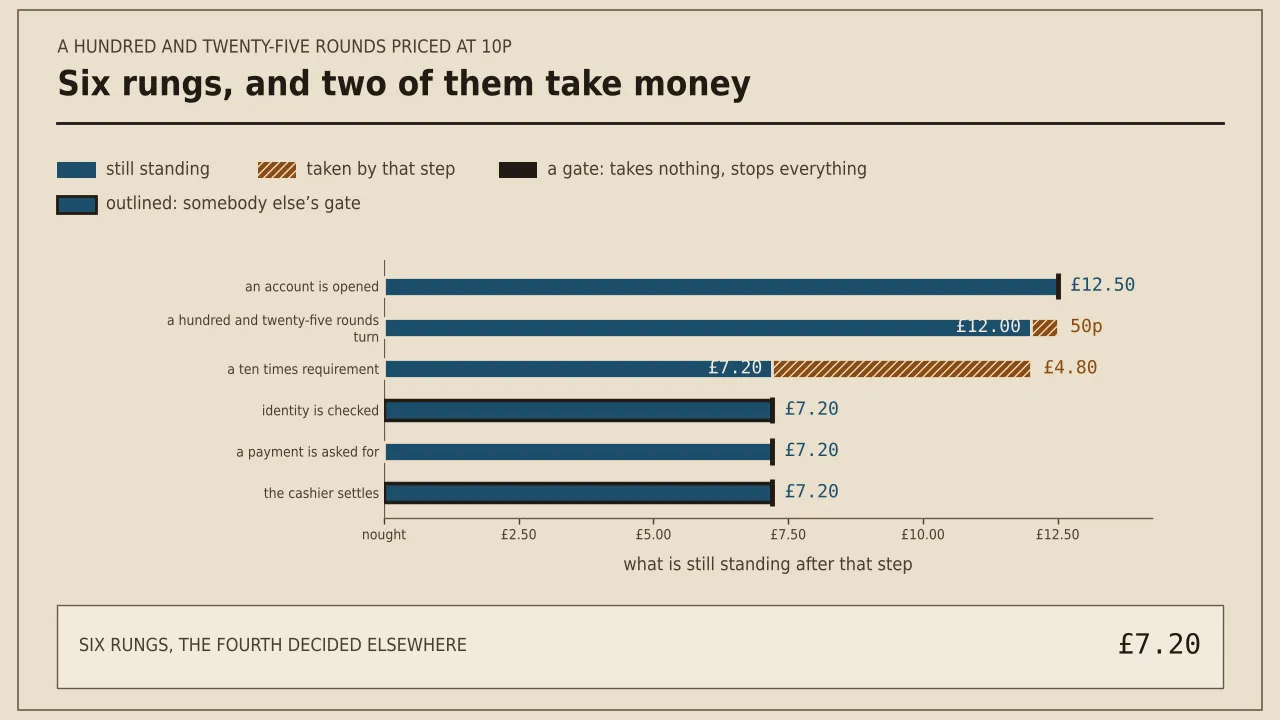
£4.80 of the £12.00 that landed is spent on the condition, which is two fifths of everything the rounds returned
Two of the six rungs take money and four take none. The reels take 48p because they pay out less than they take in. The condition takes £4.80 because the staking goes round ten times. Ten times the size, and identical in kind: arithmetic arriving on schedule with nobody weighing anything.
The rate underneath £4.80 is four pence in the pound, level the whole way across £120.00. No charge waits for the end, no rate steepens as the count climbs, and the last three rungs take nothing whatever.
Set the cost beside the gift and the proportion is what to remember. A hundred and twenty-five rounds were handed over, and two fifths of what they gave back leaves again in order to qualify. Nobody charges that. It is twelve hundred rounds played at a loss of four pence in the pound, which is the only mechanism a condition of this kind has.
Like every money figure here, £7.20 is an expectation. It is the middle of a great many separate runs of twelve hundred rounds. One run finishes with the £12.00 whole and another with none of it, and the ladder prints where the middle lies.
Raise the multiple and the figure runs out. Four pence a pound means twenty-five passes over £12.00 account for all of it, so nought is reached on the twenty-fifth pass. Sixty has been recorded by the regulator off the rule sheet, claim 94, and sixty drives this expression under nought, which reports an expectation and never a debt.
There is one more figure worth taking from this part. £4.80 is the cost of qualifying and £12.50 was the headline, so the condition eats rather more than a third of what the offer announced. On a sign up offer that is the number a reader has not been shown.
3
Twelve hundred rounds, and fifty minutes of pressing
A 10p round divides into £120.00 twelve hundred times. The ladder has six rungs, and one of those six is a thing done twelve hundred times.
Twelve hundred and six are not to be added. One is a tally of obstacles. The other is a tally of presses inside the third obstacle. A page that put them in the same column would be adding unlike things.
The labour is nine and a half times the gift. A hundred and twenty-five rounds came free of charge and twelve hundred are owed, and what sets that gap is the multiple together with the assumed return.
Reels have a published minimum pace. A following cycle may not begin inside 2.5 seconds off the rule sheet, claim 107, the button being released and depressed afresh each time, and nothing may be left to run on its own off the rule sheet, claim 115.
Fifty minutes is what twelve hundred rounds come to at that minimum. The hundred and twenty-five given rounds account for five of those minutes. Five minutes given and fifty minutes owed is the whole offer expressed as time.
Divide £7.20 by fifty minutes and the offer pays about fourteen pence for each minute of pressing. That rate assumes the floor is observed. Without a licence the floor is not there at all, so a quicker screen pays the same £7.20 for a shorter evening.
Four tenths of a penny is the cost of one round. Twelve hundred rounds divide £4.80 between them, and nobody can perceive four tenths of a penny leaving. Two fifths of what the reels returned goes out at that speed, and the difference between a quantity felt and a quantity counted is the whole reason for an instrument.
One row carries £120.00 rather than twelve hundred rows carrying 10p. A condition is a single thing with a size attached to it, and the size sits in prose beside the rung count where both can be read at once.
4
Five standards written for reels, and a chain under none
The standards in this part are written for the kind of game this offer is made of, which is what separates this key from the rest of the heading. They run from 14A to 14G, and the page carrying them was altered on 12 January 2026 off the rule sheet, claim 106. Four can be priced against twelve hundred rounds and a fifth against the 96 pence.
Take the stake ceiling first. A cycle is capped at £5, or at £2 where the customer is under twenty-five off the rule sheet, claim 124, and neither figure reaches past online slots off the rule sheet, claim 127. Ten pence is a long way under both, so the ceilings have nothing to say about this chain even where they do bind.
Which matters, and not because of the 10p. No ceiling stands over this cashier, so the price of a round on the staking is whatever a screen offers. Twelve hundred rounds at a pound apiece is £1,200.00 of turnover inside the same fifty minutes, with nothing published in the way.
Playing several games at once is the second. A licensed system may not even provide the means off the rule sheet, claim 110, and the guidance takes in split screens and multi-screen arrangements. Run twelve hundred rounds in parallel and the condition clears in a fraction of fifty minutes while every screen still respects the floor.
Showing the result is the third. A licensed system has to display what happened and what the customer’s own wager did, for long enough to be taken in off the rule sheet, claim 119. That is the standard turning a count of rounds into a sequence of legible events, and its absence is the hardest of the five to notice.
The pace floor is the fourth and it was priced in the part above. Fifty minutes stands on it entirely. Remove it and twelve hundred rounds take whatever time a screen wants, with the same £7.20 at the end.
The fifth bears on the 96 pence rather than on the rounds. The duty to let a customer judge their chances is satisfied by any one of four things off the rule sheet, claim 120, the four being alternatives off the rule sheet, claim 121. A share of stakes returned is only one of them, so a licensed reel can comply while printing no percentage anywhere.
Five standards about the very thing this offer is made of, and a chain that answers to none. Two of the five would have governed how long twelve hundred rounds take. One would have capped what they could cost. One would have governed what a reader could see while they ran. The fifth would not have secured the 96 pence in either direction.
5
The ceiling, its dates, and one figure nobody should attribute to a regulator
£120.00 of staking rests on a single published number, which is ten. The paperwork behind that number is worth a part to itself, because a reader who wants to check the figure needs to know which text it came out of.
The page carrying the cap was published on 26 March 2025 and last altered on 27 January 2026 off the rule sheet, claim 98. Both dates belong in a citation. The commencement of the cap shifted once while the consultation was running, so a page quoting an undated version cannot show which wording it had in front of it.
The code rule the cap sits inside forbids four things, and what the four have in common is a shape rather than a subject: each describes a way of making an incentive worse for somebody who has already started on it off the rule sheet, claim 58. Two further limbs cover customers a licensee has labelled high value off the rule sheet, claim 59.
The ban on mixing products has a narrow aim that is easy to overstate. One incentive is caught where its terms are tied together and held in common off the rule sheet, claim 101, rather than everything an operator happens to offer at once. On a rounds-only offer it has nothing to catch.
Which leaves this key with the simplest condition anywhere on the heading. A count, a price, a return and a multiple: four numbers, three multiplications, and nothing bundled to anything. £12.50, £12.00, £120.00 and £7.20 are all of it, and a reader who disagrees with the 10p or the 96 can put their own figures through the same three steps and keep the shape of the answer.
There is one figure a reader may meet in this area and should not lay at the regulator’s door. One operator, answering the consultation, put three quarters of what it offered inside the band from one to ten off the rule sheet, claim 95. A respondent describing its own list is not a regulator describing a market, and the sentence supports no claim about what any other cashier asks for.
So the ten on this ladder is a ceiling and not an average. It is used here because it is the only multiple anybody has published, and the third row says as much in the column that names where a figure comes from.
Outside the licence the multiple is whatever a term says. The regulator’s own record carries sixty off the rule sheet, claim 94, and sixty against £12.00 asks for £720.00 of staking, which is seven thousand two hundred rounds and five hours of pressing at the published floor. The £7.20 would be gone long before the end of it.
Which is the practical value of knowing where ten comes from. A reader who meets a multiple above ten has met a figure no British licence would permit, and the arithmetic on this page can be redone against theirs in two multiplications.
6
The one check a reader is told to run, and what it answers
Everything above is arithmetic about an offer. One published step is not arithmetic at all, and the regulator puts it before the rest.
Four registers are published and three of them can be searched and taken away as data off the rule sheet, claim 53, covering businesses, people, enforcement and premises between them. Anybody with a name in front of them can settle the licence question in a minute, which is before any figure on this page starts to matter.
What the register will not settle is published by omission. There is no date on the page and no guidance for reading what is on it, nothing about a domain shown against a licensee, and no definition of an active or an inactive entry off the rule sheet, claim 54. Anything resting on register data has to say when it was looked at.
So the check gives a clean answer and a dirty interpretation. A business absent from the register is not licensed here, and that is the answer governing this entire page. A business present, beside a domain a reader has never seen, is a question the register declines to take.
This page names nobody and runs no check of that kind, because none of the arithmetic depends on one. £7.20 at the fourth rung is what a hundred and twenty-five rounds at 10p come to under a ten times condition, whoever happens to be behind the counter.
A game that looks familiar is no substitute. Casino games from licensed suppliers have turned up where no licence is held off the rule sheet, claim 131, so recognising a reel settles nothing about its keeper.
A working card is no substitute either. Trading without a licence is illegal, and the named consequences are two: action by the regulator against the operator, and the big payment organisations pulling the payment facilities off the rule sheet, claim 129. Neither is a protection a reader can rely on in advance.
One check, one minute, one answer, and it belongs before the first rung rather than after the sixth. Of everything written here that is the sentence worth keeping, and it is not about £7.20 at all.
7
The fourth rung, and why £7.20 stops there
£7.20 reaches the fourth rung entire and the check standing there removes none of it. Everything higher up was a sum a reader could work again. At this rung and below, nothing is.
A licence settles three items before anybody plays off the rule sheet, claim 10, and money handed over as an incentive excuses none of them off the rule sheet, claim 18. The documents that may be wanted, and the moment they may be wanted, go to a customer in advance of a deposit off the rule sheet, claim 12. Licensed, this rung would come first with its appetite on the record.
Leaving the demand until the payout is ruled out off the rule sheet, claim 11. The same ground, read from where the player stands, puts laundering checks at the beginning off the rule sheet, claim 15, and a payment delayed over them may amount to a breach by itself off the rule sheet, claim 16.
Away from the licence the rung floats. Nothing read here fixes where a cashier puts it, how long it may take, or what will satisfy it. Blocked payouts and ceilings nobody can reach have been recorded off the rule sheet, claim 135, and the same source gathers unfair dealing, lost money and the absence of any remedy off the rule sheet, claim 134.
Three rungs stand at the fourth and under it. The fifth is the reader’s: a request made this afternoon or next month, with £7.20 waiting through either. Ownership of the fourth and the sixth never passes to the reader on any reading.
Part payment is not available at either of them. The whole £7.20 goes or none of it does, so this chain stops at one of two numbers with no third. The £4.80 higher up was a different kind of event: a fixed proportion of a fixed sum, removed by a calculation that weighs nothing.
A small figure is also a figure a minimum could swallow whole. The reading produced no minimum withdrawal, so the ladder shows none, and a minimum set anywhere above £7.20 would finish this chain at nought while breaching nothing published.
Which is why the finding sits at the fourth rung rather than the third. £4.80 is four pence in the pound over £120.00 and nobody selected it. The fourth rung is selected, and £7.20 is what sits in front of whoever does the selecting.
8
£7.20, fifty minutes, and no licence behind the reels
The published rules have been given every benefit on this page, and a licence is where the benefit comes from. These reels carry no Great Britain licence.
Sign up offers of this shape reach readers in Great Britain from cashiers that answer to nobody here. Three British licence duties will measure against the chain above. The pace floor is one, and the fifty minutes rests on it alone: two and a half seconds between cycles off the rule sheet, claim 107, with nothing permitted to run unattended off the rule sheet, claim 115. The stake ceiling is another: £5 a cycle, or £2 where the customer is the younger sort off the rule sheet, claim 124, and online slots are as far as it goes off the rule sheet, claim 127. The exclusion scheme is the third: being inside it comes with a British licence off the rule sheet, claim 181, and the scheme itself disclaims any reach past its own membership off the rule sheet, claim 183. Joining it is a result rather than a repair, and no procedure of any sort appears on this site.
The first two of those govern the labour and its price rather than the £7.20. Fifty minutes is the shortest the floor permits, and ten thousand rounds an hour is what a screen can serve once the floor is gone. The ceilings would have limited what a round could cost against the staking, so out here the 10p is a courtesy and not a constraint.
A fourth duty bears on what a reader watches over those fifty minutes. A licensed build may not dress up an outcome that returned no more than the stake off the rule sheet, claim 112, which strips the noise and the lights off a round that gave nothing. Over twelve hundred rounds that single rule is most of the gap between reading a balance and being flattered by one.
A notice of 20 January 2025 reads as one proposition rather than as a list of entries, every entry being something a regulator insists upon and nobody here is bound to do. One thing it records is that an account closed by the customer themselves makes that customer a target off the rule sheet, claim 130.
A fact pointing the opposite way keeps the page straight. The party the statute reaches is whoever provides the facilities off the rule sheet, claim 3, and the customer is given no matching offence. Protection is what goes when the licence goes: six rungs, two of them settled across the counter, £7.20 resting on that pair, and fifty minutes of pressing already behind the reader.
Asked at the booth
- What does a sign up bonus of a hundred and twenty-five rounds come to
- On the 10p and the 96 per cent declared here, a face of £12.50 brings £12.00 to an account, and ten times through leaves £7.20.
- How many rounds does the condition ask for
- Twelve hundred. That is £120.00 of staking at 10p, against the hundred and twenty-five rounds the offer gave.
- How long does that take
- Fifty minutes, if the 2.5 seconds the standard puts after each cycle is respected. The given rounds are five of those minutes.
- Where does the 10p come from
- This publisher. No published rule values a given round, so the figure has to be declared by whoever uses it.
- Which of the six rungs carries the finding
- The fourth. Identity is checked there with £7.20 standing, and the answer to it belongs to somebody the reader never deals with.
- Do the stake ceilings apply to the rounds
- Both ceilings belong to a British licence and reach online slots only. Nothing here is licensed, so neither figure governs a round.
- What would playing several games at once do
- It would clear £120.00 in a fraction of fifty minutes while every screen kept to the pace floor. A licensed system may not provide the means.
- What check does the regulator tell a reader to make
- The public register of licensed businesses, which can be searched and downloaded. It answers the licence question and declines the harder ones.
- Could £7.20 be too small to take out
- It could. The reading produced no minimum withdrawal, so the ladder shows none, and a minimum above £7.20 would finish the chain at nought.
- Is there a British licence behind any of it
- None at all. Three duties of one were measured above: the pace floor, the stake ceilings, and compulsory membership of the exclusion scheme.