Terms read 26 October 2026 Counted in 2026
300% deposit bonus: £36.00 at the fourth rung, which somebody else holds
Three hundred per cent turns a twenty pound deposit into sixty pounds of credit and six hundred pounds of staking. £20.00 goes in, £60.00 of bonus arrives, and the bonus enters the requirement at the figure stated because nothing has played it yet. The requirement costs £24.00, £36.00 comes out the other end, and from there to the bottom of the ladder no rung moves the figure and two of them belong to a stranger.
How many steps six Register, fund, clear £600.00 of staking, be checked, claim, be paid. The first gate somebody else holds the fourth Papers are read behind a counter, to no timetable a reader can see. Standing when it is reached £36.00 Three fifths of £60.00, and the largest sum in this section.
| What has to happen | Who takes this step | What it leaves standing | Printed where |
|---|---|---|---|
| An account is opened | the reader | £60.00, or nought unopened | the offer’s own headline |
| A deposit is funded | the reader | £60.00, or nought unfunded | the offer’s own headline |
| £600.00 of staking clears | the house’s arithmetic | £36.00 | the published British ceiling |
| Identity is checked | the cashier | £36.00, or nought unverified | a licence condition, not a term |
| A payment is asked for | the reader | £36.00, or nought unasked | the cashier’s withdrawal form |
| The cashier settles | the cashier | £36.00, or nought unpaid | nothing published behind this |
| What six rungs leave | two gates the cashier holds | £36.00 | this page |
1
Sixty pounds of credit on a twenty pound deposit
Three hundred per cent describes a ratio, so it has no value until a deposit is named. Twenty pounds is what this page names, making the bonus £60.00. A reader depositing half as much would be looking at £30.00 of bonus and every figure below would halve with it.
The £20.00 is an assumption declared here, as the 15p round further down is. Neither comes off a term, and saying so is the first obligation of a page that then spends the next three thousand words multiplying them.
Sixty pounds of credit and twenty pounds of a reader’s own money are now in one account, and nothing on this site adds them. The £20.00 was the reader’s before the offer appeared and could have been staked or taken back without it. The £60.00 exists because a cashier created it and is worth nothing until a condition has been met. An £80.00 total describes neither, so the instrument prices the £60.00 alone.
Credit at three times the deposit is what three hundred per cent means, and that changes what a reader is really exposed to. £36.00 of bonus is expected to reach the fourth rung, which is nearly twice the £20.00 that went in. Everything a reader stands to gain, and everything they stand to be refused, is larger than the sum they chose to risk.
That is the appeal of a high multiplier stated precisely, and it comes with the matching caution. A balance showing £80.00 is not £80.00 of money. The bonus half of it is locked behind £600.00 of staking and then behind three further rungs, and the deposit half is behind the same three.
One figure is worth separating out before the arithmetic starts, because a large multiplier invites a particular mistake. Three hundred per cent does not mean a reader keeps three times as much. It means the credit is three times the deposit, the staking is thirty times it, and the surviving figure is three fifths of the credit. The proportion kept is the same at every multiplier under this heading, because the ceiling and the assumed return are the same at every one of them.
The deposit appears at the second rung because without it nothing happens. It does not alter the bonus figure, which is why the second row carries £60.00 across unchanged. Two rungs in, the thing this page measures has lost nothing at all.
A reader can rebuild every figure on this page from two multiplications and one subtraction. Twenty pounds trebled is £60.00. Ten times £60.00 is £600.00. Four pence in each pound of £600.00 is £24.00. Sixty less twenty-four is £36.00. Nothing arrives from anywhere that cannot be checked, which is the only basis on which a reader can sensibly disagree with the answer.
Which leaves one caution a reader can take away whole. A balance of £80.00 on a screen is £20.00 of money and £60.00 of conditions.
So a 300 per cent banner, read plainly, offers £60.00 of playable credit for £20.00 of a reader’s money, with £600.00 of staking attached. The credit is what the ladder counts, because the credit is what the offer actually supplied.
2
Six hundred pounds of staking, thirty times the deposit
£600.00 is the figure this chain turns on and no banner carries it. It is the staking the requirement asks for, and against a £20.00 deposit it is thirty to one.
Thirty to one comes out of two multiplications, neither of them hidden. The match turns £20.00 into £60.00. The requirement turns £60.00 into £600.00. A reader who put twenty pounds into an account has undertaken to send six hundred through a game.
Credit is what makes the second multiplication large. A sum of credit enters a requirement at the value written on it, nothing having played it through, which is the rule this site uses for a bonus of money and which the page on counting a chain explains.
Follow the ratio as the multiplier climbs. A hundred per cent on £20.00 would carry £200.00 of staking, ten to one. Two hundred, £400.00 and twenty to one. Three hundred, £600.00 and thirty to one. Four hundred would mean £800.00. Every extra hundred points adds ten times the deposit to the staking. Nothing shows more directly what a bigger headline actually buys.
The figure that survives climbs on the same slope, which is the half a reader notices. Three fifths of £60.00 is £36.00, where a match at one hundred on the same deposit would have left £12.00. More credit, more staking, more survival, all in one fixed proportion.
Which is why £600.00 belongs in the opening sentence of any honest account of a 300 per cent offer. Sixty pounds is what is advertised. Six hundred is what is agreed to, and the second of those settles whether a reader has an evening to give it.
There is a reading of £600.00 that bears on the evening rather than on the money. Each of the four thousand rounds wants committing separately, each with its own act off the rule sheet, claim 115, so £600.00 of staking is also four thousand separate decisions to carry on. £36.00 divided across those decisions is nine tenths of a penny for each one, which is the rate at which this chain pays for attention.
One further number for scale. £600.00 of staking is thirty times the deposit and ten times the bonus, and the expected cost of putting it £24.00, which is more than the £20.00 the reader deposited. The cost expected of the exercise runs above the sum asked for at the start.
3
Twenty-four pounds gone, and £36.00 carried forward
The requirement works on £60.00 and the multiple is ten. A licensee may not write eleven off the rule sheet, claim 91. January 2026 fixed the figure at ten, and only technical and software licences stand outside it off the rule sheet, claim 93. The staking is therefore £600.00, ten of those balances over.
B is £60.00 here, W is ten, the share is whole: E = B × (1 − W × (1 − RTP) ∕ g) returns £36.00. What the requirement is, in the published wording, is a total of wagers that has to be reached off the rule sheet, claim 92, with no word anywhere about the pace of reaching it.
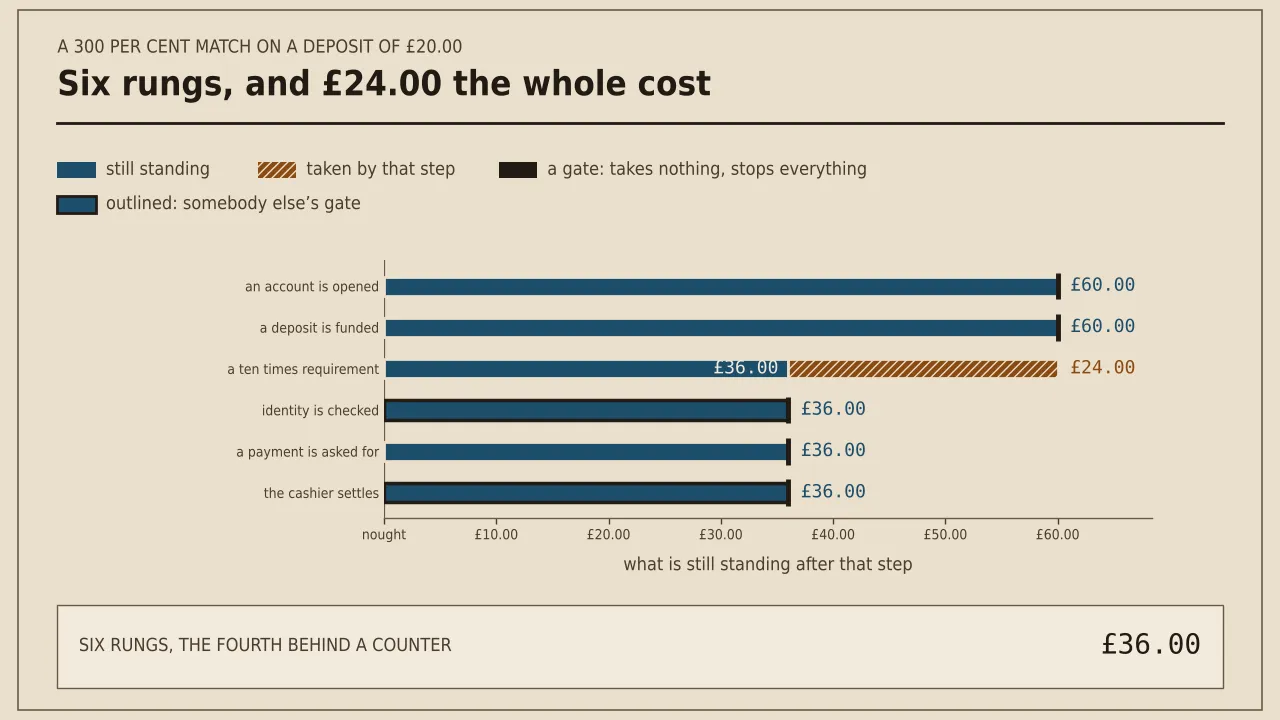
The requirement takes £24.00 out of the £60.00 of credit, two fifths of the of the credit, and the only sum removed at any rung on this chain
£24.00 is the largest single deduction anywhere in this section, and it is taken at one rung with five rungs around it that take nothing. A chain with that shape does not bleed. It drops once and then waits on people, and the waiting is where the rest of the value goes.
There is a second reading of £36.00 that belongs beside the first. It is the average of very many separate runs of four thousand rounds, and not a figure anybody will see settle on a screen. One run can finish with the £60.00 intact and another with none of it, and £36.00 marks the middle of that range. Every money figure on this page is an expectation, and each is labelled as one where it is used.
Divide the deduction by the staking that causes it and the rate is flat all the way through. Four pence is lost in each pound put through a reel; six hundred pounds go through; £24.00 is the cost. No charge accelerates, no fee waits at the end, and no rung introduces one quietly.
Set that £24.00 beside the £20.00 deposited and the comparison is worth pausing on. The expected cost of clearing this requirement exceeds the deposit that bought the bonus. A reader who put in £20.00 to obtain £60.00 is expected to lose £24.00 of the £60.00 in the course of qualifying for it, which is the arithmetic a percentage was never going to show.
Push the multiple higher and the credit gives out. Four pence in the pound means twenty-five passes over £60.00 consume the whole bonus, so expectation hits nought on the twenty-fifth pass. Sixty times has been seen in the market off the rule sheet, claim 94, and sixty against £60.00 takes the expression below nought, which reports an expectation and not a debt.
4
Four thousand rounds at 15p, and the two floors under them
Something has to carry the £600.00, and a 15p round is assumed here so the sum can be read as a count of rounds. Four thousand. The ladder holds six rungs and the third of them is taken four thousand times.
Those two counts answer separate questions. Six says how many things can go wrong. Four thousand says how long the third of them takes. Putting them together would produce a figure answering neither.
Two floors exist because a bonus like this one can be worked off on more than one sort of game. On slots, 2.5 seconds have to run before a fresh cycle may be opened, timed from the start of the last off the rule sheet, claim 107 . For other casino games, poker between players set aside, the figure is five seconds off the rule sheet, claim 108, dated 17 January 2025 off the rule sheet, claim 114. Each cycle wants its own act of commitment either way off the rule sheet, claim 115.
Four thousand rounds at 2.5 seconds comes to two hours and forty-seven minutes. At five seconds it is five hours and thirty-three. The choice of game therefore doubles or halves the evening, and no banner about a tripled deposit mentions that the choice is there to be made.
Neither figure forecasts anything. Both are minima, built by multiplying a published number of seconds by a count this page worked out, and a real sitting runs longer because nobody plays at a floor. What they settle is that £600.00 of staking occupies most of an evening at the very least.
Divide the cost across the rounds and the charge vanishes into the background. Four thousand rounds share £24.00, which is six tenths of a penny on each one. Imperceptible singly. Taken together they amount to two fifths of the bonus, and that gap between what is felt and what is counted is the reason this site counts.
Put the two times against the money and the rate of pay is visible. £36.00 across two hours and forty-seven minutes is about thirteen pence a minute of pressing. Across five hours and thirty-three it is nearer six pence. Those are the figures a reader is actually weighing, and no banner about a tripled deposit computes either of them.
The instrument shows one row for £600.00 and not four thousand rows, because the requirement is a single condition carrying a quantity. The quantity belongs in prose where it has just been counted, alongside the step count and never folded into it.
5
The ceiling on £36.00 that nobody has published
On a chain closing at £36.00 the most important unpublished figure is a roof over what the bonus may win. This is the largest surviving sum in the section, which makes it the page where the absence of that figure is worth setting out properly.
A protection does exist and its subject is something else. A term that caps withdrawals out of a deposit balance is barred off the rule sheet, claim 34, a daily-and-weekly limit being the specimen the regulator gives off the rule sheet, claim 35. Withdrawals from a deposit balance are to be available at any time, winnings along with the rest, and restrictions on their size or number have to be reasonable.
That is a rule about a deposit balance. Bonus winnings go unmentioned, and no published source fixes a maximum win on an incentive off the rule sheet, claim 105. So a roof on what £60.00 of credit may produce, and a free hand over a deposit balance, can both hold of one account without contradiction.
Which matters here in a way it would not on a smaller chain. A cap pitched anywhere below £36.00 would move this page’s closing number, and there is no figure to draw. The ladder therefore carries no such rung, and £36.00 is what the arithmetic produces and not a sum promised by anybody.
The protection itself is also undated, which a page leaning on it should say. The source shows neither a publication date nor a revision off the rule sheet, claim 36, so the rule is taken from it with no claim about how current it is. That is a smaller point than the gap, and it belongs beside it.
A second protection sits at the exit and belongs in the same part. A licensed system never offers anybody the chance to call back a withdrawal off the rule sheet, claim 37, and the guidance looks for the way out kept as unobstructed as a licensee can manage. On this chain the fifth rung is the request, and nothing requires it to be easy or irreversible.
Put the three side by side and the position on £36.00 is plain. No published roof over what the credit may win; a published protection covering the deposit balance but not the credit; and a published rule about the shape of a withdrawal request that reaches licensees only. Every one of the three bears on the largest figure in this section, and not one of them binds the party holding it.
6
The fourth rung, with the section’s largest sum resting on it
£36.00 arrives at the fourth rung in one piece. An identity check stands there taking nothing: the figure goes through entire or it does not go. Above that rung every number came of multiplication. At it, and at the sixth, the numbers come from somebody’s judgement.
Under a licence the identifying comes first off the rule sheet, claim 10, and a bonus is no exception off the rule sheet, claim 18. A licensee has to tell a customer before a deposit what documents might be needed and when off the rule sheet, claim 12. Both duties would have put this rung above the first one and told the reader in advance what it wanted.
A licensee cannot hold money back for documents it should have sought sooner off the rule sheet, claim 11. The player-facing wording puts the laundering checks at the beginning off the rule sheet, claim 15 and treats a payment delayed for want of them as a possible breach off the rule sheet, claim 16.
A cashier outside the regime answers to none of it. The published account speaks of payments stopped and thresholds nobody meets off the rule sheet, claim 135, with unfair play, money gone and no way of complaining recorded alongside off the rule sheet, claim 134.
Three rungs sit beneath the requirement and one belongs to the reader: the claim, which may be lodged at once or left for weeks while £36.00 waits patiently. The check and the settlement sit elsewhere entirely, and the two of them carry the whole figure.
The size of the figure is what distinguishes this page. £36.00 is nearly twice the £20.00 a reader deposited, and the £20.00 is in the same account while the fourth rung is decided. The bonus is what this page prices, since the bonus is the thing supplied. No source consulted here states what happens to a deposit lodged with a cashier under no British condition.
No part of £36.00 is ever paid. The outcome at the fourth rung is all of it or none, and the sixth rung works the same way, so this chain ends on one of two figures with no third possibility between them. The £24.00 above behaved otherwise: a settled fraction of a settled sum, removed by arithmetic that holds no opinion.
Hence a finding at the fourth rung and not at the third. The £24.00 at the third went because four pence to the pound across £600.00 is £24.00, and nobody decided it. A judgement is what the fourth rung is, and £36.00 is the sum a stranger is looking at while making it.
7
£36.00, with the protections stopping short of it
Every figure on this page stands at its most favourable reading, and the kindness is lent by a licence. No Great Britain licence covers a single rung of it.
Three hundred per cent reaches British readers through a cashier working beyond the Great Britain licensing regime. Three of that regime’s duties can be measured against the chain above. The withdrawal cap comes first, and here it is the duty that bites: a licensee may not rely on a term capping what comes out of a deposit balance off the rule sheet, claim 34, with a daily and weekly limit offered as the specimen of one off the rule sheet, claim 35. Nothing here restrains such a term. The request is the second: a licensed system never offers to call one back off the rule sheet, claim 37, which is the duty that would have governed the fifth rung on this ladder. Exclusion is the third. Scheme membership rides on the British licence off the rule sheet, claim 181, and the scheme’s writ stops at its own members off the rule sheet, claim 183. Registering is a consequence rather than a remedy down here, and this site sets out no procedure at all.
A fourth duty belongs in the list although it reaches the closing rungs rather than either sum. Under the licence a complaint has eight weeks as its limit off the rule sheet, claim 39, has to be accepted for half a year after the event off the rule sheet, claim 40, and ends with the naming of an approved adjudicator off the rule sheet, claim 42. The regulator will not take the dispute itself off the rule sheet, claim 46. So £36.00 would end in front of an adjudicator inside the licence, and outside it no route of any kind appeared in the reading for this page.
Two of those three would have changed a figure on this page rather than offering reassurance. A published cap on bonus winnings would have put a rung on the ladder and lowered the closing number. The protection against capped withdrawals would have made the £20.00 retrievable on terms a reader could read in advance. Neither applies, which is why the £36.00 at the foot is an upper bound.
There is an industry notice of 20 January 2025 which records what such a site may be without, and every absence on it has one cause, which is that no licence stands over the desk to require otherwise. The same notice records that people who exclude themselves are frequently the chosen target off the rule sheet, claim 130, and that games built by licensed suppliers have shown up where no licence is held off the rule sheet, claim 131.
Price the absence and the price is £36.00 exactly. Not a fraction of it: two rungs under no British condition hold every penny of the surviving credit, and a reader’s own £20.00 is lodged in the same account for as long as the question takes to answer. A count beside a sum is what this page was built to print.
And the fact on the other side, without which this page would be a sermon. Under the Act it is the provider who offends; no customer offence was created off the rule sheet, claim 3. A reader surrenders protection rather than permission. Six rungs on a tripled deposit, the fourth of them a stranger to settle, £36.00 of credit standing at it, and £20.00 of a reader’s own in the same account throughout.
Asked at the booth
- What does a 300 per cent match on £20.00 leave
- Sixty pounds of credit enters the requirement whole, £24.00 of it is spent on the staking, and £36.00 survives to the fourth rung.
- How much staking is attached to it
- Six hundred pounds, which is thirty times the deposit and four thousand rounds at the 15p this page uses to turn the sum into a count.
- How long does four thousand rounds take
- Two hours and forty-seven minutes on slots at the published minimum, or five hours and thirty-three on other casino games.
- Does the expected cost exceed the deposit
- It does here. Clearing the requirement is expected to cost £24.00 against a deposit of £20.00, which is a feature of the higher multiplier.
- Is a maximum win fixed for the credit
- Nothing published sets one. The protection over withdrawals has a deposit balance as its subject, so a cap on bonus winnings breaks no published rule.
- Which of the six is reported
- The fourth, where identity is checked and £36.00 is standing. That figure is nearly twice the deposit, and the rung is nobody’s decision on the reader’s side.
- Why is £36.00 described as an upper bound
- Because three things that would lower it are unpublished: a win cap, a requirement reaching the deposit, and any weighting on the games used for staking.
- Does a British licence reach any of this
- No. Three of its duties were weighed above: the ban on limiting withdrawals out of a deposit balance, the ban on offering a withdrawal back, and the exclusion scheme.