Terms read 26 October 2026 Counted in 2026
A hundred and fifty rounds on Book of Dead, and the rung no term puts a number on
At the 10p a round declared throughout, a hundred and fifty given rounds carry a face of £15.00. Once the reels have had their 60p, £14.40 reaches a balance, and there the falling stops, four rungs short of the end. Not because the chain is over, but because the next thing that has to happen is a turnover, and no multiple for it is printed anywhere a reader could go and read. Put the British ceiling against that balance and £8.64 would survive; put twenty-five times and nothing would. This page prints neither figure on the ladder, carries £14.40 through all four remaining rungs instead, and reports the fourth of the seven as the first gate held on the counter’s far side.
How many steps seven Register, claim, turn the rounds, clear a turnover, be checked, ask, be paid. The first gate somebody else holds the fourth Whoever writes the multiple decides its size and judges it satisfied. Standing when it is reached £14.40 Everything the reels left, since no rung after them carries a figure.
| What has to happen | Who takes this step | What it leaves standing | Printed where |
|---|---|---|---|
| An account is opened | the reader | £15.00, or nought unopened | the headline itself |
| The offer is claimed | the reader | £15.00, or nought unclaimed | nothing published behind this rung |
| A hundred and fifty rounds turn | the house’s arithmetic | £14.40 | nowhere, declared on this page |
| A turnover is satisfied | the cashier | £14.40, or nought unmet | nothing published behind this rung |
| Identity is checked | the cashier | £14.40, or nought unverified | nothing published behind this rung |
| A payment is asked for | the reader | £14.40, or nought unasked | the withdrawal form |
| The cashier settles | the cashier | £14.40, or nought unpaid | nothing published behind this rung |
| What seven steps leave | three gates across the counter | £14.40 | this page |
1
Fifteen pounds of face, and the only 60p anybody can account for
A hundred and fifty rounds is a count of occasions, not a sum of money. Two further quantities turn the one into the other, and a headline offering rounds for nothing prints neither of them: the cash a single round puts at stake, and the proportion of everything staked that a reel returns over a run long enough to mean anything.
Neither quantity is fixed by anything published. The regulator’s own estate carries nothing on what sets a round’s cash value, nothing on who sets it, and nothing on what a cashier owes anybody by way of disclosure off the rule sheet, claim 89, which leaves the figure a commercial choice taken offer by offer. This page therefore declares 10p and claims no reading behind the declaration. A hundred and fifty rounds at 10p gives a face of £15.00, and above that top rung nobody has taken a thing.
The second quantity is the return. Ninety-six per cent is the share a reel of ordinary design returns over a long enough run, declared on this page as a figure for the industry at large and attached to no machine in particular, there being no sheet behind any title on this site for such a thing to be read off. Ninety-six per cent of a £15.00 face is £14.40, and the 60p of difference is the only deduction on this chain that a published quantity accounts for. Reading the third column downwards is the business of a standing page of its own, and this one gets on with the arithmetic.
Nothing lets a reader check £14.40 against a term, and the technical standard is why even a licensed site need not supply the means. Four things satisfy the duty to put the odds within reach before anybody commits, and they stand in the alternative: how the mechanism works and how a prize gets allocated; the house edge; the returned share of stakes; the chances of the winning events off the rule sheet, claim 120. Any single one discharges it, so a percentage is nowhere compulsory off the rule sheet, claim 121, and a guide sending somebody off to look one up would be inventing an obligation.
Both quantities belong to this page rather than to anybody’s terms. At 5p a round the face halves to £7.50 and £7.20 reaches a balance. At a 94 per cent return the balance comes out at £14.10 instead. Nor is the method sensitive to the count: three hundred rounds at the same 10p would double the face to £30.00 and double every figure beneath it, while leaving the fourth rung exactly as blank as it already is. Every figure underneath is carried from 10p and from 96 per cent and from no third quantity.
2
The fourth rung, and the figure it stops this page printing
A turnover is an instruction to put the same money through a game repeatedly, a counted number of times, and to leave it where it is until that is done. The regulatory definition adds only this: the sum of what gets wagered has to reach a figure somebody names off the rule sheet, claim 92. Which fixes what kind of thing an obligation is and says nothing whatever about how big this one is.
That a turnover belongs on this chain at all is not guesswork, and the warrant is on the record twice. The advertising code’s catalogue of significant conditions in a gambling promotion runs through eligibility such as new customers only, how long there is to take an offer up or spend it, what has to go in as a deposit, what has to be staked afterwards, and any floor under the odds off the rule sheet, claim 62. A player is separately told by the British regulator to go and find out what has to be spent before a bonus gets paid at all off the rule sheet, claim 87. Two regulators naming the condition is warrant enough to count a rung for it, and neither of them is describing this particular offer or any multiple attached to it.
Nothing read for this guide states a multiple against a hundred and fifty rounds handed over for nothing, and the honest consequence is that the fourth rung carries £14.40 across unchanged with its fourth column saying so. The figure is not a forecast of what anybody will be paid. It is the last sum on the chain that something published stands behind.
Setting the multiple is a decision and somebody on the counter’s far side takes it, which is what makes the fourth rung this page’s finding rather than the third. A published obligation would be arithmetic running its course. An unpublished one is a figure somebody chooses, applies, and afterwards judges to have been met or not met.
What has to be done to turn an opened account into a hundred and fifty rounds is the second rung, and nothing read for this page says what it is. A code, a tick, an answered message, a button: each is ordinary, and which of them applies is not on any record this publisher may cite. Participation is nonetheless a condition an advertisement is expected to make plain off the rule sheet, claim 71, which is what warrants the rung, and the rung is the reader’s because whoever is reading does the claiming whenever they choose. That is also why it cannot be the finding, however little the route to it is described.
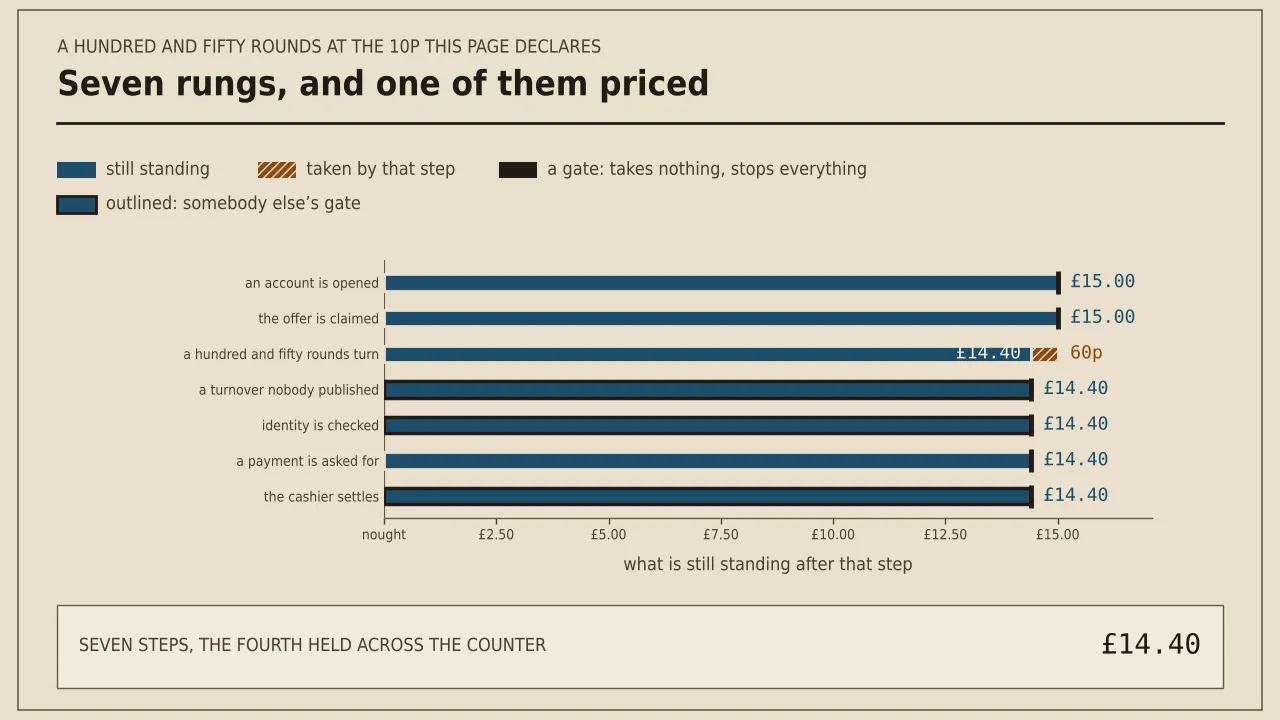
60p of the £15.00 promised is the whole of what a published quantity takes off this chain, a twenty-fifth of the face, with every later reduction unwritten
One rule that does reach an incentive of this shape leaves it alone, and saying so keeps the count honest. Putting two of the four gambling products into one incentive has been barred since the ceiling arrived, the four being betting, casino, bingo and lottery off the rule sheet, claim 99. A hundred and fifty rounds on one machine is a casino incentive and nothing besides off the rule sheet, claim 102, so it crosses no boundary between products and the ban takes nothing off any of the seven rungs. The rule stands in the record as something this chain satisfies rather than as something it offends.
3
What £14.40 comes to at ten, at twenty and at twenty-five
£14.40 is where the falling stops, and the fourth rung is where it stops. Set the British ceiling of ten times against that balance and £8.64 survives it: £144.00 would have to pass through a reel, which at 10p a round is one thousand four hundred and forty of them. Set fifteen times against it and £5.76 survives. Set twenty-five and nothing does. The whole of that range is what the missing multiple on the fourth rung covers, and no part of the range can be ruled out from anything read for this page.
The table that follows is this site’s own working and nothing in it is read off a term. Each row puts a different multiple against the £14.40 that reached a balance, and prints what E = B × (1 − W × (1 − RTP) ∕ g) leaves, what has to be staked to get there, and how many 10p rounds that staking comes to. The row at ten is the gentlest reading any published figure supports, ten being the ceiling a British licensee is held to and nothing an unlicensed one owes off the rule sheet, claim 91.
| Multiple | Left standing | Staked to get there | Rounds at 10p |
|---|---|---|---|
| Ten times | £8.64 | £144.00 | 1,440 |
| Fifteen times | £5.76 | £216.00 | 2,160 |
| Twenty times | £2.88 | £288.00 | 2,880 |
| Twenty-five times | nought | £360.00 | 3,600 |
| Sixty times | minus £20.16 | £864.00 | 8,640 |
Read the second column and the cost of the blank fourth rung stops being abstract. At ten the chain ends with £8.64 and one thousand four hundred and forty rounds behind it. At twenty-five it ends with nothing at all, and three thousand six hundred rounds have gone into ending it that way. Both outcomes sit inside the range an unpublished condition can occupy, and everything the offer is worth lies between the two.
Divide that range by the hundred and fifty rounds and the headline’s unit gets a value. At the kindest multiple any source supports, a round declared at 10p is worth 5.76p by the time the chain ends, which is a little over half the face it carried at the top. At fifteen times it is worth 3.84p, at twenty 1.92p, and at twenty-five nothing whatever. A headline counting rounds rather than pence is counting the one quantity on the offer that the missing multiple cannot touch.
Sixty is the number the regulator attached to what the cap was correcting, recording that play-through at that level was being applied by some licensees before the ceiling arrived off the rule sheet, claim 94, and no other market multiple on this publisher’s sheet comes from the regulator at all. Minus £20.16 is owed by nobody and is not a debt. The expression is reporting that £14.40 runs dry long before sixty turnovers of it are finished, and the fourth row prints the multiple at which that first becomes true.
Two readings of the table bear on the ladder. The first is that the top row, the kindest multiple any source supports, already takes £5.76 off a balance of £14.40, which is nearly ten times what the reels took. The second is that nothing below the top row may be drafted by a British licensee, the ceiling having bound every remote casino licence since 19 January 2026 off the rule sheet, claim 93, and that the counter behind a hundred and fifty free rounds is bound by none of the rows.
4
Sixty-six minutes at the gentlest multiple, six hours at the harshest
A licensed cycle must wait two seconds and a half behind the one before it off the rule sheet, claim 107, nothing may be set going by a held button, and no run of cycles may be automatic off the rule sheet, claim 115. An unlicensed counter owes neither rule, so the minutes that follow are a floor beneath a licensed chain and not a forecast about this one.
A hundred and fifty given rounds take six minutes and a quarter at that floor. Add the one thousand four hundred and forty rounds a ten times obligation would want and the chain runs to sixty-six minutes of unbroken pressing. At twenty-five times the staking is three thousand six hundred rounds, which is two hours and thirty-six minutes, and the balance at the end of those two hours and thirty-six minutes is nought. At the sixty the regulator named, eight thousand six hundred and forty rounds take six hours and six minutes.
Each of those durations is the fastest that a licensed game’s rules would let the staking in its row be finished, this site having done the multiplication and the regulator having supplied the interval. The use of the arithmetic is scale. The blank on the fourth rung is the difference between an hour of pressing that ends with £8.64 and six hours of pressing that ends £20.16 short of where it started, and a headline counting a hundred and fifty rounds has mentioned neither.
5
A machine’s name on the headline, weighed as evidence
A reader is owed a plain account of what the machine named in this key buys them, and the answer is recognition. No figure on this page is taken off that title, no return is attributed to it, and nothing here describes what it pays or how often, because this publisher holds no sheet of readings behind any game.
Recognising the machine is not evidence about the counter. Games written by licensed suppliers have been found on websites that carry no licence whatever off the rule sheet, claim 131, and one supplier settled at £4.75m after its own titles were found on six unlicensed sites somebody in Great Britain could reach, the agreement carrying the date 23 July 2026 off the rule sheet, claim 132. The licence conditions governing how a machine may behave are the content of the word licensed, and a title in the window carries none of that content across with it off the rule sheet, claim 168.
There is a narrower reason the title changes no figure above. A restriction confining the rounds to one machine is a description of the offer rather than a step in it: there is nothing for anybody to do about it, and a reader either plays the named machine or has no rounds. So it earns no rung, and it moves neither the £15.00 at the top nor the £14.40 under the reels. What a confinement of that kind could move is the turnover, if a multiple existed and if that machine’s contribution towards one were published. Neither is.
The one check the regulator recommends to a player is the public register, where what a site claims for itself ought to tally with the activities and the domain names recorded against a licence off the rule sheet, claim 88. That is a check about the counter and not about the window, which is the whole of the distinction this part exists to draw.
6
Five further conditions, and the figure each one withholds
Five more conditions bear on this key. None of them gets a rung, because no source read for this page puts a number on any of them, and against each one this part prints the figure it withholds.
A window is the first. Among the conditions an advertisement has to disclose are the time limits on taking an offer up or using it off the rule sheet, claim 62, and a ruling in the middle of July 2024 went on precisely that point, a ten pound free bet needing a reply to a text by an hour the advertisement never gave off the rule sheet, claim 65. A window would have turned the fourth row of the table into a daily rate: three thousand six hundred rounds across seven days is five hundred and fourteen rounds a day. No window is stated against this key, so no daily rate gets printed.
A roof over what the rounds may win is the second. No published source supplies a standard one, nor any rule turning what a round wins into bonus funds off the rule sheet, claim 105. The prohibition on capping withdrawals is drafted about a deposit balance off the rule sheet, claim 34, so an uncappable deposit balance and a roof over a bonus payout can stand side by side, and a page has to say which of the two it is talking about. With no figure published, the £14.40 at the foot is what the arithmetic leaves and not a sum anybody has promised to hand over.
Whether what a round wins is bonus funds at all is the third. The ceiling names bonus funds as the thing it caps, while no source anywhere says in either direction whether a free round falls inside that description off the rule sheet, claim 90. This page takes neither side, which is why the fourth rung is written as an unpublished condition and not as a ceiling borrowed from somewhere.
Weighting is the fourth, and it would move the arithmetic furthest of the five. Thirty per cent appears in the regulator’s own consultation papers as a rate respondents described rather than one the regulator set, and at that rate a pound staked counts thirty pence towards an obligation off the rule sheet, claim 96. Nothing was done about weighting when the ceiling was settled, so it came through untouched off the rule sheet, claim 97, and no current table of contributions sits in any source this publisher may cite off the rule sheet, claim 105. Laid over the top row, thirty per cent turns £144.00 of required contribution into £480.00 of staking, which is four thousand eight hundred rounds in place of one thousand four hundred and forty, and takes what the formula leaves from £8.64 down to minus £4.80. Laid over the fourth row the same rate bites harder. £360.00 of required contribution at thirty pence in the pound wants £1,200.00 of staking behind it, which is twelve thousand rounds at 10p and eight hours and twenty minutes at the licensed floor, to arrive at a balance of nought. Weighting is therefore the one unpublished figure on this list capable of turning a ceiling into something stricter than the ceiling, while the term on the offer still reads ten.
A free hand over the account is the fifth, and only it has a penalty behind it. £170,000 fell in July 2025 on the small print of a welcome bonus, where the wording kept a discretion over closing accounts and over winnings off the rule sheet, claim 83, and the condition breached was fair and open dealing off the rule sheet, claim 84. The clause has drawn a fine, and nothing anywhere calls one void off the rule sheet, claim 86. Over this chain it would hold £14.40 level and remove the lot at any of seven rungs.
Where a reader finds any of the five written against a particular offer, each is a rung and each is a gate rather than a deduction. Until one of them is written somewhere, a figure for it would be the only quantity on this page that nothing could be checked against.
7
What £14.40 would be if it ever arrived in an account
Suppose £14.40 survives all seven rungs. Whether it is safe if the counter fails is something a licensee must disclose and rate, winnings left on deposit counting as customer money for that purpose, and the disclosure falls due when a deposit is first made off the rule sheet, claim 54a. A chain beginning with no deposit never arrives at that moment. From 31 October 2025, a licensee on either of the two ratings that read as unprotected owes a reminder twice a year with no balance beneath which it stops off the rule sheet, claim 54b, so £14.40 would carry one. What this page cannot print is the rating itself, an operator without the licence publishing none off the rule sheet, claim 54c.
Tax runs the other way and falls on the counter. Winnings are not trading income, gambling not being of itself a trade off the rule sheet, claim 169, and nothing published declares in terms that they go untaxed off the rule sheet, claim 175. The charge is on the operator: remote gaming duty, forty per cent from the start of April 2026, owed by an operator anywhere at all on gaming played by a customer ordinarily resident in Britain off the rule sheet, claim 173. So the counter behind these rounds sits inside a British tax while standing outside a British licence off the rule sheet, claim 174, which is more useful to know than the word unregulated.
A licensee also owes a prompt about money before anything is staked, and this chain reaches only half of it. A limit on spending must be offerable from the moment somebody registers, with the prompt falling due at registration or else when money first goes in off the rule sheet, claim 23, and declining one has to take a deliberate act because the default is to set it off the rule sheet, claim 31. A reader taking a hundred and fifty rounds without depositing meets the first of those two moments and never the second, so all the prompting on this chain happens above the first rung. None of it is owed by a counter outside the licence, and the nearest offshore rulebook read for this page carries no equivalent off the rule sheet, claim 147.
Both of those bear on the same sum and neither touches the third column. A rating is a disclosure about £14.40 rather than a deduction from it, and a duty on the counter’s profits is no charge against what a reader holds. They are set out because the seventh rung is a settlement, and a settlement is made out of money somebody is holding, which makes the terms on which it is held part of what a reader is counting.
8
The licence none of it was drawn against
Every generous reading available has been taken, and the thing held back until now governs all of them. The duties that would have filled the blank rungs hang on a British licence, and the counter behind a hundred and fifty given rounds has not got one.
Rounds handed out in this quantity to readers in Great Britain come from counters standing outside the Great Britain licensing regime altogether, and three of the duties that regime imposes can be priced off this chain directly. The fourth rung first. No licensee may put play-through past ten times the funds, and none has been able to since 19 January 2026 off the rule sheet, claim 91, a bar drafted for licensed incentives and nothing else, so the top row of the table above is the row a licence would have compelled and the blank at the fourth rung stands where that row should be. The stake second. One game cycle on a licensed online reel may take £5 at the most from a player of twenty-five and over, and £2 at the most from anyone below that age off the rule sheet, claim 124, which puts the 10p declared on this page at a fiftieth of the larger figure: at £5 a cycle the whole £15.00 face would be three cycles rather than a hundred and fifty rounds. Self-exclusion third. Gamstop membership is a licence requirement for every online gambling business licensed in Britain off the rule sheet, claim 181, while the scheme’s terms are clear that it reaches no operator outside its own membership off the rule sheet, claim 183, so a registration good across the licensed market is good at none of the seven rungs counted here. Anybody who has signed should take that as a consequence and not a hint, and no way around any of the three is described anywhere on this site.
Seven steps, the fourth of them a condition nobody has published, and the whole of £14.40 resting on three rungs this page cannot hold anybody to. The offence in all of this is providing gambling facilities unlicensed, and it is the provider who commits it, no answering offence having been drafted against the customer off the rule sheet, claim 3. What goes missing outside the licence is the protection, and the figures this page has had to leave unprinted are the measure of what went.
Asked at the booth
- How many separate things have to happen
- Seven. Registering, claiming, turning the rounds, meeting a turnover, being verified, asking for payment, and being paid.
- Which of the seven does somebody else decide
- The fourth, a turnover whose size nobody has published, with £14.40 standing when the chain arrives at it.
- Why is no multiple printed against that rung
- No source read for this guide states one. A number produced from nowhere would be the only figure on the page nothing could check.
- So how much are a hundred and fifty given rounds worth
- £15.00 of face at the 10p declared, of which £14.40 reaches a balance. Every deduction after that one is unpublished.
- Who decided that a round is worth 10p
- This page did, and nothing else. No rule anywhere fixes a given round’s cash value, so the figure is a declaration.
- Does the ten times ceiling bind this offer
- Ten times binds a Great Britain licensee and nobody else. Applied to this chain anyway it would bring £14.40 down to £8.64.
- What does the machine named in the key tell a reader
- Nothing about the chain. A licensed supplier’s games have been found on sites without any licence, so recognition is not evidence about a counter.
- How long would the staking take
- At ten times, sixty-six minutes at the licensed pace floor. At twenty-five times, two hours and thirty-six minutes, ending at nought.