Terms read 26 October 2026 Counted in 2026
5 free spins no deposit: 72p standing when the fourth rung is reached
Five rounds is the smallest count anybody advertises, and the chain under it is the same length as the chain under a hundred. Five rounds at 25p make £1.25. Put 96 per cent on what a reel gives back and £1.20 lands. A ten times turnover takes 48p and 72p comes out the other side, where it waits on a document check, a request and a settlement, none of which moves it and any of which ends it.
How many steps six Sign up, spin five, clear £12.00, submit papers, claim, be settled. The first gate somebody else holds the fourth A cashier reads the documents and answers in its own time. Standing when it is reached 72p Just over half the headline, and the whole of what is left.
| What has to happen | Who takes this step | What it leaves standing | Printed where |
|---|---|---|---|
| An account is opened | the reader | £1.25, or nought unopened | the offer’s own headline |
| Five rounds turn | the house’s arithmetic | £1.20 | nowhere, declared here |
| £12.00 is turned over | the house’s arithmetic | 72p | the published British ceiling |
| Identity is checked | the cashier | 72p, or nought unverified | a licence condition, not a term |
| A payment is asked for | the reader | 72p, or nought unasked | the cashier’s withdrawal form |
| The cashier settles | the cashier | 72p, or nought unpaid | nothing published behind this |
| What six rungs leave | two gates the cashier holds | 72p | this page |
1
A pound twenty-five of face, and 5p gone at once
Five rounds have to be priced before they are worth anything, and no headline counting them prints a price. This page puts a round at 25p, which makes the face £1.25 and makes everything below it checkable.
A round’s cash value is set by nothing published off the rule sheet, claim 89, so the 25p is declared and not a figure anybody can be held to. What the rules do insist on is the shape of the terms around an incentive: clear, fair, and within reach of whoever is offered it off the rule sheet, claim 57. Pricing is left where the market leaves it.
The share a reel returns is taken at 96 per cent here, as it is on every page of this site, and it is an industry assumption rather than a figure read off a machine. Five pence of £1.25 therefore goes at the second rung, and £1.20 lands in an account.
Five pence is the smallest deduction anywhere in this section, and the smallness is instructive rather than comforting. A reader looking at the ladder could reasonably conclude that the reels are not the problem on a five-round offer, and would be right: 4 per cent of £1.25 is 5p, and the rung below it costs nearly ten times as much.
There is a reason to print the 5p rather than fold it into the next line. The reels and the turnover are two different kinds of event with two different owners. On a five-round chain the second dwarfs the first, at nine and a half to one. A reader told only that £1.25 became 72p could not tell whether the loss came from a hard game or a hard condition. The condition took it, and the two figures show that.
Change the 25p and everything scales. At half that price the face would be 62p and the chain would end at 36p. At double it the face would be £2.50 and the chain would end at £1.44. Six rungs either way, the same two parties at the bottom, and the same proportions throughout. The price of a round decides the pounds and nothing else about the shape.
A reader can test the whole page from one line of arithmetic. Five rounds at 25p is £1.25. Four per cent of £1.25 is 5p, which leaves £1.20. Two fifths of £1.20 is 48p, which leaves 72p. Three multiplications, no hidden step, and each figure in between printed on the ladder above. That is the whole computation, laid out so that disagreeing with the answer means disagreeing with one of two declared figures rather than with a method nobody can see.
So the inputs are 25p a round, 96 per cent coming back, and ten times as the turnover. Three figures, one of them published and two of them this page’s. Every sum below is built from those three and can be rebuilt by anybody who disagrees with either declaration.
2
Forty-eight pence, which is what ten times costs here
£1.20 is the balance the turnover works on, and ten is the multiple. Ten is as high as a licensed play-through may go off the rule sheet, claim 91, from 19 January 2026 onward, with the technical and software licences all that escape it off the rule sheet, claim 93. No gentler figure is published. Ten times £1.20 is £12.00 of staking.
Give the expression £1.20 for B, ten for W and the qualifying share at full weight: E = B × (1 − W × (1 − RTP) ∕ g) returns 72p. Wagers have to reach a named total off the rule sheet, claim 92 and the rest of it is unwritten, so a figure like £12.00 carries no deadline and no minimum piece size with it.
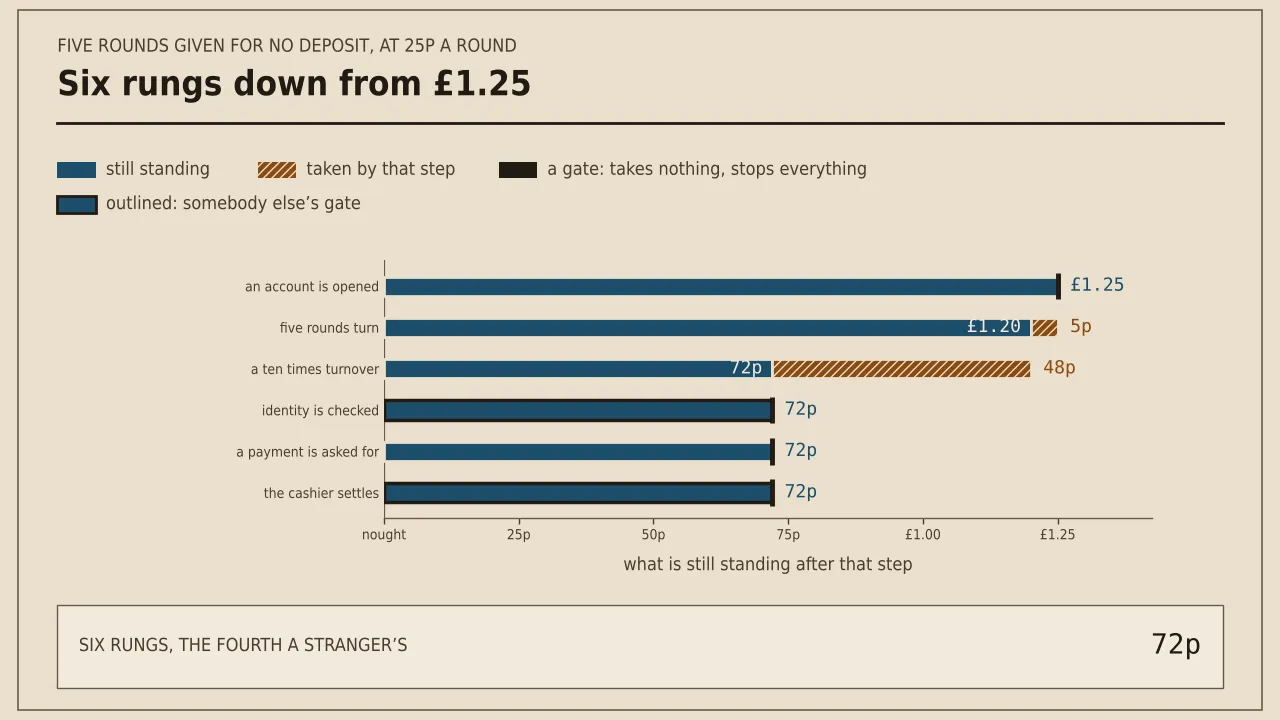
Forty-eight pence of the £1.20 that landed goes to the turnover, two fifths of the balance and well over a third of the £1.25 announced
Put the pair of deductions together: 5p and 48p. The turnover runs to nine and a half times the reels here, and it is the rung a five-round headline never mentions. Below it, nothing at all is taken. 72p is the figure at rung three and the figure at rung six.
Seventy-two pence out of £1.25 is 57.6 per cent. Said as money, a reader who takes the five rounds, clears £12.00 of staking and is paid in full walks away with seventy-two pence. That is the quantity this page sets out to put in front of a reader at the start rather than at the end.
Twelve pounds of staking against a 72p outcome is the ratio worth keeping. Every penny the chain is expected to yield costs better than sixteen pence of turnover, and the turnover is where the time goes. A reader weighing five free rounds is weighing £12.00 of staking, not £1.25 of gift.
Raise the multiple and 72p disappears. The reel takes four pence in each pound put through it, so twenty-five passes over £1.20 come to the lot and the expectation lands on nought at twenty-five. Multiples reaching sixty are on the regulator’s own record off the rule sheet, claim 94, and sixty against £1.20 puts the same expression below nought: no debt, just a report that £1.20 is not expected to last that long.
3
Fifty-three rounds, and two minutes twelve
£12.00 of staking at 25p a round is forty-eight rounds. Add the five that were given and the chain asks for fifty-three rounds in total. Six steps, one of which happens fifty-three times.
Fifty-three is the smallest instance count in this section and it is still better than ten times the number on the headline. That ratio holds wherever a turnover is drawn at ten and a reel is assumed to return 96 per cent: the rounds a chain asks for come to about 10.6 times the rounds it advertises, whatever the count.
Time can be put on fifty-three rounds, because a floor is published for slots. Slots are held to 2.5 seconds a cycle off the rule sheet, claim 107, with the control released and pressed afresh each time, and automatic play is not allowed on online gaming at all off the rule sheet, claim 115. Fifty-three cycles at 2.5 seconds is two minutes and twelve seconds, which is this site’s multiplication over the regulator’s figure.
Two minutes twelve is the figure here that makes a five-round offer look as small as it is. A reader could walk the whole repeated part of this chain in the time it takes to boil a kettle, and come out of it with 72p standing and four rungs still to go, two of them somebody else’s. The labour is trivial. The length of the chain is not.
Two more figures finish the count. Forty-eight rounds of staking at 25p put £12.00 through a reel in a hundred and twenty seconds of pressing, which is six pence of turnover a second at the published floor. And the expected cost of that £12.00 is 48p, so the chain burns four pence of real money for every pound that passes. Both figures are this page’s own multiplication and neither appears on any headline.
That asymmetry is the finding on a short count, and it is the reverse of what the headline implies. Five free rounds sounds like a small offer with a small chain. It is a small offer with a chain of exactly the same length as the largest offer in this section, and the fixed cost of walking it is the same six steps.
The instrument carries one row for £12.00 rather than forty-eight rows, because a row is a condition and not a round. The quantity attached to the condition belongs in a counted paragraph, which is where it has just been counted, and the two numbers are never added into one.
4
The fourth rung, and 72p waiting on a stranger
Seventy-two pence reaches the fourth rung and either passes whole or does not pass. An identity check sits there. On a sum this size the check is the whole of the risk, because there is nothing left for anything else to take.
Who somebody is gets established before play off the rule sheet, claim 10, incentive or not off the rule sheet, claim 18. A licensed cashier could not have issued five rounds to an unidentified customer, so this rung would have stood above the first one and not fourth.
At the far end, papers asked for only at the payout are refused off the rule sheet, claim 11. The version for players puts the checks at the beginning off the rule sheet, claim 15, with a payment held back for want of them capable of being a breach off the rule sheet, claim 16.
Lacking a licence the rung has no settled place, no stated timetable and no list of what will satisfy it. The record speaks of payouts stopped and limits nobody could reach off the rule sheet, claim 135. The same post puts the loss on the play, on the money and on the remedy at once off the rule sheet, claim 134.
There is an arithmetic point about small sums that belongs here. A withdrawal of 72p is under any plausible minimum payment, and no figure for such a minimum turned up in the reading, so none is on the ladder. If one exists and is above 72p, the chain does not end at 72p: it ends at nought, with the whole of the surviving figure stranded inside an account because it is too small to take out.
Separate the two rungs at the bottom of this chain, because only one of the two is the finding. Asking to be paid belongs to the reader and can be done at any hour or put off for a month, and 72p waits without complaint. Being settled with belongs to the cashier, as the document check does. So of six rungs, two are the reader’s to take, two are arithmetic, and two are decided by a party with no published timetable.
That possibility is not priced here, because pricing an unpublished figure is how a page invents a term. It is named instead, and it is the single most likely way a five-round chain finishes at nought while every rung on it has been satisfied. The fourth rung is the first that somebody else decides. A minimum payment would be a seventh rung, and it would be theirs too.
5
How many conditions a 72p outcome can carry
Seventy-two pence is the sum at stake and the conditions attached to it are not scaled down to match. That mismatch is the subject of published advertising rules, and the rules are worth reading against this page’s own figures rather than in the abstract.
Promotional material has to communicate every significant condition clearly and prominently off the rule sheet, claim 61 wherever an omission would mislead. The worked examples run to four kinds off the rule sheet, claim 62, and all four are limits on taking an offer up or on keeping it, which is why a reader who has seen only the headline has seen none of them. All four can sit on five free rounds.
Count them against 72p. A wagering requirement: £12.00 of staking. A time limit: unpriced here, because none was read. An eligibility restriction: nothing to do, since a reader either is or is not a new customer. Even at two live conditions the paperwork around 72p is heavier than the sum, and the advertising rules exist because that imbalance is where a reader gets misled.
There is an arithmetic version of the same imbalance. Seventy-two pence is the sum in play; £12.00 is the staking; fifty-three rounds is the labour; six rungs is the chain. Set the first figure against the other three and the shape of a five-round offer is visible in a way no list of conditions makes it. The rules below are about disclosure. The figures above are about size, and the two questions are different.
Rulings on the point are published and they bite on small omissions. A deadline for answering a message counted as significant, its omission being likely to mislead off the rule sheet, claim 65. An excluded payment method stated in the small print was considered insufficiently prominent off the rule sheet, claim 66. A voucher that would not work on one particular day, with nothing said about it, was found to breach the code off the rule sheet, claim 67.
There is a proportionality rule as well, and that one speaks directly to a 72p outcome: a reward ought to answer to the money and the time somebody spends, and should not climb faster as spending climbs off the rule sheet, claim 69. One acceptable arrangement is offered as an example, a single reward once £50 has gone through, and the example carries a condition with it off the rule sheet, claim 70.
Three further rules bear on how an offer like this may be put in front of anybody at all. Promotional material must not push repeated or frequent play, nor encourage spending beyond what somebody can lose off the rule sheet, claim 64. Marketing for gambling has to be socially responsible off the rule sheet, claim 73. And it may not present gambling as an answer to money trouble off the rule sheet, claim 74. None of those is about the 72p. All of them are about the sentence that gets a reader to the 72p in the first place.
Set that example beside this chain. £12.00 of staking produces 72p in expectation, which is a rate of six pence returned for every pound put through a reel. That rate is this page’s own working and not a judgement from any source, and it is here because the alternative is to print a rule about proportion without ever saying what the proportion on this chain actually is.
6
Four things unsaid, measured against 72p
Seventy-two pence is the figure one published ceiling and two declarations leave standing. Four further things bear on it and none is published, so each is named here with the sum it would have moved.
The price of a round is the first, settled above: nothing published prices one off the rule sheet, claim 89. The second is whether a given round’s winnings count as bonus funds for the ceiling. Whether a given round’s winnings are bonus money is unpublished off the rule sheet, claim 90, so the third row of the instrument reads as a ceiling carried over rather than as a term somebody wrote.
Weighting is the third, and the arithmetic under it is worth a figure. A thirty per cent contribution was the figure respondents brought forward off the rule sheet, claim 96, and nothing was done about contribution rates off the rule sheet, claim 97. At thirty pence in the pound, the £12.00 of credit this turnover needs would want £40.00 of staking behind it, which is a hundred and sixty rounds at 25p instead of forty-eight, and better than six minutes of pressing instead of two. Run the expression with the share at thirty per cent and it comes back below nought.
A ceiling over what five rounds may win is the fourth. No source puts one on what an incentive may win off the rule sheet, claim 105, and the deposit balance rule is about deposits and leaves bonus winnings alone off the rule sheet, claim 34. On a72p chain a win cap is unlikely to bite, which is exactly why it is worth naming: the figure that would bite instead is a minimum payment, and that is unpublished too.
Beside those four stands the clause that has cost money. A discretionary forfeiture term has cost one operator £170,000 off the rule sheet, claim 83, for shutting accounts or taking winnings away, under a penalty of 3 July 2025, and fair and open dealing was what it breached off the rule sheet, claim 84. No sourcecalls such a term void off the rule sheet, claim 86. Over this chain it changes no figure and can finish the chain anywhere along it.
Each of the four would push the figure down and not one of them can be priced from a citable source. So 72p is the most a reader can keep and not what a reader should expect, and treating it as an expectation means inventing the four figures nobody published.
7
Seventy-two pence, and the duties that do not reach it
Every figure here is the gentlest reading the published rules allow, and the gentleness is borrowed. Its source is a set of conditions on a British licence, and nobody offering five rounds for nothing to a British reader is working under one.
Five given rounds of this kind are offered without a Great Britain licence. Two duties of that licence can be set against the rungs above and a third against the game itself. The first is withdrawal. Consumers are not to be given the chance of cancelling a withdrawal off the rule sheet, claim 37, and the guidance wants the way out made as frictionless as a licensee can make it. On this chain 72p sits behind a fifth and a sixth rung with no such duty over either. The second is design. A build may not mislead anybody about the chance of a result, and swapping a losing outcome for a near miss is named off the rule sheet, claim 116. The five rounds that produced £1.20 answer to no such rule. Exclusion comes third, and a British licensee has to belong to the national exclusion scheme off the rule sheet, claim 181. The scheme’s own terms disclaim any power over non-members off the rule sheet, claim 183. That is the consequence. No route round it appears anywhere on this site.
One last figure for the part, and it is the smallest on the page. £12.00 of staking at 25p is forty-eight rounds, and forty-eight rounds carry an expected cost of 48p, so each round of the staking costs a penny. A penny a round, forty-eight times, to release seventy-two pence. Set out that way the chain is neither generous nor punitive: it is small, and it is six rungs long whatever its size.
Two further duties bear on the 96 per cent that produced £1.20 rather than on the rungs. Hurrying a result along is not something a customer may do, so turbo and quick spin and slam stop are all out off the rule sheet, claim 111. And a result no better than the stake may not be celebrated, which rules out the noises and the animations off the rule sheet, claim 112. Both shape what a stated return feels like over forty-eight rounds, and neither applies here.
Two of those three duties would have changed figures on this page rather than merely reassured anybody. Without the bar on hurrying a result, the forty-eight rounds of staking need not take two minutes twelve, and the only published floor under the labour disappears. Without the near-miss prohibition, the 96 per cent this page assumed is an assumption about a build nothing constrains. Both go to the honesty of the arithmetic and not to the comfort of the reader.
A page that stopped at the word unlicensed would be hiding that detail. Twenty January 2025 carries a notice recording what may be absent, and the entries have one thing in common: a licence is the only instrument that would have required any of them. Customers who shut themselves out are a frequent target off the rule sheet, claim 130. Licensed suppliers’ games have appeared on unlicensed sites off the rule sheet, claim 131, so recognising a reel proves nothing.
One fact runs against all of that and the page would be bent without it. The statute puts the offence on the provider off the rule sheet, claim 3 and names no customer offence. The loss outside the licence is cover rather than permission. Six rungs on a five-round offer, the fourth of them decided by somebody else, and 72p standing when it is reached.
Asked at the booth
- What do five given rounds come to
- At 25p a round the face is £1.25. A 96 per cent return leaves £1.20, and a ten times turnover leaves 72p of that.
- Is the chain shorter because the count is small
- No. Six rungs, the same as every other count under this heading. Only the pounds shrink, and the two rungs at the bottom belong to somebody else either way.
- How long does the repeated part take
- Forty-eight rounds of staking and five given rounds make fifty-three, which is two minutes and twelve seconds at the published floor for slots.
- Which rung is the finding
- The fourth, the document check, with 72p standing. It is the first point on the chain where the answer comes from the other side of the counter.
- Could 72p be too small to withdraw
- It could. No figure for a minimum payment turned up in the reading, so none is on the ladder, and a minimum above 72p would end the chain at nought.
- How much staking does 72p cost
- Twelve pounds, which is better than sixteen pence of turnover for every penny the chain is expected to yield.
- What would weighting do to the forty-eight rounds
- At thirty pence in the pound, £40.00 of staking would be needed instead of £12.00, which is a hundred and sixty rounds at 25p.
- Does anything here answer to a British regulator
- Nothing does. Three duties of a British licence were set against 72p above: the bar on cancelling a withdrawal, the near-miss prohibition, and compulsory membership of the exclusion scheme.