Terms read 26 October 2026 Counted in 2026
100 free spins no deposit: six steps, and the fourth is the cashier’s to decide
Six things have to happen in turn before any part of a hundred given rounds is money anybody can spend, and the fourth of them is a decision taken on the other side of the counter. A hundred rounds staked at the 10p assumed throughout this guide carry a face of £10.00, out of which an ordinary reel hands back £9.60. A turnover drawn no higher than Britain would let a licensee draw it leaves £5.76. That whole sum then waits on an identity check nobody on this side of the counter settles, and on two further things after it, none of which shifts the figure by a penny and any of which can end it.
How many steps six Register, turn the rounds, clear the turnover, be checked, request, be settled. The first gate somebody else holds the fourth Documents go in and a cashier decides, at its own pace, whether they will do. Standing when it is reached £5.76 Everything the reels and the obligation left, waiting on somebody else’s say-so.
| What has to happen | Who takes this step | What it leaves standing | Printed where |
|---|---|---|---|
| An account is opened | the reader | £10.00, or nought unopened | the offer’s own headline |
| A hundred rounds turn | the house’s arithmetic | £9.60 | nowhere, assumed on this page |
| Ten times is turned over | the house’s arithmetic | £5.76 | the published British ceiling, not a term |
| Identity is checked | the cashier | £5.76, or nought unverified | a British licence condition, not a term |
| A payment is asked for | the reader | £5.76, or nought unasked | the cashier’s own withdrawal form |
| The cashier pays | the cashier | £5.76, or nought unpaid | nothing published behind this rung |
| What six steps leave | two gates the cashier holds | £5.76 | this page |
1
Where the £10.00 comes from, and where 40p of it goes
Two numbers have to be settled before a hundred rounds is a sum of money at all, and this publisher declares both rather than sourcing either. Why neither can be sourced, and what moves if they are moved, is set out with the rest of the method. What follows is only what the two of them do to this particular headline.
The round is put at 10p, so a hundred of them carry a face of £10.00. Nothing published fixes what a round is worth off the rule sheet, claim 89, which is exactly why that figure is declared and not cited. The reel is put at 96 per cent, so £9.60 of the face arrives as a balance and 40p does not. That 40p is the first thing anybody on this chain takes, and the ladder enters it against the second rung, which is the rung that took it.
One point about British licensing belongs here, because it is usually made backwards. What a licensee has to put within a customer’s reach before they commit can be satisfied four separate ways and the word between them is or off the rule sheet, claim 120, so a return figure is one way of meeting the standard rather than anything a licence obliges a site to print off the rule sheet, claim 121. A guide sending a reader off to look the return up before taking a hundred rounds would be describing a duty nobody has. That 96 per cent belongs to this publisher and to nobody else, which is the whole of its standing.
2
What ten times takes off £9.60
A turnover is a condition that money be staked again, so many times over, before any of it may leave. The regulator’s own definition fixes the size of that obligation and says nothing whatever about how long it takes to discharge off the rule sheet, claim 92, which is the gap this page’s third part exists to fill.
Britain publishes a ceiling on that multiple. A play-through multiple above ten on bonus funds became unlawful for a licensee on 19 January 2026 off the rule sheet, claim 91. Its scope spares only the technical and software licences, which leaves it covering every remote casino the British regulator licenses, and with that every licensed offer of free rounds in the country off the rule sheet, claim 93. This ladder is drawn at that ten, and the reason deserves stating plainly: ten is the gentlest multiple any published figure will support, so using it prices the chain in the manner most generous to the offer. Nothing holds the cashier behind a hundred given rounds to it, which is the subject of the last part below.
Put £9.60 through the house expression with ten for the multiple and no weighting taken off the qualifying share, and E = B × (1 − W × (1 − RTP) ∕ g) returns £5.76. A second road reaches the same place and is worth walking for the check. Ten passes of £9.60 come to £96.00 that has to go through a reel; putting that much through a reel of this return is expected to cost £3.84; and what £9.60 has left once £3.84 has gone is £5.76. Two fifths of everything that reached a balance goes to one step, and both workings are this site’s own.
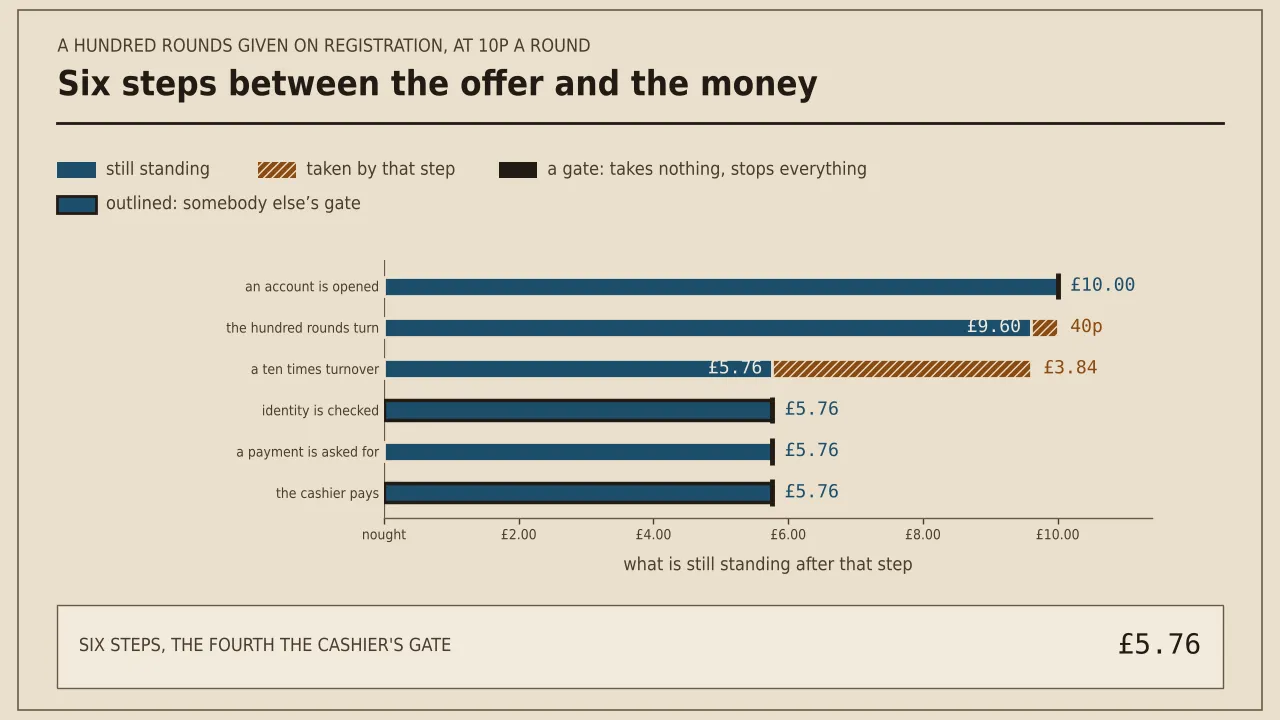
£3.84 of the £9.60 that reached a balance is taken by the turnover alone, two fifths of what arrived and well over a third of the face promised
Two readings of that figure matter more than the figure does. The first is that one step dwarfs the rest as a taker: the reel’s share is 40p and the obligation’s is £3.84, so more than nine tenths of everything lost between a headline and an ending goes on a single rung. The second is that nothing below it takes a penny. From the third rung down the money stops falling and starts waiting, and what it waits on is the business of the fourth part below.
The regulator has said what the ceiling was for, and the sentence is usable: before the cap, some licensees were running play-through multiples as high as sixty off the rule sheet, claim 94. On this publisher’s sheet that is the one multiple from the market traceable to the regulator itself. Run sixty through the same expression at the same return and the result drops below nought. A negative there is not a debt and nobody owes it: it is the sum reporting that £9.60 is expected to run out before sixty turnovers of it are finished. Where this balance gives out is worth printing, being a figure about £9.60 rather than about arithmetic in general: at four per cent a pass, £9.60 is expected to be gone by the twenty-fifth, so sixty is more than twice the multiple this particular balance is expected to survive.
3
Nine hundred and sixty rounds, and six steps
A hundred rounds is a count of one thing and ten times is a count of another, and the two are never added together here. This chain runs to six steps. One of those six is performed nine hundred and sixty times.
The second count falls out of the first. Play-through is the multiple times the balance, so ten against £9.60 is £96.00 that has to go through a reel. At 10p a round that is nine hundred and sixty rounds, on top of the hundred that were given, which puts a thousand and sixty rounds between a headline and a request for payment. Reporting that as a thousand and sixty steps would be counting rounds and calling them conditions. Reporting six steps without the other number would be describing a short chain while leaving out the only part of it that costs real time.
Time is what the second count buys a reader. Pace has a published floor under a British licence: a licensed cycle may not start until 2.5 seconds have run since the one before it did, each cycle wants the control released and pressed afresh, and a button held down starts nothing off the rule sheet, claim 107. Autoplay is separately barred on online gaming, each cycle needing its own act of commitment from the player off the rule sheet, claim 115. Lay that floor over a thousand and sixty rounds and the chain cannot be walked in less than about forty-four minutes of continuous pressing, which is this site’s arithmetic set on top of the regulator’s figure rather than a duration anybody has published. Nothing about it is an estimate. It is the quickest a licensed game’s own rules would permit, and no real sitting runs at a floor.
Two things follow for anybody looking at a headline. The number in the headline is the smaller of the two counts by a factor of about ten, and it is the one the headline prints. And a chain’s length in kinds of step says nothing at all about its length in effort: six is a short chain by the standards of this site, while the third step in it is the longest-running single obligation anywhere in this section.
Set the closing figure against that second count and the headline shrinks again. £5.76 spread over a thousand and sixty rounds is a little over half a penny a round, which is the rate at which a hundred given rounds pay for the work they ask for, and it is not a figure any headline on this key carries.
4
Four gates, and which two of them are the cashier’s
Four of the six rungs move no money whatever: opening the account, the identity check, the request for payment, and the settlement. They fall into two kinds, and the division is where this guide’s finding comes from. Opening the account and asking to be paid are the reader’s own, taken whenever the reader likes and willing to wait indefinitely. The identity check and the settlement are the cashier’s, taken when it likes and on terms it writes, with nothing on this side able to hurry either. The first rung where the decision sits across the counter is the fourth, and £5.76 is standing when it is reached.
The second rung is none of the four and is not what this guide reports, for all that nobody steers a reel: the 40p it takes is a 96 per cent return turning up on schedule rather than anybody’s decision. Why a row of that kind is entered differently from a gate, and never as a fraction of the sum, belongs with the method and not here.
What belongs here is where the two cashier’s gates stand. Both of them come after the money has stopped falling, which on a column read downwards makes them look like formalities, and formalities are the one thing they are not. By the fourth rung every penny this offer was ever going to take has been taken. Everything that can still happen to the remaining £5.76 is somebody deciding, and on two of the four occasions that somebody is not the reader.
5
Where the identity check sits, and why its place is the whole of it
An identity check is not a controversial thing in itself. What matters about one is where in a chain it is permitted to stand, and that question has a published British answer and no published answer anywhere outside.
Who somebody is must be obtained and checked under a British licence before any gambling happens whatever, and the condition names a floor of three items: the name, the address, the birth date off the rule sheet, claim 10. The duty does not wait for a deposit. It covers play funded by an incentive exactly as it covers play funded out of a customer’s own pocket, and it reaches the demonstration versions on a licensee’s own site as well off the rule sheet, claim 18. On a licensed site, then, the check sitting at the fourth rung above would already have happened before the first rung, because a licensed cashier may not hand a hundred rounds to somebody it has not identified.
The same condition shuts the door at the far end. The withdrawal request is not a moment at which fresh paperwork may suddenly be required, where there was ample opportunity to collect it earlier off the rule sheet, claim 11. The regulator puts it to players in plainer words still: an operator cannot hold a payment back until age and identity are proved, if proving them was something it might have called for earlier, and money-laundering paperwork belongs at the beginning rather than at the exit off the rule sheet, claim 15. A payment held up for want of that paperwork may put the operator in breach off the rule sheet, claim 16.
Read those together and the British position is that the gate has a fixed place in the chain: at the top, before anything has been handed over, and not at the bottom where the money is. Outside the licence nothing fixes it. No source read for this page states where a cashier without a British licence puts its check, how long it takes, or what it asks for, and this guide invents none of that. What is on the record is the regulator’s general account of the unlicensed market: payouts blocked flat, and withdrawal ceilings pitched so far up that nobody reaches them off the rule sheet, claim 135, together with unfair play, money lost, and nowhere to take a complaint when something goes wrong off the rule sheet, claim 134.
That is why the fourth rung is drawn as a gate and carries an outline. The reader supplies documents. Somebody else decides whether they will do, when to ask for them, and what becomes of £5.76 while that is being thought about. It is the first rung on this chain where the decision sits across the counter, which is what makes it the finding, and the sixth rung is the only other one like it.
One further thing a reader is entitled to know concerns recourse. Under a British licence a complaints process has to be finished inside eight weeks of the complaint arriving off the rule sheet, claim 39, complaints have to be accepted for six months at least from the incident off the rule sheet, claim 40, and whoever closes it has to point the way on to an independent adjudicator that the regulator has itself approved off the rule sheet, claim 42. The regulator says of itself that the ombudsman role is not one it holds: settling a dispute and recovering anybody’s money are both outside its powers, and it cannot see into an account to work out what happened off the rule sheet, claim 46. Even the British route therefore ends at an approved adjudicator rather than at the regulator, and the route outside the licence goes undescribed on this page because nothing read for it describes one.
6
What no term states, and what this page will not supply
A chain can only be counted out of things that are published or things a page declares in its own name. Everything else is a silence, and the useful thing to do with a silence is to name it rather than quietly fill it. Five of them bear on this key and each one would move a figure above.
The first is a round’s value, already dealt with: nothing published fixes it, so the 10p here is a declaration off the rule sheet, claim 89. The second is whether what a given round wins counts as bonus funds under the ten times ceiling. Should those winnings arrive as bonus funds in the account, the ten bites on them; whether the round itself is bonus funds has never been published in either direction off the rule sheet, claim 90. This page says neither thing, which is why the third rung is labelled as a published ceiling read across rather than as a term anybody printed.
The third silence is weighting, which the next part takes up on its own. The fourth is a roof over what a bonus may win. No published source supplies a standard one, and the rule that stops a cashier limiting withdrawals is written about a deposit balance rather than about bonus winnings off the rule sheet, claim 34, so a cap on what a bonus pays and an unfettered right to take out a deposit balance can hold at the same time off the rule sheet, claim 105. Since no figure for such a cap is published, none goes on the ladder, and £5.76 at the foot of it is what the arithmetic leaves rather than what any cashier has undertaken to pay.
The fifth is the discretionary clause, and it is the only silence here with an enforcement outcome standing behind it. One operator paid £170,000 for the small print of a new casino bonus, the penalty dated 3 July 2025, the objection being to wording that kept back a free hand to close an account or take winnings off it off the rule sheet, claim 83. What was breached was the condition requiring fair and open dealing, the regulator’s words being that a term of that shape is short on transparency and can land a consumer unfairly off the rule sheet, claim 84. It pays to be careful about what that establishes: a clause of that kind has been fined, and no source says such a clause is void off the rule sheet, claim 86. One sitting over the ladder above leaves the third column untouched from top to bottom and could end the chain at any rung, which is exactly the property that makes a gate a gate.
Two further things are off the ladder deliberately. There is no rung for a deadline, although the advertising regulator treats a deadline for taking up or spending an offer as one of the conditions a promotion has to put plainly in front of people off the rule sheet, claim 62, because no figure for one was read and a rung with no number on it is furniture. There is no rung for a minimum payout either, for the same reason. Where a reader finds either of them stated against a particular offer, both are rungs, and both are gates rather than deductions.
7
The multiple that is not the multiple
The ceiling is written about the multiple and about nothing else, and a second number sits underneath it that the ceiling never touches. Where a game returns under a pound of credit against every pound put through it, satisfying ten times takes more than ten times in staking, and the offer stays inside the cap the whole way.
A worked rate appears in the regulator’s own consultation response, supplied by respondents rather than written by the regulator: on a hundred pound bonus carrying ten times, a game weighted at thirty per cent turns every pound wagered into thirty pence of credit off the rule sheet, claim 96. That point went on the record and nothing was done about it, so weighting came through the cap intact off the rule sheet, claim 97. No table of current contributions exists in any source this publisher may cite off the rule sheet, claim 105, so the thirty per cent used below is that quoted rate and not a market figure, and the sums laid over it are this site’s own.
Here is what it does to the chain on this page. Ten against a £9.60 balance is £96.00 of credit that has to be earned. Where each pound staked earns a pound of credit, £96.00 of staking clears it, which is the nine hundred and sixty rounds counted earlier. Where each pound staked earns thirty pence, the same £96.00 of credit needs £320.00 of staking behind it, which is three thousand two hundred rounds at 10p a round. The multiple written on the term has not moved an inch. The staking under it has more than trebled, and so has the sitting: three thousand three hundred rounds all told, against the pace floor used in the third part, is something over two and a quarter hours of unbroken pressing before a withdrawal can even be asked for.
The house formula carries that share as its last variable, which is what a last variable is for. Put the qualifying share at thirty per cent instead of taking it whole and E = B × (1 − W × (1 − RTP) ∕ g) returns a figure under nought: minus a third of the balance, against the plus two fifths it returns at full weight. Nobody owes that £3.20. It is the arithmetic reporting that at this return the balance is expected to run dry before the obligation is discharged, in the same way that twenty-five passes at full weight empty it exactly.
So the ten drawn on the ladder above reads an offer of this shape as gently as it can be read, and it is gentle on two counts. It is a ceiling and not a term anybody printed, and it is drawn with the qualifying share taken whole because no contribution percentage was published to take in its place. Where a cashier does publish a weighting, the figure worth working with is the staking and not the multiple, and the only honest comparison between two offers is one that puts both of them on that footing.
8
The licence that stands behind none of it
Every figure above has been worked at the most generous reading available, and one thing has been kept back until now because it governs all of them. The duties that fixed those generous readings hang on a British licence, and the cashier fronting a hundred given rounds does not have one.
Offers of a hundred given rounds, put to readers in Great Britain, hold no Great Britain licence. Pick three duties a holder of one would carry, and each can be priced straight off the rungs above. The first is the ten the third rung was drawn at: a play-through multiple above ten on bonus funds has been barred since 19 January 2026 off the rule sheet, claim 91, and that bar falls on licensed incentives only, so every penny of the £3.84 the third rung takes is the kindest figure this chain could have been given rather than a figure anything obliges. The second is the stake. A licensed online reel is capped for each game cycle at £5 where the player is twenty-five or older and at £2 where the player is younger off the rule sheet, claim 124, which makes the 10p assumed on this page a fiftieth of the larger ceiling and a twentieth of the smaller, and makes neither ceiling a thing that reaches an unlicensed cashier. The third is self-exclusion. Membership of Gamstop is compulsory for every online gambling business the British regulator licenses off the rule sheet, claim 181, and the scheme’s own terms say that an operator outside its membership is one it has no power to keep anybody away from off the rule sheet, claim 183, so a registration covering the whole licensed market covers nothing whatever at this end of the chain. A reader who has signed it should take that as the consequence it is, and nothing on this site describes a way round any of the three.
One further duty bears on £5.76 in particular, because £5.76 is a figure sitting in somebody else’s account while two gates are decided. Under a British licence the terms themselves have to say, in a form the regulator settles, whether money being held would come through an insolvency, how far it would, and by what mechanism; and an acknowledgement has to come back before any of it is played off the rule sheet, claim 54a. Where the honest answer is that it would not come through, a reminder is owed every six months carrying the sum then on deposit, and the acknowledgement has to be given afresh, a requirement live since 31 October 2025 off the rule sheet, claim 54b. None of it binds a cashier holding no such licence, so £5.76 at the foot of this ladder is a sum whose fate, were the house behind it to stop trading, nobody has promised to tell anybody.
The regulator has set the position down in general terms more than once, and a page settling for the word unregulated would be throwing the detail away. The regulator’s warning to operators, published on 20 January 2025, sets out what an unlicensed site may be missing: the social responsibility controls, the money-laundering controls, and with them a customer’s cover against fraud, against mishandled data and against unfair dealing. The same notice records that people who have excluded themselves are often who such sites go after off the rule sheet, claim 130. It makes a second point bearing directly on how an offer of this shape looks from outside: work from licensed suppliers has shown up on sites that hold no licence at all, so a game somebody recognises in the window proves nothing at all about the cashier behind it off the rule sheet, claim 131.
There is money behind that finding. The regulator traced one supplier’s games onto six unlicensed sites, all of them open to somebody sitting in Great Britain, and that supplier settled. The sum was £4.75m and the date 23 July 2026 off the rule sheet, claim 132. The point for this page is narrow and it is not about that company. Somebody looking at a hundred given rounds cannot tell from the game on the screen which side of the licence the cashier stands on, and the one check the regulator actually recommends is the public register, where the licensed activities and the website domain names ought to match what a site claims for itself off the rule sheet, claim 88.
One more thing points the opposite way, and dropping it would skew this page as badly as dropping the rest. Providing gambling facilities without a licence is the criminal offence, and whoever provides them is the one committing it; no answering offence of taking part as a customer was written into the Act off the rule sheet, claim 3. Outside the licence what gets surrendered is protection, not liberty, and this page has tried to count that loss duty by duty instead of asserting it: the ceiling over the turnover, the fixed place of the identity check, the bar on putting a roof over a deposit balance, the eight weeks allowed for a complaint, the approved adjudicator at its end, and compulsory membership of the exclusion scheme off the rule sheet, claim 168. Six steps, the fourth of them decided across the counter, and the whole of the £5.76 resting on two rungs nothing on this page can hold anybody to.
Asked at the booth
- How long is the chain on this key
- Six steps: registering, turning the rounds, clearing the turnover, being checked, making the request, and being settled with.
- Which of the six is the first that somebody else decides
- The fourth, the identity check, with £5.76 standing when it is reached. The two rungs above it take a share, but no person decides those.
- What is a hundred given rounds actually worth
- At the 10p and the 96 per cent this page declares, £9.60 reaches a balance and £5.76 survives a ten times turnover.
- Where does the 10p come from
- From this page and nowhere else. No published rule fixes what a given round is worth, so the figure is declared rather than sourced.
- Why is the turnover drawn at ten times
- Ten is the ceiling Britain publishes for a licensed incentive. It is the gentlest multiple any source supports, and no unlicensed cashier is held to it.
- How many rounds does a ten times turnover take
- Nine hundred and sixty at 10p a round, on top of the hundred given, so a thousand and sixty rounds in all.
- Why does being checked not cost anything on the ladder
- Because it takes nothing and passes nothing. It either lets the whole £5.76 through or lets none of it through, and a fraction would say something false.
- Does a Great Britain licence stand behind an offer like this
- No. The stake limits, the ten times ceiling and compulsory membership of the exclusion scheme all hang on that licence, and none of them reaches an offer lacking one.