Terms read 26 October 2026 Counted in 2026
Crypto casino: eight rungs, and the first gate is the third of them
Every other key filed under this heading has somebody standing in the way in. This one has nobody. Twenty pounds of coin leaves an address because its holder told it to, and no company anywhere is asked to agree, which moves this page’s finding down to rung three and makes it the cashier’s. Trebled, that twenty pounds is £40.00 of credit with £24.00 reckoned to survive ten rounds, and the whole £40.00 is riding on rung three. What stands behind that credit is the question the middle of this page is about, and the answer available is nothing at all.
How many steps eight A cashier on three, a selling venue on one, and nobody on the way in. The first gate somebody else holds rung three The cashier grants the matched credit, or keeps it back. Standing when it is reached £40.00 The promise entire, one rung later than anywhere else here.
| What has to happen | Who takes this step | What it leaves standing | Printed where |
|---|---|---|---|
| An account is opened | the reader | £40.00, or nought unopened | the offer’s own headline |
| Coin leaves an address | the reader | £40.00, or nought unsent | nothing published behind this rung |
| The trebled credit is granted | the cashier | £40.00, or nought kept back | nothing published behind this rung |
| Ten times is played through | the house’s arithmetic | £24.00 | the published British ceiling |
| Identity is checked | the cashier | £24.00, or nought unverified | the identity rule, in print |
| A payment is asked for | the reader | £24.00, or nought unasked | nothing published behind this rung |
| Coin is sent back | the cashier | £24.00, or nought unsent | nothing published behind this rung |
| Somebody buys the coin | a selling venue | £24.00, or nought unsold | no rate may be printed here |
| What eight rungs leave | seven gates, three deciders | £24.00 | this page |
1
A way in with nobody standing in it
Rung two is the interesting one on this page and it is interesting for being empty. A holder of coin instructs an address to send twenty pounds’ worth somewhere, the instruction is carried out by a network that has no opinion about it, and no company anywhere between the two ends is asked for permission.
Compare that with any neighbouring key and the difference is the whole of why this guide exists separately. A card asks a bank. A wallet asks a payments company. A telephone charge asks a telephone company. Coin asks a network of machines that will record any instruction properly signed, and recording is not deciding.
So the premise this heading runs on fails at exactly one place, and this page is that place. The heading collects keys where a stranger settles the way in. Here the way in is settled by the reader alone, and the first decision taken by somebody else waits until the credit has to be granted.
Eight rungs divide as follows: three to the reader, at the opening, the sending and the asking; three to the cashier; one to whoever buys the coin at the end; and rung four to arithmetic, which nobody owns. So four of the eight are settled elsewhere and two parties settle them. A standing page sets out how the column works for anybody who wants that first.
An absence at rung two sounds like good news and this page declines to report it as any. Nobody standing in the way in also means nobody standing anywhere a complaint could go. A bank refusal is a refusal with an institution behind it. A transfer that leaves an address and lands nowhere useful has no institution behind it at all, and the reader has signed the instruction themselves.
That cuts twice and the second cut is the one worth printing. An instruction properly signed cannot be stopped, reversed or questioned by anybody, which is the property holders of coin value most highly. The same property means a transfer to the wrong place is simply gone, with nothing between the reader and the loss except their own care at the moment of sending.
Arriving at eight by a route of its own is worth a sentence, because the total matches several neighbouring keys and nothing else about the chain does. A rung vanishes at the front, no company being asked for anything. A rung appears at the back, coin being unspendable until somebody buys it. One off, one on, and the tally lands where several other tallies land.
Twenty pounds is a figure chosen for this page. No source available here publishes a typical transfer, a typical match or a typical anything on this rail, and the ladder does not depend on the choice: halve the transfer and £12.00 survives the same multiple, with all eight rungs still standing and rung three still the first one somebody else settles.
2
£40.00 of credit, and the £24.00 reckoned to remain
Twenty pounds of coin, trebled, and £40.00 of credit granted: those are the quantities this page carries down its third column. The transfer itself is spent at rung two and the column never mentions it again, because what the ladder measures from rung three on is the credit rather than the stake that bought it.
Staking of £400.00 is what rung four requires, the multiple held at ten because no British licence permits a higher one off the rule sheet, claim 91. A reel is assumed on this site to hand back ninety-six per cent across a long run, an assumption this publisher makes and attaches to no machine, and four per cent of £400.00 is £16.00. So E = B × (1 − W × (1 − RTP) ∕ g) resolves to £24.00.
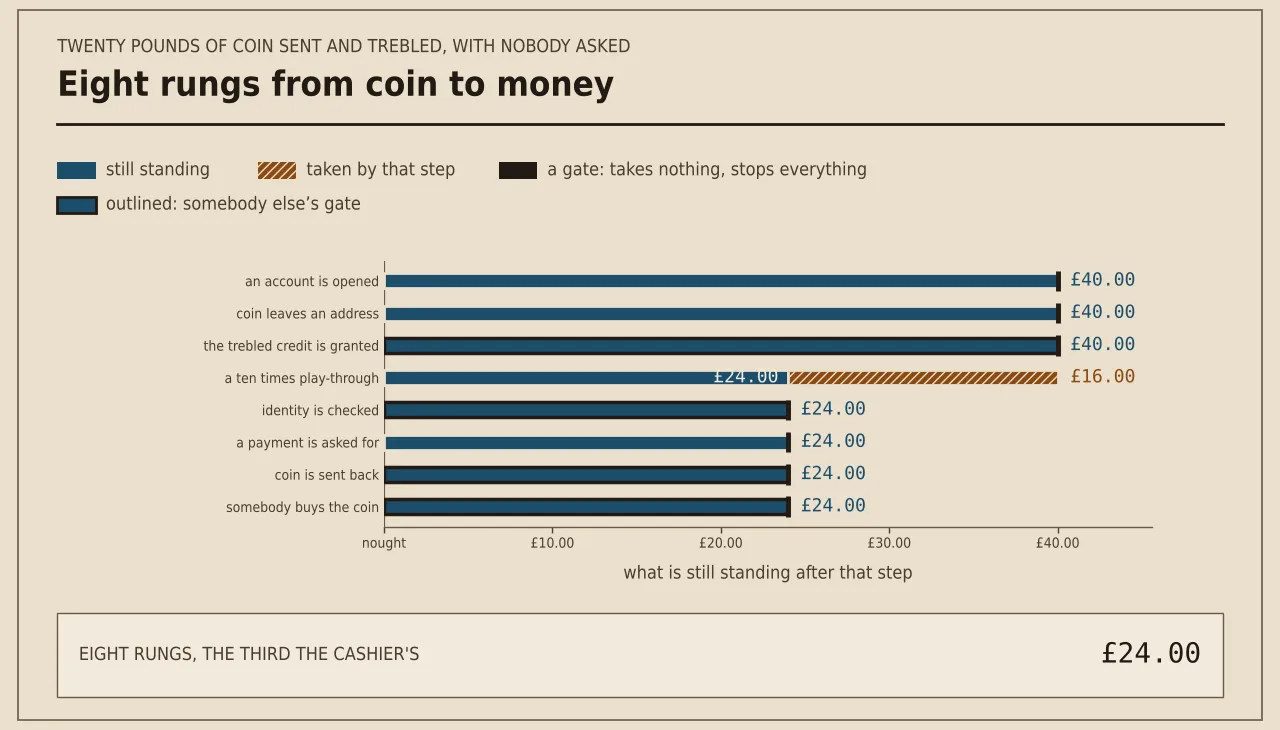
Rung four removes £16.00 of the £40.00, and the four rungs beneath it each carry £24.00 without altering it
Three rungs carry £40.00 and five carry £24.00, and £16.00 is the only money on this page that leaves without anybody deciding it should. Everything else in the column is a question of whether £24.00 travels rather than of what £24.00 is worth.
One peculiarity of the arithmetic here has no parallel on the card and wallet keys. The £40.00 is a figure in a cashier’s ledger denominated in money, while the twenty pounds that bought it and the £24.00 that is meant to come back are both coin. Three of the four quantities on this page are therefore expressed in a currency that none of them is actually held in, and the fourth is the £16.00 arithmetic takes.
Stating that plainly is the honest course, because the alternative is to print a conversion nobody has published. A rate existed when the twenty pounds went out. Another will exist when the £24.00 is sold. Neither is available to this publisher, no source behind this site carries one, and a page that supplied the difference would be supplying the most consequential figure on it out of its own head.
So the column holds £24.00 level across rungs five to eight, and holding level is declared here as an assumption rather than offered as a reading. What the ladder is measuring from rung five onward is how many parties can stop £24.00 reaching the reader, not what £24.00 will be worth when it does.
| What crosses | The form it takes | What may be printed about its value |
|---|---|---|
| Twenty pounds | Coin leaving an address at rung two. | A figure chosen here, with no rate behind it. |
| £40.00 of credit | A line in a ledger, denominated in money. | Three times the transfer, under a term nobody must publish. |
| £16.00 | Arithmetic’s share of £400.00 staked. | Four per cent of the staking, on this site’s assumption. |
| £24.00 | A ledger line until rung seven, coin after it. | Nothing fixes what a buyer pays for it at rung eight. |
Those four right-hand cells, taken together, are the shape of the key. A chosen figure, a figure resting on a term nobody must publish, a figure produced by arithmetic on a declared assumption, and a figure nothing can fix. None of the four is a promise any party has made to anybody.
3
Rung three, and a gate that arrives one rung late
Granting the credit is where somebody else first appears, and £40.00 is what depends on it. The party granting it has taken twenty pounds’ worth of coin, holds it, owes the reader a figure three times its size, and is under no obligation discoverable here to say when, whether or on what terms that figure becomes real.
One arrangement governs rung three and it is the only arrangement on this chain. There is no network rule about it, no scheme rule, no payments company in the middle and no regulator the reader can name. Rung one created a relationship between two parties, and rung three is one of those two parties deciding something about the other.
Put beside the card keys, that is a thinner situation rather than a simpler one. A card chain has a bank at rung two and a scheme behind the bank, both of which publish rules, neither of which helps much, and both of which exist. This chain reaches its first other party at rung three and finds exactly one, with nothing standing behind it.
Nothing readable here says what happens if the credit is withheld. A transfer has completed, coin has arrived, and the reader’s entire position rests on a figure appearing on a screen. Whether a dispute about that figure can be taken anywhere is addressed by no source behind this page, which is the plainest statement this guide can make about rung three.
Reading the regulator on unlicensed sites belongs at this rung rather than in a closing paragraph, since rung three is where its warnings stop being general. Weak controls against money laundering, exposure to fraud, trouble over a customer’s data and unfair practices are the four exposures its notice of January 2025 sets out off the rule sheet, claim 130. Each of the four needs a party holding the reader’s money before it can bite, and rung three is where that party first does something.
Two outcomes and no third, then. Either £40.00 appears and the chain continues to rung four, or it does not and a reader who has parted with twenty pounds’ worth of coin has nothing and nobody. The third column prints both, which is what the instrument is for.
A reader may object that rung three is the cashier’s and therefore not much of a finding, the cashier being the obvious party to worry about. The objection misses what the rung’s position is reporting. On fifteen of the sixteen keys under this heading the first other party arrives before the cashier does, and a reader meets a bank, a scheme or a wallet first. Here the cashier is met first because the rail put nobody in front of it.
So the position of the gate is itself the result. A gate at rung two says a stranger with published rules can end the chain early. A gate at rung three says no stranger can, and that the first party able to end it is the one holding the coin.
4
What stands behind the credit, and the rating nobody gives
Asking what stands behind £40.00 is a question with a published answer inside the British licensing system, and the answer is a form of words the licensee has to hand over before anybody plays.
Three things go into a licensee’s terms: survival of the customer’s balance if the business fails, the level of that survival, and the means by which it is arranged. A rating system the regulator sets governs the form, the customer gets it in writing when the first deposit is made, and play cannot begin until the customer has acknowledged it off the rule sheet, claim 54a. Cleared deposits and winnings left on account both count towards the balance being described.
Four levels are named, and two of the four open with the words not protected. Segregation of customer funds is what one of those two then adds, while the other adds no segregation at all. Above the pair sit medium protection and high protection. Whichever level a business claims, it writes its own explanation of what the level means, no exact wording having been laid down for that off the rule sheet, claim 54c.
A repeating duty sits underneath the rating. Twice a year, a licensee claiming either of the unprotected levels owes the customer a statement that insolvency would take the money, a figure for the amount held in that customer’s name, and an acknowledgement obtained afresh before play goes on. October’s last day in 2025 is when the paragraph carrying that duty began to apply off the rule sheet, claim 54b.
None of that reaches the chain counted on this page, and setting it out is still worth the room, because it establishes what a reader is entitled to ask for and therefore what the absence of an answer amounts to. A rating is a short phrase. Producing one costs nothing. A cashier that has never produced one has not been prevented from doing so.
So the honest statement about rung three is that nothing stands behind it. Not a rating, because none is given. Not segregation, because nobody has said whether the coin sent at rung two sits apart from the business’s own holdings or is indistinguishable from them. Not a six-monthly reminder, because the reminder exists inside a system this chain is outside.
That is the sentence this section’s crypto keys are here to print, and it is printed in preference to a figure. A figure would suggest a quantity of risk. The position is instead an absence of information: a reader cannot say the coin is unprotected, cannot say it is protected, and cannot find out, which is a worse position than a bad rating would be.
One further asymmetry deserves its own sentence. A licensed business giving the worst of the four ratings has still told the customer something, has still obtained an acknowledgement, and has still committed to repeating it twice a year. An unlicensed one giving no rating has made no statement that could later be held against it, which means the gap between the worst rating and no rating at all is larger than the gap between the best rating and the worst.
None of the paragraphs above is a way round anything and this domain publishes no such thing. Somebody who has shut themselves out of gambling will find the result stated here and the method absent, that being a rule this publisher works to. Where a registration has been made and a chain of this shape stays open regardless, a protection has failed and this page says so, with the helpline number printed whole at the foot.
5
Rung eight, where the figure stops being money
Rungs six, seven and eight are the back of this chain and the eighth is the one with no equivalent on a card key. A card chain ends when money arrives in the account the money came from. This one ends with coin in an address, and coin in an address is not something a shop will take.
So an eighth rung exists and it belongs to a party the reader has not met yet: whoever is willing to buy the coin. That party sets its own price, charges its own fee, asks its own questions about who the reader is, and has made no commitment of any kind to anybody on the chain above it.
Counting it as a rung rather than leaving it off is a deliberate choice and the reason is arithmetical. A ladder that stopped at rung seven would print £24.00 as the figure reaching the reader, which would be false: what reaches the reader at rung seven is coin worth some unstated amount, and the step that turns it into spendable money is a step somebody else takes.
Whether that step costs anything is not a question this page can answer with a number. No source available here publishes a selling fee, a spread or a rate on any venue, and inventing one would put the most sensitive figure on the page beyond checking. The rung therefore names the step, holds £24.00 level and says in the fourth column that no rate may be printed.
Holding level is an understatement and this page says so rather than hiding it. A figure that holds level through rung eight is a figure that has been measured in money throughout, and the thing travelling through rungs seven and eight is not measured in money. The ladder’s last two rows therefore carry the count honestly and the valuation not at all.
Rung six is the reader’s and is the request. Rung seven is the cashier’s and is the sending. Between them they repeat a pattern the whole heading shows: a reader asks, and whether the asking produces anything is settled by somebody who has published nothing about how the asking gets settled.
No duration appears on this chain and none could. Nothing read for this page fixes a time for a request to be looked at, for coin to be sent, or for a venue to pay for it, and a page printing one would be printing a guess in a position where readers would reasonably treat it as a reading. Eight is the figure this guide has, and eight is what it prints.
One more thing about rung eight is specific to this rail and is easy to miss. A reader who wanted coin in the first place may be content to be paid in coin and may never take rung eight at all. The rung is still counted, because the ladder measures the distance to money a shop will accept, and a reader who stops at rung seven has reached a different destination rather than a nearer one.
6
What a reader can check, and what a familiar game proves
Two checks can be made before rung one and neither takes long. The regulator recommends the first: a business’s own claims, held up against whatever the public register has recorded under its name off the rule sheet, claim 88. Coin reaching an address proves that a network did as it was told. About whoever controls that address it proves nothing.
Checking an instinct is the second, and the instinct in question is familiarity. None of the four other-held rungs can be settled by looking at a game, and a regulator notice records software made under licence turning up where no licence exists off the rule sheet, claim 131. So what a reader recognises on the screen is the feeblest signal obtainable, and on a coin chain it is often the only one in view.
Unlicensed is not a synonym for unregulated, and the regulator’s own words on the point are worth setting down. Illegality is what it calls gambling business conducted without a licence. Two consequences go with that word: action brought against the operator, and the big schemes pulling the means by which it takes payments off the rule sheet, claim 129.
That last clause has a particular edge on this key and the edge points both ways. A payment systems organisation can withdraw facilities from a business that takes cards. Nobody can withdraw a coin address, which is precisely why coin chains persist after card chains have been closed off. The enforcement tool the regulator names does not reach rung two of this page.
One further point belongs with the checks and it is about the national exclusion arrangements. What gives the scheme its reach is a licence condition: an online gambling business licensed in Britain may not decline to join it off the rule sheet, claim 181. A cashier taking coin for play holds no Great Britain licence, so no registration a reader has made reaches any of this chain’s eight rungs.
One figure gives the scale of what is being compared. 614,738 people had registered on the online side by the July of 2026 off the rule sheet, claim 189. Not one of those registrations travels past the licensed market’s boundary, and all four of this ladder’s other-held rungs are on the far side of it.
A reader meeting that gap unwillingly is the reader this part is written for. The consequence is printed and the procedure is not, which is this domain’s rule rather than its preference, and the National Gambling Helpline appears whole further down the page.
7
Eight rungs, and a gate that arrives late
British licence conditions supplied two figures, one date and one definition to this page. Nothing among the four reaches the cashier settling three of these rungs, and nothing among them reaches whoever buys coin at the eighth.
A coin chain reaching a British reader runs through a cashier that is outside Great Britain licensing altogether, and three features of the ladder follow from that rather than from the technology. Ten is where rung four’s multiple sits because a licence forbids any higher one off the rule sheet, claim 91, which makes its £16.00 the gentlest arithmetic obtainable rather than a figure anybody is held to. Rung five would come first under a licence, identity being owed before play rather than after it off the rule sheet, claim 10, instead of standing fifth with £24.00 behind it. And rung three would carry a stated insolvency rating, acknowledged in writing, under a condition that names what money held to a customer’s credit includes off the rule sheet, claim 54a. Three consequences, printed as consequences, and no route round any of them appears on this domain.
Why the finding here is rung three and not rung two is the question this page has been answering throughout, and the answer is that rung two has nobody in it. A finding has to be a gate another party holds. Rung two is a gate, in that the chain stops if the coin does not go, but the party holding it is the reader, and a reader cannot be the stranger in their own chain.
A gate arriving one rung late is not a shorter wait, which is the misreading this paragraph exists to head off. It means the credit is granted by the only other party present, with twenty pounds’ worth of coin already gone and no institution in between that could be asked about it. The gate comes later and it comes alone.
Four figures close the arithmetic and they are worth gathering. £40.00 is the promise. £400.00 is the staking rung four demands of it. £16.00 is arithmetic’s share on this site’s assumed return. £24.00 is what is reckoned to be left, in a form that is coin from rung seven onward and therefore in a quantity nothing on this page fixes.
A count and a warning are what the key amounts to. Eight rungs; four of them settled by somebody who is not the reader; two parties settling those four; rung three the earliest of them, with £40.00 promised and no staking yet begun. And the warning is what the middle of this page established. Behind that £40.00 there is no rating, no statement about segregation and no half-yearly reminder, so whether the coin sent at rung two sits apart from the business’s own holdings is a question published material does not answer either way.
One sentence remains, about what this ladder would look like if the rail were the problem. It would not look different. Nothing on these eight rungs is a complaint about how coin moves, which it does exactly as advertised and without asking anybody. Every gate on the ladder sits at a point where coin has already arrived and a person has to decide something, and the number of those points is the answer this page has.
Asked at the booth
- Who settles the way in on a coin chain
- Nobody but the reader. A signed instruction is recorded by a network that has no opinion about it, so no company is asked to agree.
- Why is the finding the third rung rather than the second
- Because the finding has to be a gate another party holds, and rung two is the reader’s own. The cashier granting the credit is the first other party on the chain.
- What stands behind the £40.00 of credit
- Nothing readable. No insolvency rating is given, nothing says whether the coin is held apart from the business’s own money, and no six-monthly reminder applies.
- What would a Great Britain licence require instead
- A stated protection rating from four named levels, given in writing on the first deposit and acknowledged before the money may be gambled with.
- What is £40.00 of credit reckoned to leave
- Twenty-four pounds. Staking of £400.00 comes first, and on the reel this site assumes the house keeps four per cent of that, which is £16.00.
- Why does the ladder carry an eighth rung
- Because coin in an address is not money a shop will take. Somebody has to buy it, and that party sets its own price and asks its own questions.
- Can the page say what the coin will be worth at the end
- No. No rate, spread or selling fee is available to this publisher, so the figure holds level and the ladder carries the count rather than the valuation.
- Does a self-exclusion registration reach this chain
- No. The scheme reaches businesses a Great Britain licence covers, and a cashier taking coin for play is not one of them.
- Is a familiar game evidence that a site is licensed
- No. Software made under licence has been recorded running where no licence exists, so what a reader recognises on the screen settles nothing at all.
- Which rungs belong to the cashier
- The third, the fifth and the seventh: granting the credit, checking identity, sending coin back. Three belong to the reader, one to a buyer, and one to arithmetic.