Terms read 26 October 2026 Counted in 2026
PayPal casino: eight steps, and the second of them belongs to the wallet
Eight things have to happen before a matched offer funded through a wallet becomes spendable money, and the earliest one settled by somebody other than the reader is rung two, reached before a round has turned. A tenner matched pound for pound puts £10.00 of credit at the head of the chain and the obligation on it is expected to leave £6.00. What makes this key unlike a chain funded straight from a bank is the company sitting at rung two: a wallet, holding one contract with the reader and, on anything this publisher is allowed to cite, no arrangement with the cashier whatever.
How many steps eight Register, fund, be credited, play through, be checked, ask, be returned, be paid. The first gate somebody else holds the second A wallet lets the funding reach that merchant, or quietly does not. Standing when it is reached £10.00 Every penny promised, nothing having been played for by then.
| What has to happen | Who takes this step | What it leaves standing | Printed where |
|---|---|---|---|
| An account is opened | the reader | £10.00, or nought unopened | the offer’s own headline |
| The funding is allowed through | the wallet | £10.00, or nought declined | nothing published behind this rung |
| The matched credit is granted | the cashier | £10.00, or nought withheld | nothing published behind this rung |
| Ten times is played through | the house’s arithmetic | £6.00 | the published British ceiling |
| Identity is checked | the cashier | £6.00, or nought unverified | a British licence condition |
| A payment is asked for | the reader | £6.00, or nought unasked | the cashier’s withdrawal form |
| The wallet takes the money back | the wallet | £6.00, or nought refused | nothing published behind this rung |
| The cashier settles | the cashier | £6.00, or nought unpaid | nothing published behind this rung |
| What eight steps leave | five gates, two outside parties | £6.00 | this page |
1
A wallet, a funding source and a cashier: three parties, eight rungs
A reader who searches for a casino that takes a wallet is asking a question about the way in. The answer this guide gives is about the way out, and it is a count: eight rungs, five of them settled by a company rather than by the reader, and two of those five settled by a company that never signed anything about the offer.
Set the parties out before the figures. Three of them stand on this chain. The reader opens the account and later asks to be paid, which is rungs one and six. The cashier grants the match, checks the identity and settles the payment, which is rungs three, five and eight. The wallet lets the funding reach the merchant at rung two and takes the money back at rung seven. A fourth party is in there too, further back: whatever card or bank account stands behind the wallet and is what actually pays. It is counted inside rung two on this ladder because a reader meets it as one refusal rather than as two.
Four parties is already one more than anybody counts unprompted, and the extra one is why rung two cannot be read off a payment screen. A refusal at that rung may come from the wallet or from the card or account standing behind the wallet, and the message a reader sees is the same either way. So this guide prices the rung and not the reason, the reason being something no source read for the page can supply.
That arrangement is the whole reason a wallet key is filed under this heading. Put the same tenner in from a bank account and the funding rung has the reader’s own bank in it, a party the reader can at least telephone. Put it in through a wallet and the funding rung has a company in it that the reader can telephone and the cashier cannot, which sounds like an improvement and is a longer chain by one party.
The eight rungs are not evenly distributed either. Five of them come before any money has moved at all and three of them come after the obligation has finished taking its share, which means a reader can be most of the way down this ladder with the figure unchanged and still be three decisions from spending anything. Reading the column itself is a separate business, handled on its own page and not rehearsed at every rung.
One last thing about the count. Eight is the length of a chain with a wallet in it and not the length of a chain in general. Taking the wallet out shortens it by two rungs and swaps the party at the funding step. Adding a prepaid instrument that cannot receive a payment lengthens it instead, because something else then has to be put up at the far end. The number is a property of the method of payment, which is exactly what makes a key naming a method of payment worth counting.
2
Where £10.00 of credit comes from and what £6.00 is left of it
£10.00 is the figure this page counts downwards, and it arrives in one move: a tenner handed over and matched pound for pound. The tenner stays the reader’s own and is not part of the column. The matched £10.00 is the promise, and the promise is what eight rungs stand in front of.
That pairing has a sourced shape behind it. The regulator’s own worked figures put a tenner against £10 of bonus and £100 of required staking, then £20 against £200, £30 against £300 and £40 against £400 as the headline percentage rises off the rule sheet, claim 103. Ten to one throughout, so a bigger headline is a bigger obligation, and this page takes the quietest of the four.
The tenner is this publisher’s declaration rather than a published minimum, because no primary reading fixes a smallest deposit for a wallet or for anything else, and the only sourced statement about the offshore market says no spread of multiples, ceilings or values could be obtained across it at all off the rule sheet, claim 159. Halve it and £5.00 of credit leaves £3.00; double it and £20.00 leaves £12.00. The rung count does not move with the deposit, which is the finding, so a reader who prefers a different tenner can rework the column in a minute and leave the answer standing.
Ninety-six per cent is the other declaration, used as a general industry return and attached to no machine and no maker. It is not applied to the £10.00 as it lands, because credit lands as money rather than as the outcome of anything. Rung four wants £100.00 staked; four per cent of £100.00 is £4.00; £6.00 is what the house expression leaves. Ten is the multiple used because ten is the highest a British licensee has been permitted since 19 January 2026 off the rule sheet, claim 91, which makes rung four the gentlest reading any sourced figure supports.
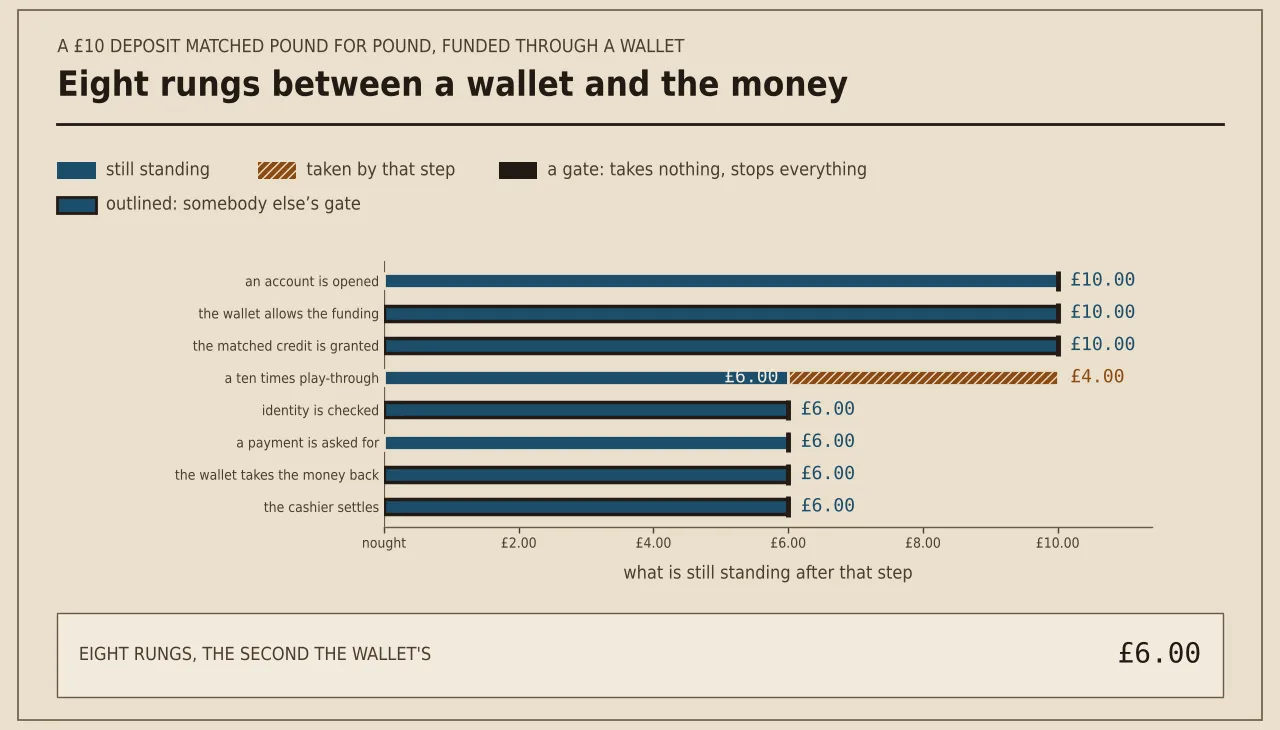
£4.00 of the £10.00 goes at rung four, two fifths of the promise, and the other seven rungs move the figure by nothing at all
Two counts come out of this and they are kept apart. The chain is eight steps long. One of those eight steps is £100.00 of staking. A guide reporting the staking as a number of conditions would be dressing an obligation up as paperwork, and a guide reporting eight rungs without the £100.00 beside them would make a demanding chain sound like an errand.
3
Rung two, and the whole £10.00 standing at it
Rung two is what this guide found, and £10.00 is standing when it is reached. Nothing has been staked. The obligation has not begun. The cashier has done nothing yet. In the way is a payments company weighing up whether a tenner may travel from this reader to this merchant, and that company is party to the offer under no document on either of this publisher’s sheets.
Count the contracts and the asymmetry is the finding in one line. The reader holds one with the wallet. The reader holds one with the cashier from registration onwards. Between wallet and cashier there is nothing citable at all. So rung two runs on terms the reader agreed to, about a merchant the reader did not choose, applied by a company that owes the cashier nothing and the offer nothing.
The regulator reaches that rung from a direction most readers would not expect. Its advice before gambling records that trading without a Commission licence is illegal, and lists among the consequences the withdrawal of a business’s payment facilities by the large payment systems organisations, a card scheme being the example it gives off the rule sheet, claim 129. Notice who decides and about whom. A payments body decides, about a merchant. The reader is not asked, not notified, and meets the decision as a payment that does not complete with £10.00 of promise untouched and no account of why available from either end of the chain.
There is a second asymmetry worth printing, because it is particular to a wallet and not to a card. A wallet is a layer with its own balance, and money put into one has already left the reader’s bank before it reaches the merchant. Whether that matters depends on terms this publisher may not cite, so the honest entry in the fourth column is that nothing is published behind rung two, and the honest sentence in prose is that a reader cannot find out which way rung two will fall from anything this site is permitted to quote.
What rung two does to the figure is nothing, and what it does to the chain is everything. The column carries £10.00 across unchanged because the rung passes the whole promise or none of it. A reader who has met a refusal there has lost no money and has no chain.
Set that beside rung eight, which is where most readers expect a chain to break. At rung eight £6.00 is at stake and the cashier is doing the weighing. At rung two £10.00 is at stake and the weighing is done by a company the reader chose and the cashier did not, in a judgement about the cashier rather than about the reader. The two rungs are not one risk in two coats. One is a decision about paying a customer. The other is a decision about serving a merchant, and a reader refused by it has been refused for reasons that are nothing to do with them.
On that last point this site prints the consequence and no procedure. Where a payment will not complete, where a bank has a block in place, or where somebody has registered with the national self-exclusion scheme, the consequence is that the chain ends, and that is the whole of what is said. Where one of the three bites, this site prints the consequence and stops there. A reader who has signed that register and meets a refused payment is looking at a protection working as intended, and the helpline further down this page is there for anybody who would rather talk to a person than to a cashier.
4
What a wallet publishes, and what reaches an offshore cashier
This heading of the site exists for a gap, and a wallet shows it more plainly than any other method of payment. A rail of this kind publishes rules. An unlicensed cashier is not bound by them, is not audited against them, and in the general case has not agreed to anything that mentions them. Between a published rule and an honoured one sits a contract that nobody has shown a reader.
Being exact about this matters more than being emphatic. Two sheets of primary readings stand behind this site, one of regulation and one of named operators, and neither holds a payments company’s own rulebook. So this guide does not tell a reader what a wallet’s terms say about gambling merchants, about reversing a payment, or about where a payout may be sent. A guide that does tell them has taken it from somewhere, and the worth of the sentence depends entirely on where.
What can be said is what each party publishes about each rung, and the answer for five of the eight rungs is nothing.
| Party | Rungs it settles | What this publisher could read about those rungs |
|---|---|---|
| The reader | One and six | Taken at the reader’s convenience, and neither of them waits on anybody. |
| The wallet | Two and seven | Nothing. A payments company’s own terms are not a source this site may cite, so both rungs carry the sum unchanged and a blank in the fourth column of the ladder. |
| The cashier | Three, five and eight | Nothing published by the cashier. British licence conditions describe what rung five would look like under a licence, and the cashier holds none. |
| The house’s arithmetic | Four | The ten times ceiling is published, as a limit on a licensee rather than as a term of this offer, and £4.00 follows from it. |
One exclusion of exactly this shape has been ruled on, which is the nearest thing to a published fact about methods of payment and offers. A ruling of 31 July 2024 concerned an offer that shut one method of payment out and said so down in the small print, which the advertising regulator judged not prominent enough off the rule sheet, claim 66. The lesson a reader can use is narrow and real: exclusions of that sort exist, an advertiser owes prominence for them under a code, and a cashier standing outside that code owes nothing at all.
A time limit belongs to the same family of conditions, filed there beside eligibility and wagering off the rule sheet, claim 62, and the long version of the terms is supposed to sit roughly one click from the advertisement off the rule sheet, claim 63. No deadline figure was read for this page, so none goes on the ladder. Where a reader meets one stated against a live offer, this chain is nine rungs rather than eight.
5
Rung seven, where £6.00 has to travel back the way it came
Rung seven is the second rung the wallet holds, and it is the one readers think about least. £6.00 is standing at it. The question it settles is whether the money can go back along the path it came in by, and the question has three parts: whether the cashier will send it that way, whether the wallet will take it, and whether the thing behind the wallet will accept it from the wallet.
None of the three is published. What is published is a British duty that describes exactly the friction rung seven consists of: no cancel button may sit on a withdrawal request under a British licence, the money asked for may not be handed back as a fresh deposit, and the way out is to be kept frictionless off the rule sheet, claim 37. Three rungs follow a request on this chain. Each of them is friction, and the duty naming friction binds a licensee and nobody at the far end of this one.
A second published rule gets closer to the £6.00 and then stops short of it. A deposit balance may not be capped on its way out by a licensee off the rule sheet, claim 34, the forbidden kind of term being illustrated as a daily fifty set against a weekly five hundred off the rule sheet, claim 35. The £6.00 at the foot of this ladder is not a deposit balance. It is what an obligation attached to a bonus is expected to leave, and a ceiling on bonus winnings is outside that rule, so the two sit together, and this page says which of them is which off the rule sheet, claim 105. The rule that would protect this page’s closing figure most directly does not reach it even where a licence applies.
So no figure for a payout ceiling goes on this ladder, and the £6.00 printed at the foot of it is an expectation produced by arithmetic and not a sum that anybody undertook to release. Take that away from a key about payment: a method settles the route and settles nothing whatever about the amount.
Following the £6.00 through a refusal at rung seven is worth doing, because the answer is neither a loss nor a payment. Where the wallet will not take the money, the money has not arrived and has not gone: it is still recorded on the cashier’s side, which puts the reader back at rung six with another method to nominate and a fresh set of rungs behind it. That is why rung seven is drawn as a gate rather than as a cost. It takes nothing. What it can do is send a reader round the last three rungs again with the whole £6.00 standing and the chain no shorter than it was.
A practical question falls out of all this and deserves a plain answer. Funding an account one way and asking to be paid another is a change of route, and a change of route is a change of parties: the chain then has one more company in it, each with its own view of rung seven, and nothing published says whether a cashier will permit it. The eight rungs counted on this page therefore assume one wallet at both ends, which is the shortest version available. Every variation this publisher could think of makes the count go up rather than down, and that is a conclusion about methods of payment worth stating once: a chain running through an intermediary is not shortened by adding a second one.
What the regulator has on record about the far end is a description of behaviour rather than of terms: payouts simply blocked, and ceilings over a withdrawal set at heights nobody gets to off the rule sheet, claim 135. Those are failure modes it says it has seen, not clauses anybody published, and they belong in this paragraph rather than in a cell with a number in it.
6
Who is holding the £6.00 while it waits
From rung three to rung eight somebody is holding £10.00 and then £6.00 that belongs to a reader who cannot reach it. Who, and on what footing, is answered by British licence conditions and by nothing outside them, and the measurable gap is not about safety. It is about whether a reader was ever told.
A British licensee holding customer money owes a written disclosure about it: a specified rating, whether an insolvency would leave the money intact and by what means, acknowledged before a penny of it is gambled, and given again whenever the protection terms move off the rule sheet, claim 54a. Four ratings exist and the first two of them say no protection off the rule sheet, claim 54c. A reader on this chain, £10.00 in and waiting, would have signed something acknowledging which of the four applied.
There is a reminder behind the disclosure as well, in force since 31 October 2025 and carrying no balance threshold, so a customer owed any sum at all is told twice a year that unprotected money is unprotected and asked to acknowledge it again off the rule sheet, claim 54b. Six months into a £100.00 obligation, a reader on a licensed site would have had that letter. On this chain nothing read for the page says who would send one, what it would say, or what the £6.00 is sitting in while the obligation runs.
That is the honest shape of the gap and it is worth stating without decoration. The licence does not promise that money held by a licensee is safe. It promises that the holder has to tell a customer, in writing and twice a year, what would happen to it. A wallet chain outside the licence has three parties holding or routeing money, two of them with nothing published about rungs two and seven, and a reader who wants to know where £6.00 lives for the duration of a hundred pounds of staking has nowhere citable to look.
7
The licence that stands behind none of the eight
Each figure printed above sits at the kindest reading a source will bear, and what made those readings available has been held back until this point. It comes out of British licence conditions, and nobody on this chain holds a British licence.
An offer funded this way carries no Great Britain licence, and two of this page’s rungs can be priced against duties a licence would have brought with it. Rung four was drawn at ten because ten has been the most a licensee may apply since 19 January 2026 off the rule sheet, claim 91, a bar reaching licensed incentives and nothing else, which makes the £4.00 at rung four the kindest figure available rather than one anything obliges. Rung five would not be rung five at all: three particulars, the name, the address, the birth date, have to be taken and verified before any gambling whatever off the rule sheet, claim 10, and an incentive falls inside that duty as squarely as a reader’s own stake does off the rule sheet, claim 18, which puts that check above rung one instead of five rungs down with £6.00 waiting on it. The whole ladder also stands outside the national exclusion scheme, a scheme no online gambling business licensed in Britain may decline to join off the rule sheet, claim 181 and one whose terms disclaim all power over operators that have not joined it off the rule sheet, claim 183. A registration covering the entire licensed market covers none of these eight rungs, which is the consequence, and this site describes no route round any of it.
At a payment screen one check outranks all the others, and the regulator names it: the public register, where a licensee’s activities and its website domain names ought to match whatever the site claims for itself off the rule sheet, claim 88. A wallet logo on a checkout page is not that check and cannot stand in for it, because the logo says something about the route and nothing about the merchant.
Where this chain breaks at rung seven or rung eight, the regulator sets out what it will not do: the ombudsman role is not its own, getting a consumer’s money back lies beyond its powers, a quarrel about a withdrawal or a fault in a game is not for it to settle, and it has no sight of an account off the rule sheet, claim 46. The licensed route that does exist runs eight weeks at the outside through an operator’s own process off the rule sheet, claim 39 and has to finish by naming an adjudicator the regulator has approved off the rule sheet, claim 42. For a reader whose £6.00 stopped at a rung that nothing is published about, this page names no route, because nothing read for it names one.
One fact pulls against all of that, and a page omitting it would be tilted. Whoever provides unlicensed gambling facilities commits the offence, and the Act wrote no answering offence for the person playing off the rule sheet, claim 3. Outside the licence a reader gives up protection and keeps every liberty, and this guide has priced the giving up one rung at a time: the ceiling over rung four, the place of rung five, the disclosure naming who holds the money, the ban on a ceiling over a deposit balance on its way out, the eight weeks, the approved adjudicator and compulsory scheme membership off the rule sheet, claim 168. Eight rungs, rung two taken by a company with no stake in the offer, and £6.00 at the foot of the column resting on four decisions that nothing printed here can oblige anybody to take.
One line is worth adding about the size of the tenner, since a reader may suppose the count follows from it. It does not. A larger deposit moves every figure in the third column and leaves all eight rungs where they are, with the wallet still settling the second of them.
Asked at the booth
- What does a wallet deposit put in the way
- Eight: registering, funding, being credited, playing through, being checked, asking for payment, being returned to, then being paid.
- Which of the eight rungs does somebody else settle first
- Rung two, where a wallet lets the funding reach the merchant or does not, with the whole £10.00 of credit standing when it arrives.
- Why count a payments company as a step at all
- Because nothing continues without it, and because the company weighing it up is party to neither the offer nor the account.
- Does a wallet make the chain shorter or longer
- Longer by two rungs than funding straight from a bank, since the wallet settles the way in at rung two and the way back at rung seven.
- What is the matched credit expected to be worth
- At the tenner and the ninety-six per cent declared on this page, £10.00 of credit meets a ten times obligation and £6.00 is expected to survive.
- Who decided on a tenner
- This publisher did, on this page. Nothing published fixes a smallest deposit for any method of payment, so that figure is a declaration and not a reading.
- Can a reader find out in advance what the wallet will do
- Not from anything this site may cite. A payments company’s own terms are not a primary source available to this publisher, so rungs two and seven are blank.
- Is there a Great Britain licence behind a wallet offer
- There is not. Ten times, the check before play and scheme membership are duties of a licensee, and no licensee stands on this chain.