Terms read 26 October 2026 Counted in 2026
Credit card casino: seven rungs, and a first one no licensee may offer
Seven things stand between a matched offer bought on borrowed money and anything spendable, and one of the seven could not legally be offered at all by a business licensed in Great Britain. Twenty-five pounds at an equal match puts £25.00 of credit on the table, of which £15.00 is reckoned to survive the play-through. The earliest rung the reader does not hold is rung two, where a lender decides whether to advance the money, and the whole £25.00 is standing when that rung arrives.
How many steps seven Register, borrow, be credited, stake, be checked, request, be repaid. The first gate somebody else holds rung two A lender advances twenty-five pounds to that merchant, or does not. Standing when it is reached £25.00 The promise entire, nothing having been staked when rung two falls.
| What has to happen | Who takes this step | What it leaves standing | Printed where |
|---|---|---|---|
| An account is opened | the reader | £25.00, or nought unopened | the offer’s own headline |
| The card is authorised | the issuing bank | £25.00, or nought declined | nothing published behind this rung |
| The matched credit lands | the cashier | £25.00, or nought withheld | nothing published behind this rung |
| Ten times is played through | the house’s arithmetic | £15.00 | the published British ceiling |
| Identity is checked | the cashier | £15.00, or nought unverified | licence condition 17.1.1 |
| A payment is asked for | the reader | £15.00, or nought unasked | the cashier’s withdrawal form |
| The card is credited | the cashier | £15.00, or nought unpaid | nothing published behind this rung |
| What seven rungs leave | four gates, two deciders | £15.00 | this page |
1
A rung that a British licence forbids outright
Every other key filed under this heading describes a way of paying that a licensed business in Great Britain may accept. This one does not. Of every way of paying a cashier, the credit card is the one a British licensee is forbidden to accept off the rule sheet, claim 21, so rung two of the chain counted on this page is a rung no licensed cashier is allowed to have at all.
That makes this guide a slightly different object from its neighbours. The other pages in this section compare a chain outside the licence with the same chain inside it. Here there is no inside version to compare with. The licensed shape of this chain is not a shorter chain or a kinder one. It does not exist.
So the seven rungs below count something that, by construction, is only ever met away from a British licence. That has one further consequence for the reading of the whole page. Where a guide in this section says that a figure was drawn at the kindest setting a source allows, the setting meant is the one binding a cashier that carries a licence. Here the kindest setting is borrowed from a regime that would not have let the chain start, which makes every figure below a courtesy extended to an offer that no rule obliges to accept it.
The reader holds rung one and rung six. A lender holds rung two. A cashier holds the other three that anybody decides, and rung four is arithmetic owned by nobody. Four rungs take nothing and can still stop everything, two of them answerable to a party the reader cannot instruct. The column itself, and what a gate mark means on it, are explained on their own page.The ban has a date and a scope, and both are worth having before anything else. The April of 2020 is when it started, and its reach runs across the remote licences and the non-remote betting ones alike, stopping only at the technical, software and host licences off the rule sheet, claim 22. In other words it covers, near enough, every business in Great Britain that a reader could put a deposit into.
What that does to the finding on this page is interesting and slightly counter-intuitive. The finding is not the ban. A ban is not a step: nothing has to happen at it, and a reader either is or is not dealing with a licensee. The finding is still rung two, the lender’s decision, with £25.00 standing on it. The ban is the reason rung two exists in this shape at all, which makes it the most important fact on the page and not a rung of the ladder.
One more consequence of the ban is structural rather than legal. Because no licensed chain of this shape exists, there is nothing published anywhere about how such a chain behaves at any of its seven rungs. On the card page next door a reader can at least set the offshore version against a licensed version and see which rungs moved. Here the comparison is with an empty set, so the only honest measurements are the count, the arithmetic, and the names of the parties.
2
£25.00 of credit, and the £15.00 reckoned to survive it
£25.00 is the quantity counted downwards on this page. It arrives as a match: twenty-five pounds advanced on a card, matched one for one by the cashier. What was advanced is a debt owed elsewhere and sits outside the column entirely. The matched £25.00 is the promise, and seven rungs stand in front of it.
Twenty-five pounds is a figure chosen on this page and nowhere else. No reading available fixes a smallest payment on any instrument, and the market beyond the licence yields no sourceable spread of multiples, ceilings or values at all off the rule sheet, claim 159. So the number is declared and every sum below moves with it: ten pounds advanced would leave £6.00 at the foot, fifty would leave £30.00, and the count of rungs would not shift by one.
£250.00 is the staking rung four asks for, the multiple being ten because that is as far as a licence lets one go off the rule sheet, claim 91 and because no cashier beyond the licence has put a figure of its own in writing. Ninety-six per cent is what this publisher assumes a reel hands back, from no particular machine, which leaves £10.00 as the arithmetic’s share of £250.00 and E = B × (1 − W × (1 − RTP) ∕ g) standing at £15.00.
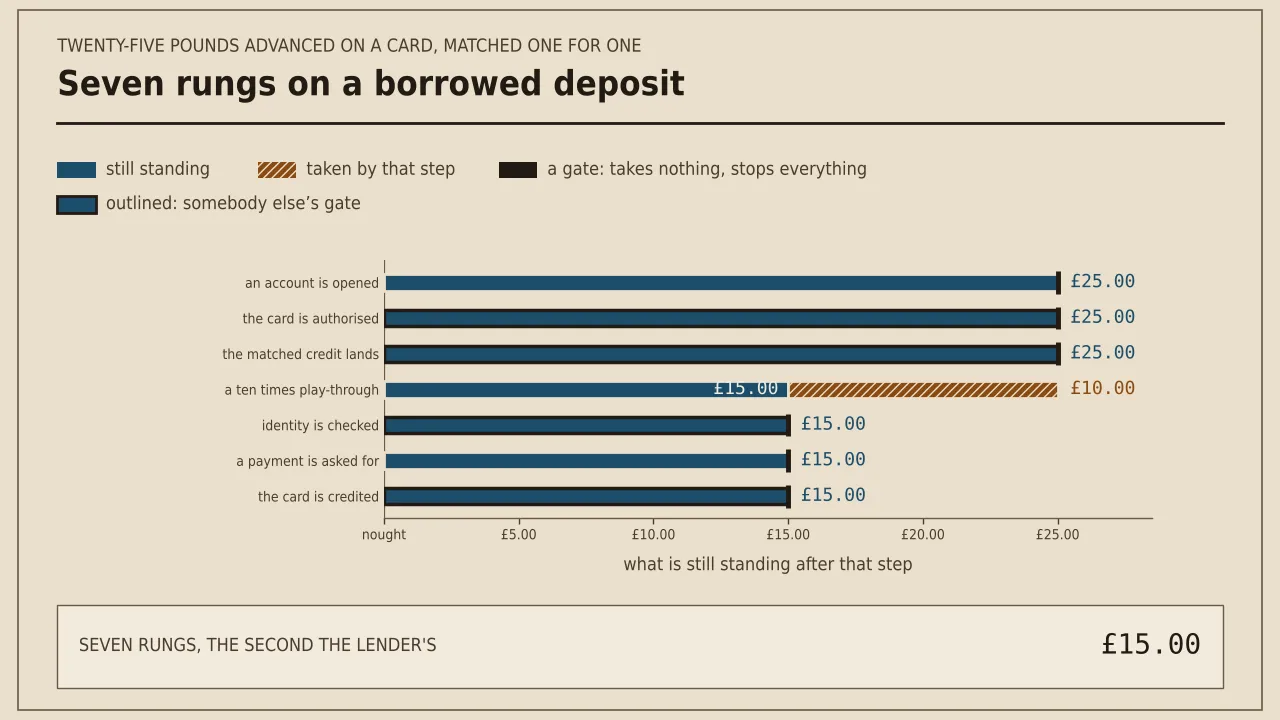
Only rung four shifts anything: £10.00 of the £25.00 goes there, and the six rungs on either side of it leave the figure alone
Keep the two counts separate. Seven is how many things can end this chain. £250.00 is how much staking one of the seven demands. The second figure is the one that costs time and the first is the one that decides whether the time was spent for anything, and a page reporting either alone would be describing half an offer.
There is an extra reason to keep the reader’s twenty-five pounds out of the column on this particular key, and it is the only place in this section where it comes up. On every other page the money paid in has left the reader’s own balance. Here it has not: it is borrowed, and it will be asked for again by somebody who is not on this ladder at all. The chain as counted runs from a promise to a payment. The debt runs on past the end of it, and no rung on this page can touch that.
So the honest reading of the third column is narrower here than elsewhere. £15.00 at the foot is what the arithmetic expects the promise to leave. It is not a gain, it is not a balance, and it says nothing about the twenty-five pounds that has to be repaid whatever happens at rungs three, five and seven.
3
Rung two, where borrowing meets a lending decision
£25.00 is standing at rung two and rung two is a lending decision. The question put is whether twenty-five pounds may be advanced to this merchant on this account, and the party answering is the bank that issued the card. It answers in a moment, without reasons, and it is the earliest point on this chain where the reader has stopped deciding things.
The party answering has read none of the offer and has no opinion on whether £25.00 of credit is worth £250.00 of staking. It has, on the other hand, read the reader’s agreement, and it is the only decider on this chain that the reader could put a question to. The test it applies at that moment is in no document available to this publisher, which is why the fourth column at rung two says so.
What rung two costs is nothing at all. A refusal leaves the reader without a debt and without a chain, which is why the third column carries £25.00 across the rung unaltered. A reader who met a refusal there is in the position they were in before they started, and that is the whole of the consequence this page will state.
Where a refusal comes from a block the lender has in place of its own, the consequence is the same and the page stops at the same place: the chain ends at rung two with nothing promised and nothing owed. No way past such a block is set out here, and no alternative instrument is suggested for a payment that has been refused. The National Gambling Helpline is printed on this page for anybody meeting a refusal at a bad moment.
Why this page stops there is worth one sentence, this key being the one where the temptation to go on would be strongest. The condition this whole guide is about exists to keep borrowed money out of gambling inside the licensed market. Treating its absence elsewhere as a convenience would be writing against the single duty the page spends four thousand words describing.
There is also a figure on the other side of rung two that no rung can carry. Twenty-five pounds advanced at rung two becomes twenty-five pounds owed, on terms set by the lender rather than by the cashier, and the £15.00 at the foot of this ladder does not repay it. The arithmetic of this site prices what a promise leaves. It does not and cannot price what a debt costs, and a reader should not read the two as cancelling each other out.
4
How wide the condition is drawn, and the words that widen it
The condition runs to two sentences and the second does the work. Having shut the front door it shuts the side one too, so an intermediary business sitting in the path of the payment does not carry it outside the condition off the rule sheet, claim 21. That second clause is why this guide reads rung two as a decision about lending rather than about plastic.
Read the two sentences together and the shape of the duty becomes clear. The British rule is not about plastic. It is about whether the money a licensee receives originated as a loan, and it closes the obvious intermediary route in the same breath. A licensee may not take borrowed money for gambling directly, and may not take it at one remove either.
That matters to the count on this page because it tells a reader what the rule was trying to prevent, and therefore what is absent at rung two of this chain. The absent thing is not a logo on a checkout page. It is a prohibition on the composition of the money, applying to the receiving business, regardless of how many companies the payment passed through on its way.
The exclusions are worth a line for what they reveal. The licences left outside are the technical, software and host ones off the rule sheet, claim 22, which belong to businesses that take no deposit from anybody. So the condition covers every British licensee that could possibly be standing at the far side of rung two, and a scope does not get more complete than that.
Set against that completeness, the state of the evidence about this chain is worth stating plainly. Nothing read for this page says what an unlicensed cashier does about borrowed money, whether it distinguishes one instrument from another, or whether anything in its own terms addresses the question. The fourth column at rungs two, three and seven therefore reads that nothing is published behind them, and that entry is the measurement rather than a gap in it.
Only one figure attaches to the condition and it is a date. Since the April of 2020 no British licensee has been able to take borrowed money for gambling off the rule sheet, claim 22. Every penny of the twenty-five pounds advanced at rung two is therefore money that no licensed business in the country could have accepted at any point in the five years since, which is the firmest thing anywhere in this section and the sentence a reader of this key should keep.
5
Who the incentive rules bind, and what that leaves at rung three
Rung three is where the £25.00 is either granted or withheld, and it is the cashier’s. Britain has a code provision about exactly that moment, and the useful thing is to see precisely how far it reaches.
Social responsibility code 5.1.1 governs any inducement a licensee puts in front of anybody, and wants its terms clear, fair and easy to find off the rule sheet, claim 57. Two of the four things it forbids outright reach this page: the multiple at rung five cannot pass ten, and products of different kinds cannot be bundled into one inducement off the rule sheet, claim 58.
Both the figure at rung four and the shape of the thing at rung three therefore come out of one provision, and both arrive as duties laid on a licensee rather than as facts about an offer. Its scope spares the technical and software licences and its page carries no commencement date off the rule sheet, claim 59. No licensee stands on this chain, which leaves rung three a decision with an advertised figure behind it and no enforceable term.
That has a consequence for the way this page prints £25.00 at rung three. The figure is what the offer says. It is not what any rule obliges, and a reader who met a smaller credit than advertised would be in a dispute about an inducement with nobody to take it to. The ladder records the advertised sum because that is the promise a chain stands in front of, and it records in the same row that nothing is published behind the rung.
One element of that provision is routinely overread, and the carve-outs are wider than the headline suggests: two products of one type may be bundled, two offers may travel together where both were opted into, and a credit that may be spent wherever the customer chooses falls outside the bundling rule entirely off the rule sheet, claim 100. None of that moves a figure on this page. It moves what a reader should expect the rule to have prevented, which is less than it sounds.
The multiple behaves the same way when the match is read as a percentage. Going from one for one to four for one leaves the ratio untouched and lifts both the credit and the staking together off the rule sheet, claim 103, so £25.00 against £250.00 is the quietest version of that relation this page could have printed.
6
The second offence, and who commits it
Twenty-five pounds advanced at rung two is the one sum on this ladder that outlives the ladder, and this part is about what that does to the reading of £15.00 at the foot of the column.
Every other key under this heading runs from a sum that has already left a reader’s balance. On this one the sum has not left anything: it has been created. A payment of twenty-five pounds reaches the cashier and an obligation of twenty-five pounds reaches the reader at the same instant, and the second of those two is settled by a party that appears on no rung of this ladder, on terms no rung of it touches.
Two sums therefore sit on this page measuring different things. £15.00 is what the promise is reckoned to leave. Twenty-five pounds is what the reader owes whatever happens at rungs three, five and seven, and the two numbers never meet: a chain stopped by a refusal at rung seven finishes with nought in hand and twenty-five pounds still owed.
What this guide cannot do is price the gap between them, and it declines for the reason it declines everything it has not read. Whatever the advance costs to carry is set in an agreement between a reader and a lender, and no such agreement is a source available to this publisher. So the ladder carries £25.00 and £15.00 and stops. A page that put a figure on the carrying cost would be inventing the most consequential number on the key.
The whole of this part goes more plainly still. On every other key under this heading, the worst case at the foot of the ladder is that a reader is back where they started. On this one the worst case is that a reader is twenty-five pounds behind where they started, and no rung of the seven can move them back. That is a difference in kind rather than in degree, and it is the reason a licence shuts the chain off at rung two.
That asymmetry is the reason this guide will not print a single figure combining the two. A combined figure would imply that the ladder and the debt are settled in the same place, and they are not: one is settled by a cashier with no licence and the other by a lender with a written agreement. Adding them would be the arithmetic of a page trying to be reassuring.
The same asymmetry explains why the finding falls at rung two rather than rung three. Rung three is the first rung at which the cashier can disappoint a reader. Rung two is the first rung at which somebody else’s decision binds the reader to something, and on this key the something is a debt rather than a hope.
| The question | Inside a Great Britain licence | On the chain counted here |
|---|---|---|
| Borrowed money at rung two | Forbidden, and forbidden at one remove as well. | The rung the chain opens on, with nothing published behind it. |
| The multiple at rung four | Ten at the most, so £250.00 would be the ceiling on £25.00. | Drawn at ten because no other figure has a source, not because one binds. |
| The check at rung five | Owed before any play, which would lift it above rung one. | Sitting at position five with £15.00 waiting behind it. |
| The terms at rung three | Clear, fair and easy to find, as a code provision requires. | An advertised figure with no enforceable term behind it. |
| The debt outside the ladder | Never created, the chain being closed off at rung two. | Twenty-five pounds, settled by a party on none of the seven rungs. |
Of the five rows, the final one repays sitting with. Four of the five questions are about what a licence would have done to a chain that exists either way. The fifth is about a thing that exists only because the chain does, and it is the only item anywhere in this section that survives the end of a ladder.
Two statutory facts belong here and are given as the whole of what this page says about the criminal side. Advertising gambling that would need a permission it does not have is an offence in itself off the rule sheet, claim 7, and the provider of unlicensed facilities faces imprisonment, a fine, or both off the rule sheet, claim 2. Both are addressed to businesses. Neither is addressed to the reader, and neither reaches the lender at rung two, whose trade is lending rather than the provision of facilities for gambling.
7
A chain that can only exist outside a licence
The gentlest figures available have been used throughout, and all of them came out of conditions that reach nobody on this chain. On this key the sentence is stronger than it is anywhere else in the section, the chain being one that a licence forbids rather than one it merely governs.
Offers of this shape are put to readers in Great Britain by cashiers without any Great Britain licence, and on this key that is not a gap in protection but the condition of the chain existing at all. Rung two is the proof. The credit card is the instrument a licensee may not accept for gambling, and the same money reaching it through an intermediary business is caught alongside off the rule sheet, claim 21, and that has been the position since the April of 2020 across every licence under which a deposit can be received off the rule sheet, claim 22. Rung four is drawn at ten because ten is the ceiling over a licensee’s multiple off the rule sheet, claim 91, so the £10.00 it takes is the kindest figure available and not one anything imposes. Rung five sits at position five because nothing requires otherwise here; a licence would have put the check ahead of play off the rule sheet, claim 10. Protection rather than liberty is what goes missing away from a licence, duty by duty off the rule sheet, claim 168, and the duty most plainly missing from this page is the one that would have stopped the chain starting.
One check stands before all seven rungs, and the advice to make it is the regulator’s own. Hold what a business says about itself against what is recorded for it on the public register off the rule sheet, claim 88. On this key the check resolves unusually cleanly, since a business carrying a licence may not offer rung two at all, so a cashier that accepts borrowed money has answered the question by accepting it.
That is as far as the evidence goes and it is further than a reader might expect. Seven rungs, four of them taking nothing, two of those four settled by parties the reader cannot direct, and £15.00 at the foot of the column with a twenty-five pound debt sitting outside the ladder that no rung on it can clear.
Seven is also worth placing beside its neighbours, since a count is only legible against another count. A deposit funded from an account the reader already holds gives seven rungs as well, so this key is not longer than the plainest version of itself. A wallet in the path makes eight, and a payment network counted as a party of its own makes eight. The borrowed chain is therefore among the shortest in this section, which is exactly the trap a count can be set to catch: short does not mean mild, and on this one key the shortness is a consequence of there being nothing in the path to slow the money down on its way in.
Two sentences close the page. Rung two is the first rung the reader does not hold, and it is held by a lender rather than by anybody with an interest in the offer, with the full £25.00 standing when it is reached. And every other rung on the chain is either arithmetic or a cashier’s, which means that from rung three onwards the only party who can stop the £15.00 arriving is the party that owes it, and the only party who will certainly be paid is the one at rung two.
Asked at the booth
- Can a licensed business in Great Britain take a credit card
- It cannot. Condition 6.1.2 shuts a licensee out of being paid for gambling on one, and shuts the same door on money arriving at one remove.
- Since when has that been the position
- Since the April of 2020, across every licence under which a customer deposit could be received.
- Which rung is the first one the reader does not hold
- Rung two, the lending decision, with the whole £25.00 of credit standing on it and nothing staked yet.
- What is £25.00 of credit reckoned to leave
- Fifteen pounds, once £250.00 has gone through a game and a ninety-six per cent return has taken its £10.00 out of the credit.
- Does the £15.00 cover what was borrowed
- No. The twenty-five pounds advanced is owed to a lender who stands on none of these rungs, and no rung here can settle it.
- Why is the ban not counted as a step
- Because nothing happens at it. A reader is either dealing with a licensee or not, and a licensee cannot offer this chain at all.
- Who does the statute address at the far end
- Whoever provides the facilities. The penalty runs to fifty-one weeks, a level five fine, or both, and six months in place of the weeks in Scotland.
- Does the register settle the question on this key
- More cleanly than on most. A licensed business may not accept borrowed money at all, so a cashier accepting it has answered already.
- Why is this chain seven rungs and not eight
- Nothing stands in the path of the money on its way in beyond the lender, and nothing new appears on its way out, so no eighth party is counted.
- What would make it eight
- A wallet in the path, a payment network counted as a party of its own, or a payout nominated somewhere other than the card the money came in on.