Terms read 26 October 2026 Counted in 2026
Bingo no deposit bonus: £4.32 standing at the fourth of six rungs
Six separate things stand between a no-deposit bingo offer and money that can be spent, and the fourth is a stranger’s decision. Seventy-five entries priced at 10p make £7.50. A prize fund paying back 96 in the hundred leaves £7.20 in an account. Ten times that, staked over, brings the figure to £4.32, and the last three rungs leave it exactly there while any one of them can take all of it.
How many steps six Join, play out the entries, clear £72.00, be verified, claim, be settled. The first gate somebody else holds the fourth Papers are read by somebody working to no published clock at all. Standing when it is reached £4.32 What the games and the condition left, resting on two later decisions.
| What has to happen | Who takes this step | What it leaves standing | Printed where |
|---|---|---|---|
| An account is opened | the reader | £7.50, or nought unopened | the offer’s own headline |
| Seventy-five entries are played | the house’s arithmetic | £7.20 | nowhere, declared here |
| £72.00 is staked over | the house’s arithmetic | £4.32 | the published British ceiling |
| Identity is checked | the cashier | £4.32, or nought unverified | a licence condition, not a term |
| A payment is asked for | the reader | £4.32, or nought unasked | the cashier’s withdrawal form |
| The cashier settles | the cashier | £4.32, or nought unpaid | nothing published behind this |
| What six rungs leave | two gates the cashier holds | £4.32 | this page |
1
Seven pounds fifty of entries, and 30p gone before anything else
Seventy-five entries are seventy-five chances at a prize fund. They become a sum of money only after two figures are named, and a headline promising entries for no deposit names neither of them: what one entry costs, and what share of the money paid in comes back out as prizes.
This page puts an entry at 10p. Nothing published prices a given round off the rule sheet, claim 89, nothing published prices a given entry either, and the figure is declared rather than read off anything. Seventy-five at 10p make £7.50, the face this chain opens at, with no part of it yet claimed by anybody.
The share coming back is put at 96 in the hundred, which is this publisher’s assumption across every page here, not a reading taken off any single game. Against £7.50 it leaves £7.20 in an account. The 30p between the two is the first deduction, and the second row of the instrument is where it sits.
Thirty pence is one part in twenty-five of the headline figure. It is also the only part of this chain that behaves the way a reader expects a game to behave: a little goes, the rest stays, and it happens without anybody deciding anything. Everything that follows is either a much larger deduction or a decision taken by somebody else.
Bingo complicates the 96 in a way that is worth stating rather than hiding. A prize fund is shared out among whoever holds entries in the same game, so what comes back to one person over seventy-five entries depends on how many others are playing and on how the prizes are divided. The 96 is an average across a long run, as it is everywhere on this site, and on bingo it is an average across other people as well as across time.
One figure worth having before the next part: £7.50 of face against £72.00 of staking is nine pounds sixty of turnover for every pound the headline names. That ratio does not depend on the 10p and it does not depend on the count. At ten times a balance worth 96 per cent of its face, the staking always comes to 9.6 times the face, so a reader can run the same multiplication over any entry count a bingo room cares to advertise.
So the arithmetic below rests on 10p an entry and 96 in the hundred coming back, and both are this page’s declarations. Change either and every sum changes with it. What does not change is the count of rungs, the identity of the party standing at each, and the fact that the single largest deduction is the one the headline leaves out.
2
Two pounds eighty-eight, which is what ten times costs here
£7.20 in an account is the sum a staking condition is measured against, and ten is the multiple used here. A multiple over ten has been barred for licensees off the rule sheet, claim 91 since 19 January 2026, and the carve-outs reach only the technical and software licences off the rule sheet, claim 93. Ten times £7.20 is £72.00 that has to be staked.
Put £7.20 in for B, ten in for W, the qualifying share at full weight. E = B × (1 − W × (1 − RTP) ∕ g) answers £4.32. A play-through is wagers totalling a stated value off the rule sheet, claim 92 before funds may leave, and that is the whole of the published definition: a size, with nothing said about pace or pieces.
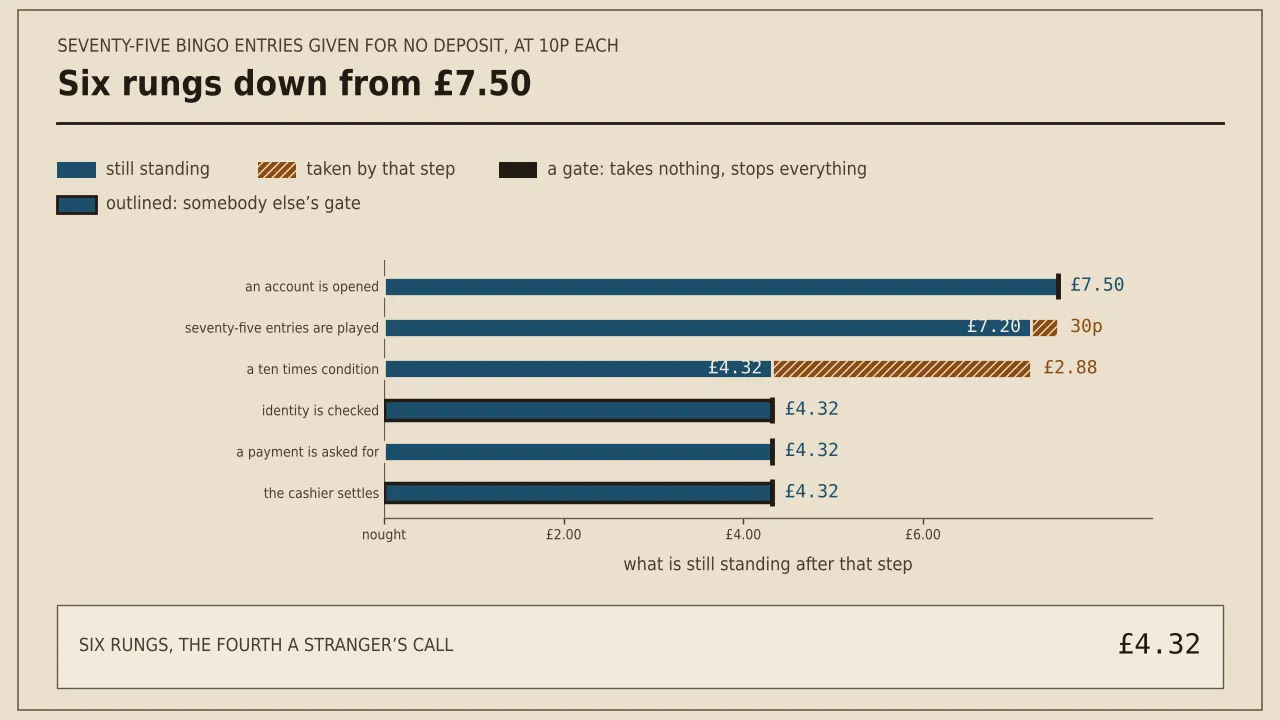
£2.88 of the £7.20 in the account goes on the staking condition, two fifths of what landed there and better than a third of the £7.50 promised
Put the two deductions next to each other and the shape is plain. The games take 30p. The condition takes £2.88. Nine and a half parts in ten of everything this chain costs goes on the third rung, and the third rung is the one a headline counting entries has no need to mention.
From the third rung down nothing further is taken. £4.32 is the figure at rung three, rung four, rung five and rung six, and the instrument shows it four times over because that is what the chain does: it drops once, hard, and then stops dropping and starts waiting on people.
£4.32 against £7.50 works out at 57.6 per cent of the promise. A reader who plays all seventy-five entries and stakes the £72.00 exactly as drawn should expect a little under three fifths of the announced figure to survive, before a single person has made a single decision about it.
One way to feel the size of £72.00 is to set it against the £7.50 that was promised. The condition asks for nine and a half times the headline figure to be staked before any of the headline can be taken out, and it asks that of a reader who deposited nothing. A reader who read seventy-five entries as seventy-five entries of play is out by seven hundred and twenty of them, and by £72.00 of staking against a face of £7.50.
Raise the multiple and the sums go the other way. At four pence lost in each pound staked, twenty-five passes over £7.20 come to the whole of it, so twenty-five times is where the expectation lands on nought. The regulator records licensees asking as much as sixty times off the rule sheet, claim 94, and sixty against £7.20 puts the same expression below nought. That is not a debt. It reports that £7.20 is not expected to last the staking out.
3
Seven hundred and twenty entries, and no clock to put on them
Divide £72.00 by a 10p entry: seven hundred and twenty of them. Add the seventy-five that were given and seven hundred and ninety-five entries stand between the headline and a request for payment. Six steps, and one of them performed seven hundred and ninety-five separate times.
The two counts are kept apart. Six is what distinguishes this chain from the one beside it. Seven hundred and ninety-five is what a reader spends an evening on. Adding them would produce a number that describes neither.
Here the second count will not turn into a time, and what stops it is a gap in the rules rather than in this page. A minimum of 2.5 seconds between cycles is written for slots off the rule sheet, claim 107. Five seconds is written for casino games other than slots off the rule sheet, claim 108. Bingo is neither of those things, and the standard states no minimum cycle for it at all.
So this guide prints no duration for seven hundred and ninety-five entries and will not estimate one. What does reach bingo is the bar on automatic play: the standard covers gaming including bingo off the rule sheet, claim 115, and each cycle needs its own commitment from whoever is playing. A reader therefore has to act seven hundred and ninety-five times, at a pace no published rule puts a floor under.
Two things follow and they pull opposite ways. A bingo game runs to a schedule rather than to a button, so the pace is set by the operator’s timetable rather than by the player, which can make seven hundred and ninety-five entries take far longer than any slots floor would imply. Equally, nothing stops a great many entries being held in one game, which could make it far shorter. No published figure settles which, and this page declines to pick one.
There is one count this page can give exactly, and it is the count of acts. Seven hundred and ninety-five commitments, each individually required, is the labour side of £4.32. Divide the surviving figure by the acts and the chain pays a little over half a penny for each commitment a reader makes. That is the arithmetic a headline about seventy-five free entries leaves out, and it is this page’s own throughout.
What the count does establish is the ratio. Seventy-five entries are in the headline and seven hundred and twenty more are in the condition, so the headline names a tenth of the entries the chain actually asks for. A reader reading seventy-five and expecting seventy-five is out by a factor of better than ten.
The instrument carries one row for £72.00 rather than seven hundred and twenty rows. One requirement is what the condition is, with a quantity set it. The quantity goes in a paragraph that counts it, and a ladder of seven hundred rows would be a ladder of rounds rather than of conditions.
4
The fourth rung, where £4.32 changes hands or does not
£4.32 arrives at the fourth rung intact. An identity check stands there and takes nothing: it passes the whole sum or none of it. Where such a check may sit in a chain has a British answer, and the position outside the licence is unpublished rather than different.
A licensee identifies a customer first off the rule sheet, claim 10, with incentive play inside the duty off the rule sheet, claim 18 and the practice builds beside it. A licensed bingo room could not have handed seventy-five entries to anybody it had not identified, so on a licensed chain the rung would have come before rung one.
The same condition closes the far end. A licensee may not spring paperwork at the exit off the rule sheet, claim 11. Put to players, that reads as checks belonging at the start rather than at the payout off the rule sheet, claim 15, and holding a payment back for want of them may breach it off the rule sheet, claim 16.
Away from the licence nothing fixes the rung at all. Nothing read here says at what point such a cashier asks, what satisfies it, or how many days £4.32 sits unpaid. Blocked payouts and unreachable ceilings are what the regulator records off the rule sheet, claim 135, alongside unfair play, lost money and no route to a complaint off the rule sheet, claim 134.
The sixth rung is the same decision taken again with the papers already in hand, and the fifth belongs to the reader, who may ask at leisure. So of the six rungs, two belong to a party nobody on this side can press, and £4.32 is the sum standing at the first of those two. Nothing on this chain pays part of £4.32. It is paid or it is not.
A reader who wanted one sentence out of this part could have it in figures alone. £4.32 is the sum; two of six rungs decide it; nothing published says when either will be reached or what either will ask for. Everything else on this page is working towards that sentence, and the sentence is the thing no other site on these keys prints.
That is why the second rung is not reported as the finding, although a reader controls a prize fund no more than a reel. The 30p the games take is arithmetic working through, and arithmetic is not a party weighing a request. The fourth rung is somebody weighing a request, and the figure standing when they begin is £4.32.
5
What a return even means when the game is bingo
The 96 in the hundred that turned £7.50 into £7.20 is the load-bearing assumption on this page, and the fair question is what could be checked against it at all. On bingo the published answer is thin, and the weakness is specific rather than general.
The standard is met by any one of four permitted answers off the rule sheet, claim 120, joined by or and not by and. Only one of the four is a percentage, so a licensed room can satisfy the rule and print no figure. On bingo the guidance goes one step further. A description of prize allocation satisfies the standard off the rule sheet, claim 121, so a licensed bingo room may publish no percentage of any kind and still comply.
Which means the 96 on this page cannot be verified against a bingo game even where the operator is licensed, because nothing obliges one to state a figure of that shape. This guide uses it because the method needs a number and because the network uses one figure everywhere, and it says plainly that the number is not a reading.
What a licensed bingo player is owed instead is the rules, reachable before committing and sufficient to cover all of them off the rule sheet, claim 122, and content about the prizes or how they are worked out off the rule sheet, claim 123. Those duties reach gaming including bingo. They are duties about description rather than about value, and a reader who wants the value has to compute it, which is what this page has done with a declared figure.
Two further duties bear on whether a stated return would mean anything. Results have to come out acceptably random, and a compensated build is barred off the rule sheet, claim 117. Nor may the rules, the payouts or the odds shift while a game is running off the rule sheet, claim 118. Those are what make an average over a long run a meaningful quantity at all.
One consequence is worth drawing out because it bears on the £7.20 rather than on the 96. If the share returned is lower than 96 in the hundred, the figure landing in the account is lower, the condition then takes two fifths of a smaller sum, and £4.32 falls on both counts at once. At 90 in the hundred the account would see £6.75 and the chain would close at £4.05. The assumption is doing more work than its single appearance suggests, which is why it is labelled wherever it is used.
Not one of those duties reaches the operator behind seventy-five no-deposit entries, which is the point of listing them here. The 96 is this page’s declaration; the machinery that would make a declared return trustworthy is British; and the chain being counted is not.
6
Four silences, and what each would do to £4.32
£4.32 is what one published ceiling and two declared figures leave. A further four bear on it that nothing published settles. Each carries the figure it would have moved.
First, the price of an entry. No rule says what a free round is worth off the rule sheet, claim 89, nothing says what a free entry is worth either, and the 10p is this page’s. Second, whether what a given entry wins counts as bonus funds for the ceiling. The boundary has never been drawn in either direction off the rule sheet, claim 90, so the third row above is labelled as a ceiling carried across rather than a term somebody printed.
Third, weighting, and this one carries sums. A game counting at thirty per cent was the rate respondents quoted off the rule sheet, claim 96, and weighting came through the consultation untouched off the rule sheet, claim 97. At that rate the £72.00 of credit this condition needs would sit behind £240.00 of staking, which is two thousand four hundred entries at 10p against seven hundred and twenty. Nothing in the published rules says how a bingo entry counts towards a condition at all, so £72.00 is the smallest honest figure and anything a cashier publishes can only raise it.
Fourth, a ceiling over what the entries may win. Nothing published sets a maximum win on bonus funds off the rule sheet, claim 105, and the withdrawal rule guards a deposit balance and says nothing of bonus winnings off the rule sheet, claim 34, so the two can hold at once of one account. No figure means no rung, and £4.32 is where the arithmetic lands rather than a sum promised by anybody.
Set beside those four is the one clause with money behind it. One operator was fined over wording that reserved a discretion off the rule sheet, claim 83 to shut accounts or strip winnings, in a penalty dated 3 July 2025, and with fair and open dealing as the condition breached off the rule sheet, claim 84. No source calls such a term void off the rule sheet, claim 86. A clause of that shape over this chain changes no figure on the ladder and can finish the chain at any rung on it.
Two rungs are left off on purpose. Time limits belong among the conditions a promotion has to show off the rule sheet, claim 62, and so does a wagering requirement, but no figure for a deadline was read here and the ladder carries nothing it cannot price. The same goes for a minimum payout. Found stated against a real offer, each would be a rung that holds £4.32 level and can stop it.
7
£4.32, and the ceilings that do not reach a bingo entry
Every figure above is the kindest reading available, and the kindness comes from one place. The duties that supplied it are conditions of a British licence, and the operator behind seventy-five no-deposit entries holds no Great Britain licence.
Nobody fronting seventy-five given entries to a British reader is licensed in Great Britain. Set three duties of such a licence against the rungs above. The first is the one that does not apply even inside the licence, and it matters here: the stake ceilings are slots rules and reach nothing else off the rule sheet, claim 127, so a licensed bingo entry has no published ceiling on its price and neither does the 10p assumed on this page. The second is automatic play, which is barred on gaming including bingo off the rule sheet, claim 115, so seven hundred and ninety-five separate commitments is what a licensed room would require and nothing requires it of this one. The third is the exclusion scheme. Gamstop membership is compulsory for British licensees off the rule sheet, claim 181, and the scheme cannot reach an operator that is not a member of it off the rule sheet, claim 183. Registration reaches the licensed market and stops there. Anybody holding one should take that as the consequence it procedure, and no procedure of any kind appears on this site.
A fourth duty lands on the last two rungs instead of on £4.32. A licensed complaint is acknowledged quickly off the rule sheet, claim 38, closed inside eight weeks off the rule sheet, claim 39, accepted for six months from the incident off the rule sheet, claim 40, and finished by naming an approved adjudicator off the rule sheet, claim 42 from a list the regulator itself approves off the rule sheet, claim 43. Sector coverage on that list differs, and not every approved body is listed for remote bingo off the rule sheet, claim 44.
Even inside the licence the route for £4.32 ends at an adjudicator rather than at the regulator, whose own published account of itself is that the ombudsman role is not its own off the rule sheet, claim 46. Outside the licence no source read for this page describes a route at all, which is why the sixth row of the instrument reads that nothing is published behind it.
Set against all of that is one fact in the other direction, and leaving it out would bend the page. Nothing in the statute makes a customer the offender, and £4.32 is not forfeit for having been promised by an unlicensed room. What is missing is the apparatus that would have told a reader when the fourth rung happens and what it wants, and the measure of that absence is the figure resting on it.
The offence belongs to whoever provides the facilities off the rule sheet, claim 3, and no answering offence was written into the statute for a customer. What a reader gives up beyond the licence is cover and not permission. Six rungs, the fourth of them settled by somebody else, and £4.32 of a £7.50 headline hanging on it, and on the rung after next.
Asked at the booth
- What are seventy-five given entries worth
- At 10p an entry the face is £7.50. A prize fund returning 96 in the hundred leaves £7.20, and a ten times condition leaves £4.32 of that.
- How many things have to happen before it is money
- Six. Joining, playing the entries out, clearing £72.00, verification, a claim, a settlement by the room. Only the middle two take anything.
- Which rung carries the finding
- The fourth. £4.32 is standing when identity is checked, and that is the first rung on the chain whose outcome a stranger decides.
- How long does £72.00 of staking take
- No published figure answers that for bingo. The 2.5 second minimum is a slots rule and the five second one covers other casino games, so neither reaches an entry.
- Can the 96 in the hundred be checked against a bingo game
- Not reliably. A description of how prizes are allocated satisfies the standard, so a licensed room need publish no percentage at all.
- Why is there no rung for a maximum win
- Because no published source sets one on bonus funds. A rung carrying no figure would be ornament, so the ladder leaves it off and says so.
- Does a stake ceiling apply to a bingo entry
- No. Those ceilings of £5 and £2 are written for online slots alone, so the 10p on this page answers to no published limit.
- Does anybody hold a Great Britain licence for this
- No. Three duties of one were set against £4.32 above: the slots-only stake ceilings, the bar on automatic play, and compulsory membership of the exclusion scheme.