Terms read 26 October 2026 Counted in 2026
Striking the turnover out takes one rung off seven, and the three that decide anything are untouched
Nought times nothing is still a chain of six. Two hundred rounds at the ten pence assumed here carry £20.00 of face, the deposit behind them is £10.00 of a reader’s own, and with the staking condition removed the only subtraction left is the 80p the reels take. £29.20 reaches the fourth rung, where somebody on the other side of the counter decides what happens to it. Removing the condition was worth £7.68. It removed no decisions at all.
How many steps six Account, deposit, two hundred rounds, a check, a request, and a settlement. The first gate somebody else holds the fourth The counter weighs documents at a speed and on terms it sets for itself. Standing when it is reached £29.20 Ten pounds the reader brought, and £19.20 the rounds are expected to produce.
| What has to happen | Who takes this step | What it leaves standing | Printed where |
|---|---|---|---|
| An account is opened | the reader | £30.00, or nought unopened | the headline, and a reader’s pocket |
| £10.00 of the reader’s own goes in | the reader | £30.00, or nought withheld | the deposit figure in the headline |
| Two hundred rounds turn | the house’s arithmetic | £29.20 | nowhere, assumed by this publisher |
| Identity is checked | the cashier | £29.20, or nought unverified | a licence condition Britain imposes |
| A payment is asked for | the reader | £29.20, or nought unasked | the cashier’s own withdrawal form |
| The cashier settles | the cashier | £29.20, or nought unpaid | nothing published behind this rung |
| What six steps leave | two of them the cashier’s | £29.20 | this page |
1
What striking out a turnover actually removes
The last four words of this key are the reason somebody searched for it, and they describe the removal of exactly one thing. A staking condition is one rung on a chain. Take it away and the chain is six rungs long rather than seven. Every other rung stays precisely where it was.
That is worth stating at the top because the natural reading runs the other way. A promise that nothing has to be wagered sounds like a promise that nothing stands in the way, and those are two different claims entirely. One of them is about a condition. The other is about a chain, and a chain of six is not a chain of one.
Here is what the removal is worth in money, which is the only honest way to size it. Two hundred rounds at ten pence produce £19.20 of credit on this page’s assumed return. Drawn at the highest multiple any licensee here may ask for, a staking condition would have taken two fifths of that, which is £7.68, and left £11.52. With the condition struck out the whole £19.20 survives. So the four words at the end of this key are worth £7.68 on these figures, and that is a real number and a substantial one.
Here is what the removal is worth in decisions, which is the figure this site exists to print and the one no headline gives. Before: seven rungs, of which two belonged to the counter. After: six rungs, of which two belong to the counter. The rung that went was the house working a sum through. Not one of the points at which somebody else gets to say no has moved, disappeared or softened.
A reader who takes away one sentence from this page should take away that pairing. Removing the condition improved the money by £7.68 and improved the reader’s position by nothing at all.
Time is where the removal shows up most, and it is the one dimension on which this key is unambiguously better than its neighbours. Two hundred rounds are all the pressing this chain requires, because no further rounds have to be turned to discharge anything. Licensed cycles carry a floor of 2.5 seconds apiece, timed from one start to the next, which puts two hundred rounds at five hundred seconds or more. Eight minutes and twenty seconds is the shortest sitting this chain could be walked in.
Put a staking condition back on and the same chain asks for £192.00 of wagering, which at the assumed stake is a further one thousand nine hundred and twenty rounds. Two thousand one hundred and twenty rounds at the same floor come to five thousand three hundred seconds, or an hour and twenty-eight minutes. So the four words at the end of this key are worth £7.68 in money and about an hour and twenty minutes in time, both of them real, and nought in decisions, which is the figure no headline prints.
There is a per-pound reading of the same thing worth putting beside it. £19.20 of expected survivor against a ten pound deposit is £1.92 returned for every pound a reader produced. With a condition attached that figure would be £1.152. The improvement is a real sixty-seven per cent, it is entirely in the money, and it leaves both of the rungs the counter settles for itself precisely where they stood. What is standing at the fourth rung is now larger, which means there is more riding on a decision nobody on this side of the counter makes, and that is the only sense in which this offer is riskier than the one it is advertised against.
2
Thirty pounds at the head, a third of it money
Two numbers open the arrangement and only one is money. Ten pounds sit in a reader’s account before anything happens. Two hundred rounds count events nobody has caused yet, and turning them into money takes two further figures, and nobody publishes either one.
What a round stakes is the first. Nothing anywhere states what sets a round’s cash value, whose decision it is, or what has to be disclosed about it off the rule sheet, claim 89, which leaves ten pence as a declaration this page makes and labels as one. Two hundred rounds at that figure carry £20.00 of face.
What a reel hands back is the second. The figure used here is 96 per cent, said about reels in general and across a long enough stretch of play. Nothing in British licensing would have supplied it. The duty to let somebody weigh their chances before committing is met by any one of four separate items, which the standard divides with the word or. Any of these will do: an explanation of the way the game runs and of how prizes are allocated, a house edge, a figure for the share of stakes a game gives up, or the odds attaching to a winning event off the rule sheet, claim 120. Publishing any one of the four discharges it, which leaves a licensed site free to put up no percentage whatever off the rule sheet, claim 121.
Put the two together and the ladder opens at £30.00, of which a third is a bank balance and two thirds are a promise about two hundred future events. The column holds both, their fates being different and both worth watching, which is why chains counted under this heading start one rung higher than the rest of the site’s: a deposit is the only money in the chain that belonged to somebody before an offer did.
Two to one is the ratio of promised face to required deposit on this key, and that ratio is the comparison worth carrying between offers. Comparing counts of rounds leads nowhere, nothing having fixed what one is worth, so two headlines quoting the same count can mean quite different money. Face against deposit can be, since both are in pounds and one of them is a figure a reader can verify by looking at their own account.
3
Eighty pence, and the only place it comes off
Two hundred rounds at ten pence apiece send £20.00 across a reel, from which the assumed return leaves £19.20. The missing 80p is the one subtraction anywhere on this ladder, and the rung that caused it carries it.
The deposit meets nothing of the kind. A count of rounds yields credit only after the rounds are played, which is why the count meets the stake first and the product then meets the return. A deposit lands as a balance already. Applying a return to it too would bill ten pounds for a game that did not take place, leaving this page to report a subtraction that nothing whatever had produced.
That puts £29.20 at the third rung, made up of two sums whose behaviour diverges from there on: £19.20 the rounds produced and £10.00 that came in from outside. Nobody decided the 80p either. An assumed return of 96 per cent produces exactly that and would have produced it regardless of what anybody wanted.
Measured against the ten pounds the reader found, that 80p comes to eight per cent; measured against the face it comes to four. Both proportions are small, and their smallness is the point of this page. On a chain with a staking condition the arithmetic is the headline event. Here the arithmetic is almost nothing, which leaves the decisions holding the entire weight of what happens next.
4
The three rungs that are left, and what each can cost
Below the rounds sit three rungs, none of which moves the figure, and any one of which can stop all of it. That is the arithmetic a reader should hold against the four words at the end of this key.
Two of the three belong to the reader, in the sense that they happen when the reader elects and will wait indefinitely: opening the account, which sits at the top, and asking to be paid, which sits at the fifth rung. The other two are the counter’s, and the earlier of them is the fourth rung, where identity is checked. £29.20 is standing when it arrives, and that is this guide’s finding.
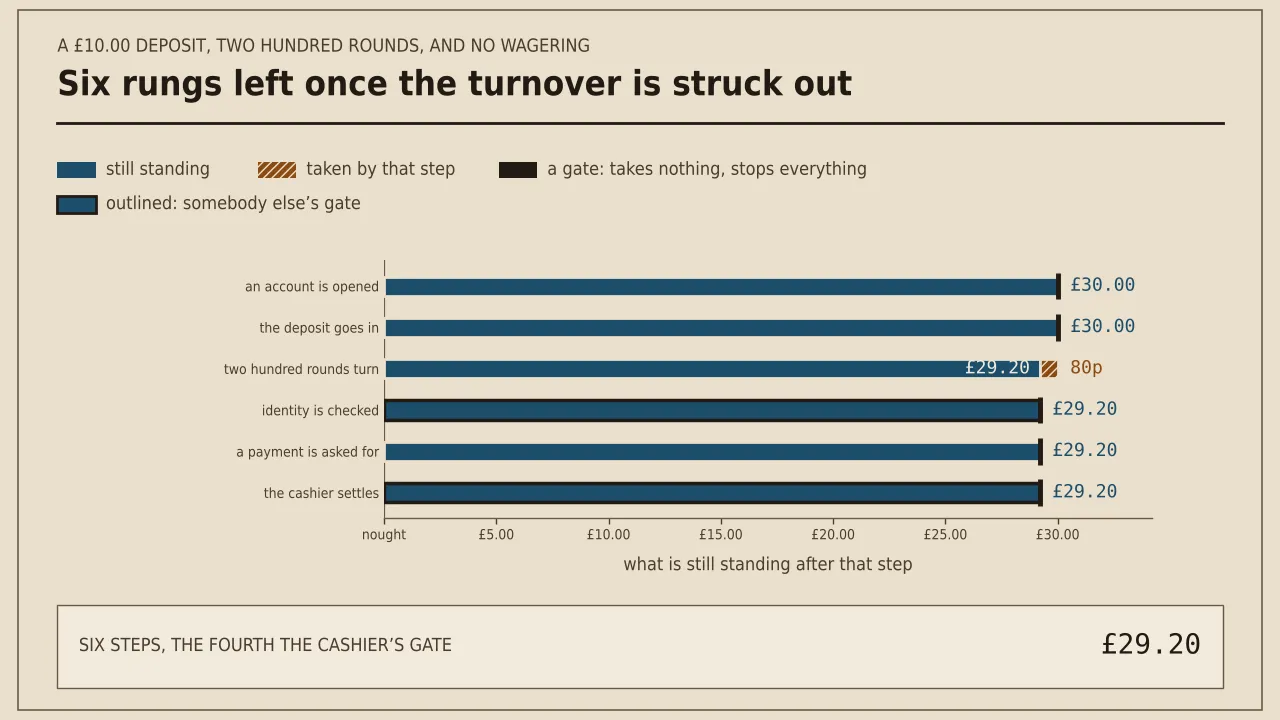
The arithmetic on this chain removes 80p in all, while each of the last three rungs is capable of stopping the entire £29.20, which is thirty-six times as much
Set the two kinds of rung against each other in figures and the shape of this offer is plain. Across six rungs the sums take 80p. Any one of the last three can take £29.20, which includes the ten pounds that were never the offer’s to give. The ratio between what the arithmetic costs and what a single decision can cost is thirty-six to one, and striking out the staking condition made that ratio worse rather than better, having left a larger sum standing in front of decisions that did not change.
One more comparison belongs on this page, being the comparison a reader will want most and the one a headline makes hardest to see. Set this key against the version of itself that keeps a staking condition and promises half as many rounds again. That chain offers three hundred rounds, runs to seven rungs, and is expected to leave £27.28 at its fifth. This one offers two hundred, runs to six, and leaves £29.20 at its fourth. The shorter chain with the smaller headline closes higher. Counting rounds alone would have got that the wrong way round, and counting rungs and money together gets it right.
Which is as close as this site comes to a recommendation, and it is not one. It is a statement about what is measurable. Two headlines can be compared on the count of their rungs, on how many of those rungs somebody else settles, and on what is standing when the first of those is reached. They cannot be compared on the size of the number in the advertising, because that number is the one quantity in the arrangement that nobody has defined.
There is a reading of this that cuts the other way and belongs on the page. A chain of six is genuinely shorter than a chain of seven, the credit genuinely survives whole, and a reader who clears the chain ends with more. Nothing here says otherwise. What the page says is narrower: the improvement is entirely in the money and none of it is in the control, and a headline describing the improvement does not distinguish between the two.
5
Four things the phrase does not settle
A promise that nothing has to be wagered is a statement about one condition. Four other things that would each move a figure on this ladder are left exactly where they were, and none of them is settled by the words at the end of this key.
First is the worth of a round, already dealt with above. Second is the question of what the winnings off a round become on arrival. If they arrive as bonus funds, a staking condition attaching to those funds is capped at ten times for a licensee; whether a round is bonus funds of itself has gone unstated in either direction off the rule sheet, claim 90. A chain with no condition on it does not need that answer, which is the one genuine simplification this key buys.
The third is what a condition would even mean if one existed, and it is worth having because it is the thing being removed. Satisfying a condition of this sort takes wagers adding up to a stated value, and only then do the funds turn withdrawable off the rule sheet, claim 92. The same code provision that caps the multiple also bars a licensee from bundling several kinds of gambling product into one incentive, from reducing the value of an incentive where its qualifying activity was completed early, and from offering travel or accommodation on terms tied to expected gambling off the rule sheet, claim 58. Striking out the wagering leaves the other three limbs untouched, and none of them reaches a counter outside the licence anyway.
Fourth is a limit on how far the credit may run, and nobody has published a standard figure for one off the rule sheet, claim 105. This is where the four words at the end of the key stop helping. A cap on winnings and a wagering condition are different terms doing different work, and removing one says nothing whatever about the other. £29.20 at the foot of this ladder is where the arithmetic stops, not a sum anybody has undertaken to pay.
And whether a condition of that sort could reach a deposit as well is unpublished in any case off the rule sheet, claim 104. On this key the question is moot, there being no condition, and saying so plainly is worth the line, this being the single silence under the heading that those four words genuinely do close.
6
What has to be said about an offer, and where
Four words at the end of a key are an advertising claim before they are anything else, so what the rules require of such claims is worth setting against them. None of it binds a counter without a British licence, and all of it describes what a reader has a right to expect in the market the rules do reach.
Underneath sits the base duty, which is that every applicable significant condition gets communicated clearly and prominently wherever its absence would be likely to mislead off the rule sheet, claim 61. Four kinds of thing count as significant on the published list for a gambling promotion, and two of the four are rungs here: eligibility; deposit and wagering requirements; time limits on claiming or using the thing; and minimum odds or bet types off the rule sheet, claim 62. The second rung of this chain is a deposit requirement, and it is the first instruction the headline gives.
Where the terms have to sit is specified too. Significant terms want displaying prominently inside the advertisement, and they belong beside the headline offer wherever the landing and sign-up pages are, and an advertisement whose significant conditions fall short of that is to be seen as misleading off the rule sheet, claim 79. Online, the expectation is that whoever sees an advertisement can reach its full terms in roughly a single click, with no hiding of the link in a footer or in small print off the rule sheet, claim 63.
Three published rulings show what a failure looks like in practice, and together they map the shapes. A free bet carried a deadline for replying that the advertisement never mentioned, and the omitted deadline counted as a significant condition likely to mislead off the rule sheet, claim 65. Small print among the full terms was where an offer put the payment method it excluded, and the condition was considered to lack prominence off the rule sheet, claim 66. And a voucher that was not valid on a particular day did not say so, which the advertising regulator treated as a breach of its code in terms off the rule sheet, claim 67.
One further rule bears on a headline this generous. Proportionality is expected of inducements and rewards, weighed against how much money and how much time have already gone in, promotions should not escalate as spending rises, and a promotion should not encourage repetitive participation or spending beyond what somebody can afford to lose off the rule sheet, claim 69. A one-off reward after fifty pounds of wagering is what the regulator holds up as potentially acceptable, and it arrives hedged by a condition rather than standing as a safe harbour off the rule sheet, claim 70.
7
What stands behind £29.20 if the fourth rung goes against a reader
Everything on this page has been leading to one question, which is what happens if the decision at the fourth rung is no. Where a British licence exists, a published process answers it. Outside it, the answer is whatever the counter has chosen to write down.
The licensed process has a clock on it. Acknowledging a complaint is bounded at three working days, falling to a single day where the operator runs gambling at all hours off the rule sheet, claim 38. The whole of it, escalation included, has to finish inside eight weeks of the complaint arriving off the rule sheet, claim 39, and complaints have to be accepted for at least six months from the incident off the rule sheet, claim 40. Seven days of silence following a reasonable request for information may make it reasonable to stop that clock, which then restarts where it halted as soon as the customer replies off the rule sheet, claim 41.
It also has an ending, and the ending is not the regulator. Whatever letter closes the matter has to give reasons, say in terms that the operator has gone as far as it goes, and point the way on to an adjudicator that decides independently off the rule sheet, claim 42. Approval by the regulator is a precondition of using any such entity off the rule sheet, claim 43, and the published list is not uniform across sectors: several are listed for remote gambling of all kinds while at least one is listed only for premises-based sectors and is not listed for remote casino at all off the rule sheet, claim 44.
The regulator is explicit about its own limits. It describes itself as no ombudsman at all. Settling a gambling dispute lies outside its powers, so does getting anybody their money back, and it has no access to an account that would let it work out what went on off the rule sheet, claim 46. Going to the operator first is what it directs a player to do instead off the rule sheet, claim 47. Even inside the licence, then, the road stops at an approved adjudicator and not at the regulator. Outside it, this page describes no road at all, because nothing read for it describes one.
Held against £29.20, that matters more here than on a chain with a staking condition, and for a reason worth printing. Where a condition takes two fifths of the credit before anybody decides anything, less money is standing at the decision. Here nothing was taken, so the whole sum, deposit included, arrives at the fourth rung intact. The four words at the end of this key put more money in front of the same unprotected decision.
8
The duty this offer has already given up, and the three it never had
There is an irony in costing a licence against this key, and it is worth naming rather than stepping round. The duty that bites hardest on every other offer under this heading is the ceiling over a staking condition, and on this key there is no staking condition for it to bite on. The offer has given away the thing the rule protects against. What it has not given away is everything else the rule sits beside.
Readers here are offered two hundred rounds on a ten pound deposit, wagering struck out, by counters holding no Great Britain licence. The ceiling on a staking condition, which runs to ten times bonus funds for a licensee and dates from the nineteenth day of January 2026 off the rule sheet, claim 91, is worth nothing at all on this chain, because the condition it limits has already been struck out. Three other duties are worth a great deal and none of them arrives. Identity is the first: a licensed counter settles three published items before anybody gambles off the rule sheet, claim 10 and tells the customer what may be wanted before a deposit may be taken off the rule sheet, claim 12, which would have lifted the fourth rung clear of the second and left a registration waiting on it instead of £29.20. Withdrawal is the second: no licensed term may fix a maximum on what a consumer takes back out of a deposit balance off the rule sheet, claim 34, so the ten pounds a reader brought would come back whenever asked for. Self-exclusion is the third: being part of Gamstop is compulsory for online gambling companies licensed here off the rule sheet, claim 181, and the scheme’s own terms concede an inability to keep anybody away from gambling run by organisations that stay outside it off the rule sheet, claim 183. Somebody registered with the scheme is owed that as a plain consequence, and no route around any of the four is described anywhere on this site.
What the regulator says about the market outside the licence is worth carrying rather than compressing into an adjective. Going without age verification, without tools for gambling responsibly and without secure payment systems is what the regulator records unlicensed sites as frequently doing, leaving consumers facing a higher chance of unfair practice, of money lost, and of nowhere to go when things turn out badly off the rule sheet, claim 134. Two specific withdrawal failures get named: payouts blocked outright, and ceilings on taking money out set at heights that are never attained off the rule sheet, claim 135.
Equally worth having is what the regulator says about the limits of its own reach. Claim the unlicensed market is being closed down and a page overstates matters one way; call it untouched and the page overstates them the other. Given the revenue involved, fully dismantling it is described as unlikely ever to happen; assessing traffic across the sites it targeted showed a fall of 32 per cent; and it describes the illegal market as increasingly sophisticated, digitally driven and global in its scale off the rule sheet, claim 136.
A correction belongs at the end. Unlicensed supply of gambling facilities is where the offence lies, the supplier is who commits it, and nothing in the Act makes being on the receiving end an offence at all off the rule sheet, claim 3. Cover rather than permission is what goes missing, and this guide has counted the cover rather than announcing it: an identity check standing above the money, no term permitted to hold down a withdrawal from a deposit balance, a complaints timetable with a clock on it and an approved adjudicator waiting at its end, and an exclusion scheme nobody licensed may opt out of off the rule sheet, claim 168. Six steps, the fourth decided on the other side of a counter, £29.20 waiting on it, and ten of those pounds a sum no offer ever handed over.
Asked at the booth
- With the turnover gone, how many steps remain
- Six. Account, deposit, two hundred rounds turning, the identity check, the request, and whatever answer the counter gives it.
- What is removing the wagering actually worth
- £7.68 on these figures. Drawn at the highest licensed multiple, a condition takes that much out of the £19.20 the rounds produce.
- How many decisions does removing it remove
- None. Two rungs belonged to the counter before and two belong to it afterwards, and the one that went was arithmetic rather than anybody’s judgement.
- Which rung does the counter settle first
- The fourth, where identity is checked, with £29.20 standing on it and ten pounds of that figure brought in by the reader.
- Does no wagering mean there is no cap on winnings
- It settles nothing about one. Nothing published anywhere sets a standard roof over the winnings a bonus may produce, and removing a wagering condition says nothing at all about a different term.
- How much does the arithmetic take across the whole chain
- 80p, which is the reels taking their share of the two hundred rounds. Each of the three rungs after it can take £29.20.
- Who chose the stake and the return on this page
- This publisher did, and says so at every point they are spent. Nobody publishes either figure, which leaves declaration or silence.
- Would a Great Britain licence have changed this offer
- The ceiling on wagering would have been worth nothing, there being no wagering. An identity check above the deposit, an uncapped deposit balance and the exclusion scheme would all have been worth a great deal.