Terms read 26 October 2026 Counted in 2026
The shortest deposit chain counted here is still six rungs, and two of them belong to the counter
A hundred rounds at the ten pence assumed throughout are worth £10.00 of face, and the price of admission is £5.00 of a reader’s own money. With no wagering attached, the single subtraction anywhere on the chain is the 40p the reels take, which leaves £14.60 at the fourth rung waiting on a decision made across the counter. This is the shortest chain under this heading that still has a deposit in it, and it is the one where the offer gives up most: £9.60 of the closing figure came from the rounds and £5.00 came from the reader.
How many steps six Account, deposit, a hundred rounds, a check, a request, and an answer. The first gate somebody else holds the fourth Papers cross a counter and come back when whoever holds them decides. Standing when it is reached £14.60 Five pounds of a reader’s own, and £9.60 the rounds are expected to make.
| What has to happen | Who takes this step | What it leaves standing | Printed where |
|---|---|---|---|
| An account is opened | the reader | £15.00, or nought unopened | the headline, and a reader’s pocket |
| £5.00 of the reader’s own goes in | the reader | £15.00, or nought withheld | the deposit figure in the headline |
| A hundred rounds turn | the house’s arithmetic | £14.60 | nowhere, assumed by this publisher |
| Identity is checked | the cashier | £14.60, or nought unverified | a licence condition Britain imposes |
| A payment is asked for | the reader | £14.60, or nought unasked | the cashier’s own withdrawal form |
| The cashier settles | the cashier | £14.60, or nought unpaid | nothing published behind this rung |
| What six steps leave | two of them the cashier’s | £14.60 | this page |
1
Fifteen pounds to begin with, a third of them already somebody’s
Two sums open this arrangement. Five pounds are sitting in an account before anything happens, and a hundred rounds are a count of things nobody has done yet. The first is money in every sense. The second becomes money only once two figures are settled that nobody publishes.
What one round stakes is the first of those. Nothing anywhere fixes it, states whose decision it is, or says what a customer is entitled to be told about it off the rule sheet, claim 89, so ten pence is a declaration this page makes openly. A hundred rounds at that stake come to £10.00 of face.
What a reel returns is the second, taken here as 96 per cent over a long enough stretch and said about reels in general. Nothing in licensing would have supplied it either. Before anybody commits, enough has to be within easy reach for them to weigh what their chances are, and four items each discharge that, the standard dividing them with the word or. An account of how a game operates and of the way its prizes fall will serve; or a house edge; or a return figure; or the probability of winning events arising off the rule sheet, claim 120. Publishing any one of them is compliance, so a licensed site may print no percentage anywhere off the rule sheet, claim 121.
Together those put £15.00 at the top of the ladder, a third of it a bank balance and two thirds a promise about a hundred future events. The column carries both, since what happens to each differs and a reader needs to watch each, and it is why every chain filed beneath this heading opens a rung sooner than the rest of the site does.
Promised face stands at two to one against the required deposit, which is about the only property of two competing headlines anybody can genuinely weigh. Counts of rounds will not compare, nothing having settled what a round is worth. Pounds against pounds will, and one side of the comparison is a figure anybody can check against their own bank.
2
Why the lower closing figure is the more generous arrangement
There is a comparison this page can draw that no other guide under this heading can, and it reverses what the figures look like at first glance. Set this key beside the one that pairs a ten pound deposit with the same hundred rounds and keeps a staking condition on them.
That chain closes at £15.76 and this one closes at £14.60, so the other looks better by £1.16. Now split each closing figure into the part the reader brought and the part the offer produced. On the other key, £10.00 was the reader’s and £5.76 came from the rounds. Here, £5.00 is the reader’s and £9.60 came from the rounds. What this arrangement is expected to produce, from an identical hundred rounds, is two thirds more than the other one produces, and it closes lower while doing so.
Both halves of that are worth stating because a reader is likely to see only one of them. The lower closing figure is real: there is less money in the account at the end. The larger yield is also real: the arrangement handed over more. The difference between the two readings is entirely the deposit, and the deposit is the one part of the figure that was never anybody’s gift.
The arithmetic behind it is short. A hundred rounds produce £9.60 of credit on this page’s assumptions. A staking condition drawn at the highest multiple any licensee may ask would take two fifths of that, which is £3.84, leaving £5.76. With the condition struck out, the whole £9.60 survives. Halving the deposit at the same time takes £5.00 off the top. £9.60 minus nothing plus £5.00 is £14.60; £5.76 plus £10.00 is £15.76.
The useful lesson is not which of the two is better, because that depends on what a reader has and what they want. It is that the closing figure on a deposit chain mixes two quite different kinds of money, and comparing two offers on it without splitting them produces an answer that is exactly backwards about which arrangement is more generous.
Reduce the same comparison to a single round and it gets sharper still. Take the expected survivor and share it across the rounds that made it, and one round here comes to 9.6 pence. On the key that keeps a staking condition, the same round is worth 5.76 pence. Identical rounds, identical stake, identical return, and two figures that differ by two thirds, with the whole difference accounted for by one condition that is present on one page and absent on this one.
Per pound of deposit the gap is wider again, because the deposits differ as well. £9.60 of survivor on five pounds down is £1.92 for each pound a reader produced. £5.76 on ten pounds down is 57.6 pence. More than three times as much comes back per pound committed, which is the figure a reader comparing two headlines would most want and the one neither headline supplies.
None of that survives a change in the assumptions, and it is worth showing what moves. Put the round at five pence instead and the face drops to £5.00, the credit to £4.80 and the close to £9.80, the deposit holding at five pounds all the while. Double it to twenty pence and the face is £20.00, the credit £19.20 and the close £24.20. Every figure on the credit side moves with the stake. The deposit stays put through all of it, and staying put is what qualifies it to measure the rest and the reason this heading counts from the deposit rather than from the offer.
One further property of a chain with no condition on it deserves a line, because it changes what a minimum payout would do. Where a staking condition exists, a reader who gives up partway through forfeits the credit and keeps whatever the deposit rules allow. Here there is nothing to give up partway through: the credit is withdrawable as soon as the rounds have turned, and the only thing between a reader and £14.60 is two decisions.
That difference is worth drawing out, because it is the one structural advantage this key has over every other offer counted under the heading. On a chain with a staking condition, stopping partway leaves a reader in the worst position the arrangement allows: the credit is not yet free, the time already spent is gone, and whatever the terms say about abandoning a bonus applies. Here no such position exists. Either the hundred rounds have turned or they have not, and once they have, the money is as free as the deposit beside it. The chain has no middle to be caught in.
The cost of that is the one this page has been making since its first line. A chain with no middle still has an end, and the end of this one is two decisions taken by somebody the reader has never met, on terms nobody has published, with £14.60 standing on the first of them, and five pounds of that figure a sum the reader found out of their own account before any of this started. Six rungs, a single subtraction of 40p, and two decisions settled entirely on the far side of a counter. That is everything the closing phrase of this key has left standing, and it is a good deal more than the phrase suggests. Where a counter imposes a minimum on the size of a request, that becomes the most consequential unpublished term anywhere on the page, and nothing read for this guide supplies a figure for one.
3
Forty pence, and the only subtraction in the chain
A hundred rounds at ten pence apiece send £10.00 across a reel, and the assumed return leaves £9.60. The missing 40p is the one subtraction drawn anywhere on this ladder, and it is shown on the rung that caused it.
Five pounds meet none of that. A count of rounds produces credit only once it has been played out, so the count meets the stake and whatever that comes to then meets the return. A deposit arrives as a balance. Running the return across it too would be billing five pounds for a game that never happened.
That brings £14.60 to the third rung, where £9.60 of it is credit the rounds made and £5.00 of it came in from outside and meets no arithmetic here at all. Nobody decided the 40p: an assumed 96 per cent return produces it, and would have produced it whatever either side of the counter wanted.
Weighed against the five pounds a reader found, that 40p is eight per cent. Weighed against everything standing at the top, it is under three. Small on both measures, and the smallness is the subject of this page: with the staking condition gone, the sums take almost nothing and the decisions carry the whole weight of what happens next.
There is a published duty about the terms of any incentive that is worth setting beside a headline as compressed as this one. Any incentive, reward or arrangement handing somebody money, goods, services or another advantage obliges the licensee to set clear, transparent and fair terms for it, and to put those terms within easy reach of everyone it is offered to off the rule sheet, claim 57. The closing words of this key are not terms at all. They summarise a single term, and the rule reaches every term there is.
The same provision carries three further prohibitions that a reader may not have heard of, and none of them has anything to do with wagering. Mixing gambling product types within one incentive is barred; so is any reduction in the value of one on the ground that its qualifying activity ended early; and so is putting up travel or lodging, free or discounted, on terms geared to how much somebody is expected to gamble off the rule sheet, claim 58. Striking the wagering out of an offer leaves all three exactly where they were, and none of the three reaches a counter without a licence in any case.
4
Six rungs, and the one where the figure stops being certain
Five of the six steps move no money whatever, which on a chain of this length is nearly all of it. Opening the account moves nothing. Paying the five pounds in moves nothing. Nor does being checked, nor lodging the request, nor whatever answer comes back to it.
Those five divide in two. Three belong to the reader and happen at the reader’s election: the account, the deposit, the request. Two belong to the counter and happen at its election: the check and the settlement. Earlier of that pair is the fourth rung, and the sum standing when it arrives is £14.60, which this guide reports as its finding.
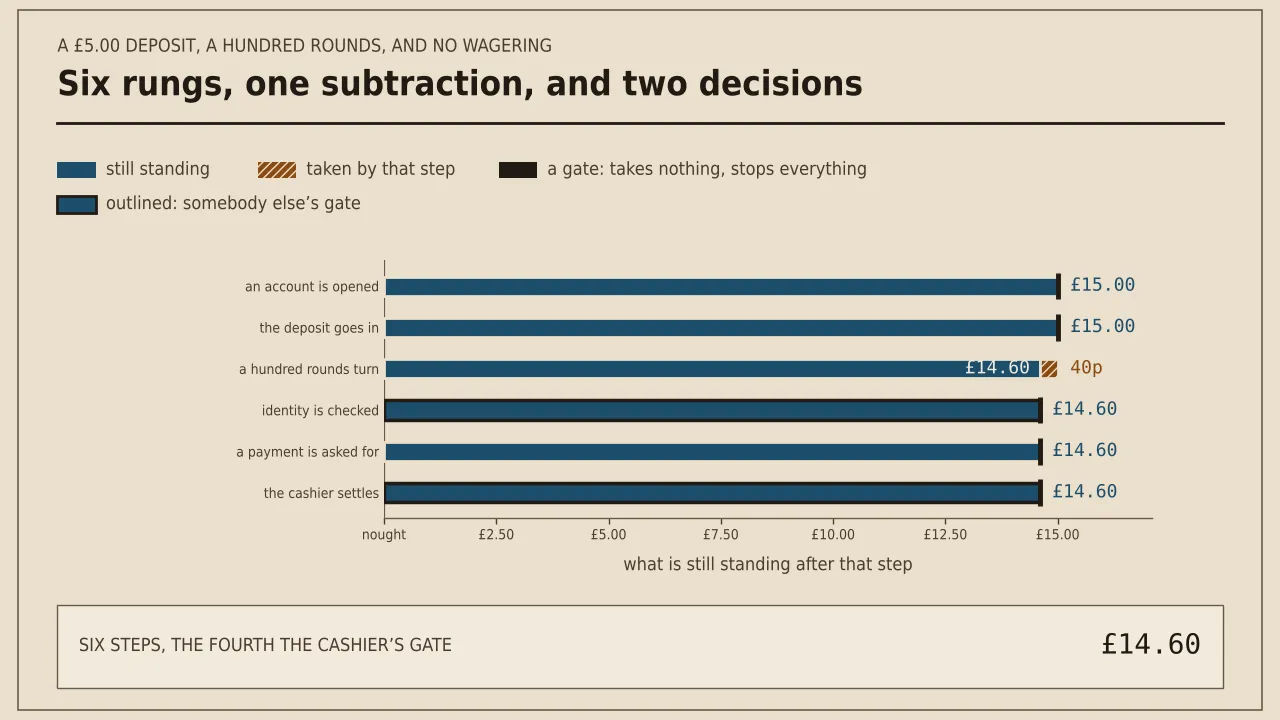
Arithmetic removes 40p from end to end of this chain, while £14.60 is what each of the three rungs under it could halt, a sum thirty-six and a half times larger
Say the same thing in time and the chain is the shortest counted under this heading. A hundred rounds is all the pressing it asks for, no further rounds being needed to discharge anything, and a licensed cycle carries a floor of 2.5 seconds measured start to start off the rule sheet, claim 107, with automatic play barred outright and every cycle wanting a separate commitment off the rule sheet, claim 115. Two hundred and fifty seconds, or four minutes and ten seconds, is the briefest sitting in which this arrangement could be walked.
Set that beside the version of this key with a staking condition on it, which would ask for £96.00 of wagering, or nine hundred and sixty further rounds, and run to forty-four minutes at the same floor. Removing the condition saved about forty minutes and £3.84, and removed no decisions at all. Six rungs, two of them the counter’s, exactly as before.
5
Where the check sits, and what sits behind the request
Two rungs decide everything on this page, and both of them belong to somebody else. Below, the duties a licence would have attached to those two rungs are set out and costed, and a counter that holds no licence carries not one.
Placement is the first thing a licence settles. Three published items have to be established and verified before anybody gambles at all off the rule sheet, claim 10, and a customer is owed notice, ahead of any deposit, of which documents or further information might be sought, at what stage, and by what route off the rule sheet, claim 12. On that ordering the fourth rung of this ladder stands above the second, and a reader learns whether verification is a difficulty before parting with five pounds rather than afterwards.
The far end is closed too. Making further information the price of a withdrawal is shut off where there had been an earlier chance to seek it off the rule sheet, claim 11; players are told the same by the regulator about proving age and identity, and money-laundering material wanted early rather than held over until a withdrawal is asked for off the rule sheet, claim 15; and a withdrawal delayed for want of that material may leave the operator in breach off the rule sheet, claim 16.
What governs the request itself is less obvious and worth knowing. Offering a customer the chance to undo a withdrawal is shut off on a licensed system, the funds are not to be put back within reach for depositing, and the operator is told to keep the way out unobstructed off the rule sheet, claim 37. The fifth rung of this chain has nothing of that kind over it.
Outside the licence the ordering is simply loose. One rulebook from outside the licence, read for this site, will not let anybody deposit or wager until the operator is happy they are eighteen, and then hangs the full document check on its money-laundering milestones, pulling it forward only where age is in doubt off the rule sheet, claim 146. That is the arrangement this ladder draws, and it explains why the fourth rung has £14.60 waiting on it instead of a registration and nothing more.
6
What the four words at the end do not settle
One question is answered by a promise that no wagering applies. Three others that would each move a figure here are left exactly as they were, and a reader should not read the first answer as covering the rest.
Whether a round’s winnings count as bonus funds is the first. Winnings landing as bonus funds have the ten times limit applied to them, while whether a round amounts to bonus funds on its own account has gone unstated in either direction off the rule sheet, claim 90. On a chain with no condition that question does not bite, which is the one genuine simplification these four words buy.
What such a condition would have asked for is the second, and it belongs here because it is the thing the headline removes. Meeting one means placing wagers that come to a particular total, after which the funds turn withdrawable and not before off the rule sheet, claim 92. Whether such a condition could reach a deposit as well as credit has never been settled either way off the rule sheet, claim 104, so on this key the question is moot and on the keys that keep a condition it is not.
Third comes the question of how far the credit may be allowed to run, for which no published source anywhere supplies a standard figure off the rule sheet, claim 105. This is where the four words stop helping altogether. Winnings caps and wagering conditions are separate terms doing separate jobs, and deleting the second settles nothing at all about the first. £14.60 is the point the arithmetic reaches and stops, not a sum that anybody has promised to hand over.
Looking for restrictions on an introductory offer is something the regulator tells readers to do, naming a required level of spending ahead of a bonus as the thing it means off the rule sheet, claim 87. That is useful advice on a key like this one precisely because the headline has already answered the question it asks, which makes it easy to assume the rest of the terms have been answered too.
7
What stands behind £14.60 if the answer is no
Everything above leads to one question, which is what a reader can do if the fourth rung goes against them. Inside a British licence there is a published answer. Outside it a reader has whatever that particular counter has chosen to put in writing, and this guide read nothing that says what it amounts to.
The licensed process has a clock. Within three working days a complaint has to be acknowledged, shortening to twenty-four hours for an operator that offers gambling round the clock off the rule sheet, claim 38, and the outer bound on the whole business is eight weeks from the day it arrived off the rule sheet, claim 39. At minimum, six months have to be left open for bringing a complaint after whatever it concerns, and terms may not close that window sooner off the rule sheet, claim 40.
It also has an ending that is not the regulator. Reasons, a statement that the operator has finished with the matter, and directions onward to an independent adjudicator are all required of the closing letter off the rule sheet, claim 42, and only an adjudicator the regulator has approved may be used off the rule sheet, claim 43. The approved list is not uniform: remote gambling of every kind is covered by several of the entities on it, while one of them is listed against premises sectors only and never against remote casino off the rule sheet, claim 44. A reader escalating a casino complaint has fewer doors than the length of the list suggests.
Against £14.60 that matters in a particular way. Five pounds of the figure were the reader’s own, which means a refusal at the fourth rung is not only a refusal of winnings. It is a refusal to return money that was never the offer’s, and the published complaints machinery that would have covered it is machinery this chain is not inside.
8
The duty this offer gave away, and the three it never had
Costing a licence against this key has an irony in it worth naming. Elsewhere beneath this heading the hardest-biting duty is the limit standing over a staking condition. Here no such condition exists for it to reach. The offer has surrendered the thing the rule exists to limit. Everything standing beside that rule is a different matter.
Counters lacking any Great Britain licence are what put a hundred rounds, sold on five pounds down with the wagering removed, in front of readers in this country. The ceiling that limits a staking condition to ten times bonus funds, running from the nineteenth day of January 2026 off the rule sheet, claim 91, is worth nothing whatever on this chain, the condition it limits having already gone. Three duties beside it are worth a great deal and none arrives. Identity is the first, settled before any gambling under a licence off the rule sheet, claim 10 and disclosed before a deposit may be taken off the rule sheet, claim 12, which would have left a registration rather than £14.60 waiting at the fourth rung. Second is withdrawal, where a licensed term is not permitted to restrict what leaves a deposit balance off the rule sheet, claim 34, and what the regulator picks out as an unacceptable term permits one figure daily beside a larger figure weekly off the rule sheet, claim 35, so the five pounds would have come back on demand. Self-exclusion is the third: belonging to Gamstop is a condition of every online gambling licence issued in this country off the rule sheet, claim 181, while the scheme itself states that it is unable to assist in keeping anybody away from operators who do not take part off the rule sheet, claim 183. Registration with the scheme buys nothing against this chain, which is a consequence worth knowing, and this site describes no way past any of the four duties.
Two published facts bear on how a counter of this kind looks from the outside, and both cut against a reader’s instincts. Work supplied by licensed firms has appeared on websites holding no licence of their own off the rule sheet, claim 131, so knowing a game by sight proves nothing at all about whose counter the five pounds crossed. And that is not theoretical: one supplier’s games were traced onto six unlicensed websites open to consumers here, and the settlement came to £4.75m, under a case carrying the date 23 July 2026 off the rule sheet, claim 132.
The regulator also states the position in general terms. Acting illegally is the regulator’s description of any gambling business that runs without its licence, and one consequence lands on that business: major payment systems organisations may pull its payment facilities off the rule sheet, claim 129. What it recommends a reader do costs nothing: look the business up on the register the regulator publishes, where listed activities and listed domain names ought to answer to whatever a site claims about itself off the rule sheet, claim 88.
A correction belongs at the close. Providing gambling facilities without a licence is where the offence sits, the provider is the person who commits it, and no offence of being that provider’s customer was ever created off the rule sheet, claim 3. What goes missing is cover and not permission, and this page has counted that cover piece by piece: identity settled before money moves; deposit balances no term may hold down; withdrawals nobody may offer to reverse; a complaints clock running out at an approved adjudicator; and an exclusion scheme that comes bolted to the licence off the rule sheet, claim 168. Six rungs, the fourth of them settled elsewhere, £14.60 waiting on that decision, and five of those pounds money no offer ever gave to anyone.
Asked at the booth
- With the wagering gone, what is left to count
- Six steps. An account, five pounds going in, a hundred rounds turning, an identity check, a request, and the answer to it.
- Which rung is the first the counter settles
- The fourth, where identity is checked, with £14.60 standing on it, five pounds of which the reader carried through the door.
- Is this better than the same rounds with a wagering condition
- It depends what is being compared. The closing figure is £1.16 lower, and the offer itself produces £9.60 against £5.76, which is two thirds more from identical rounds.
- Why is the closing figure lower if the offer gives more
- Because the deposit is half the size. Five pounds of this figure are the reader’s own against ten pounds on the other key, and the deposit is not a gift.
- How much does the arithmetic take in all
- 40p, where a hundred rounds turn. Each of the three rungs after that can stop £14.60, which is thirty-six and a half times as much.
- How long is this chain in time
- A hundred rounds at the licensed minimum cycle comes to four minutes and ten seconds, which is the shortest sitting counted under this heading.
- Does no wagering mean no cap on what the credit wins
- It settles nothing about one. No published source supplies a standard cap on bonus winnings, and removing one term says nothing about a different term.
- Who chose the stake and the return used here
- This publisher did, and the page says so wherever it spends them. Nobody publishes either figure, which leaves an open assumption or an empty page.