Terms read 26 October 2026 Counted in 2026
20 free spins on registration no deposit: six rungs, and the price is not money
Nothing is deposited here, so no sum of a reader’s own stands anywhere on this ladder. What is handed over instead is a set of personal details the rules put a floor under. Twenty rounds at the ten pence assumed throughout carry £2.00 of face, the reels take 8p of it and a staking condition read at the published ceiling takes 77p more, leaving £1.15 to arrive at the fourth rung, where somebody across the counter decides its fate. Six things have to happen for that £1.15, and the registration that starts them is the only thing the arrangement actually costs.
How many steps six Register, turn the rounds, clear the staking, be checked, ask, be paid. The first gate somebody else holds the fourth The counter weighs documents against a registration it already holds. Standing when it is reached £1.15 All that survives twenty rounds and the condition attached to them.
| What has to happen | Who takes this step | What it leaves standing | Printed where |
|---|---|---|---|
| A registration is completed | the reader | £2.00, or nought unregistered | the headline’s own last two words |
| Twenty rounds turn | the house’s arithmetic | £1.92 | nowhere, assumed by this publisher |
| The staking condition is satisfied | the house’s arithmetic | £1.15 | a ceiling Britain publishes, not a term |
| Identity is checked | the cashier | £1.15, or nought unverified | a licence condition Britain imposes |
| A payment is asked for | the reader | £1.15, or nought unasked | the cashier’s own withdrawal form |
| The cashier settles | the cashier | £1.15, or nought unpaid | nothing published behind this rung |
| What six steps leave | two of them the cashier’s | £1.15 | this page |
1
The one chain under this heading with no money of a reader’s on it
Every other key counted beneath this heading opens with somebody parting with money they already had. This one does not, and saying where the reader’s own money sits on this ladder means saying that none of it sits here at all. That is a finding rather than an omission, and it is the first thing a reader should take from the page.
What takes its place is the last two words of the key but one. Registration is the price, and a registration is not nothing. Under a British licence it means a published minimum of personal detail, established and verified before anybody gambles off the rule sheet, claim 10, and the regulator puts the same duty to players directly, giving reasons that come down to establishing age, checking a person against the exclusion register, and confirming they are who they say off the rule sheet, claim 14.
Those duties reach this kind of offer specifically, which is worth knowing because the headline says no deposit and a reader may hear that as no commitment. Whose money is funding the play makes no difference to the duty, which reaches an incentive as readily as a customer’s own stake, and it takes in the stakeless versions a licensee offers on its own site off the rule sheet, claim 18. The regulator’s reasoning on the last of those is its own: games of that sort fall outside gambling as a technical matter for want of a prize, and it sees no good reason at all for children to have access to them off the rule sheet, claim 19. A duty reaching as far as a prizeless game is plainly not a duty about money. It is a duty about who is at the keyboard, and of everything named here it is the single rule a no-deposit arrangement leaves standing.
Two further things the regulator has published bear on a transaction whose price is information rather than cash, and they belong together. Its account of the unlicensed market names controls that may not be adequate, on money laundering and on social responsibility alike, with the customer carrying whatever exposure that leaves, and self-excluded people are recorded as frequent targets of sites of that kind off the rule sheet, claim 130. Beside that it sets serious data protection concerns, naming the theft of an identity and fraud among what players face off the rule sheet, claim 135. A reader handing over a registration in exchange for twenty rounds is making a trade in exactly the commodity those two paragraphs are about, and £1.15 is the whole of what the other side of it comes to. Whether that is a fair rate for the personal detail a registration takes is a question this page leaves entirely to whoever is reading it. The one useful thing a guide can do here is put a figure on one side of the trade, so that both sides can be looked at together rather than one at a time, and £1.15 is that figure, arrived at over six rungs of which the fourth belongs to somebody the reader will never meet.
So the chain begins with a transfer, and the thing transferred is information rather than money. What that is worth is not something this page can price, because nothing published prices it. What the regulator has recorded about the market this key sits in can be said, and it is this: data protection described as a serious concern for players, identity theft and fraud among the risks, and the same account naming payments stopped and withdrawal ceilings nobody can reach off the rule sheet, claim 135.
There is a second consequence of having no deposit on the ladder, and it is one no other key under this heading can show. Most of what British licensing builds around a gambling account is built around money going in. A financial check falls due on a licensee once a customer’s net deposits pass a monthly figure, and no deposits means that threshold is never approached. Limits a reader sets on themselves are, by the published definition, ceilings over what enters an account across a period, and here nothing enters. Credit cards may not be accepted by a licensee for gambling, and nothing on this chain is being paid for in any case. Every one of those protections is inert on a chain like this one.
That leaves the identity duty standing alone. On a deposit chain a reader is covered, under a licence, by several rules at once: one governing the method of payment going in, one forbidding a ceiling on the way out, one about when a check may be demanded, and a threshold that triggers a look at whether the spending is affordable. Strip the deposit away and only the last of those survives in any form, because it is the only one that attaches to the person rather than to the payment. A no-deposit chain is not a chain with less at stake. It is a chain with fewer rules pointing at it.
There is a tidy symmetry here with the keys that keep a deposit and strike out the wagering instead. Those chains run to six rungs as well, having lost the staking condition and kept the deposit. This one runs to six having lost the deposit and kept the condition. Both are one rung shorter than a key carrying both, and in each case the rung that went was one nobody decides: a sum being handed over, or a sum being worked through. The count of decisions is two on all three, and the two are always the same two.
Which is the finding a reader should carry away from the comparison. Removing the deposit changes what is at risk and does not change who decides. Removing the wagering changes how much survives and does not change who decides. Nothing a headline can advertise about either removal touches the pair of rungs that actually determine whether anybody is paid, because those rungs belong to the counter and no offer has ever been written that gives them away.
The rest of this guide counts what the registration buys, which comes to £1.15 on the assumptions set out below. A reader deciding whether that is a fair exchange is deciding something this site cannot decide for them. What the site can do is make sure both sides of the exchange are visible, and the half that no headline prints is the six rungs standing between a registration and £1.15.
One duty bears on the shape of the offer rather than on its figures, and a reader of a no-deposit key is unusually likely to meet it. A licensee may not reduce what an incentive is worth on the ground that the qualifying activity was finished inside the offer period rather than at the end of it off the rule sheet, claim 58. On a chain whose whole obligation is two hundred and twelve rounds, finishing early is exactly what a determined reader does, and the rule protects against the value being trimmed for having done so. Like everything else set out here, the rule hangs on a licence this counter does not hold.
2
Two pounds of face, and the two figures that make it
Twenty rounds count events that have not happened. Turning a count into money takes a value for one round and a figure for what a reel returns, and nothing published supplies either, so this page declares each of them and marks each as a declaration.
Ten pence a round comes first. Nothing published settles the cash value of a round, nor whose call it is, nor what anybody has to be told about it off the rule sheet, claim 89. Twenty rounds at that stake come to £2.00 of face, which is the largest figure anywhere on this ladder and the only one that nobody has yet taken anything from.
A return of 96 per cent across a long enough stretch is the second, stated about reels in general and about no machine in particular. Licensing in this country would not have produced it either. several alternatives each satisfy the standard on its own, the word between them being or off the rule sheet, claim 120, so explaining how a game works is compliance and no percentage is compelled anywhere off the rule sheet, claim 121.
£2.00 crosses a reel as twenty rounds of ten pence, leaving £1.92 once the assumed return has taken its part. That missing 8p is the earliest subtraction here, and the ladder shows it beside the rung responsible. Nobody decided it: an assumed 96 per cent return takes 8p out of £2.00, and it would have done so whatever anybody on either side wanted.
It is worth noticing how small the face is before anything else happens. Two pounds is the whole of what twenty rounds are worth on these assumptions, which puts the entire arrangement, before a single condition is met, below the smallest deposit counted anywhere else under this heading.
Neither assumption is load-bearing, and showing what moves when they change is the quickest way to prove it. Take the round down to five pence and the face is £1.00, the credit 96p, the closing figure 58p. Take it up to twenty pence and the face is £4.00, the credit £3.84 and the close £2.30. Every figure on the page travels with the stake, in exact proportion, and the six rungs do not move at all. The shape of a chain is independent of the money running through it, which is the single most useful property of counting chains rather than pricing ends. A headline naming twenty of something sounds larger than a headline naming one pound. On this page’s figures it is twice as large and no more.
3
What the ceiling takes from a figure this small
A staking condition is met by wagers reaching a stated total, at which point and not before the funds turn withdrawable off the rule sheet, claim 92. Ten times the credit is the value drawn here, ten being the most any licensed incentive may demand, in force since the nineteenth day of January 2026 off the rule sheet, claim 91 and leaving only the technical and software licences untouched by it off the rule sheet, claim 93.
Wagering of £19.20 is what ten times £1.92 comes to. Send the credit through E = B × (1 − W × (1 − RTP) ∕ g) at that multiple, giving full weight to the qualifying share, nothing published offering a contribution rate to put there instead, and £1.152 is the answer. Rounded to the penny that is £1.15, and the rounding is stated rather than hidden because on a figure this small a tenth of a penny is a larger share of the total than it would be anywhere else on this site.
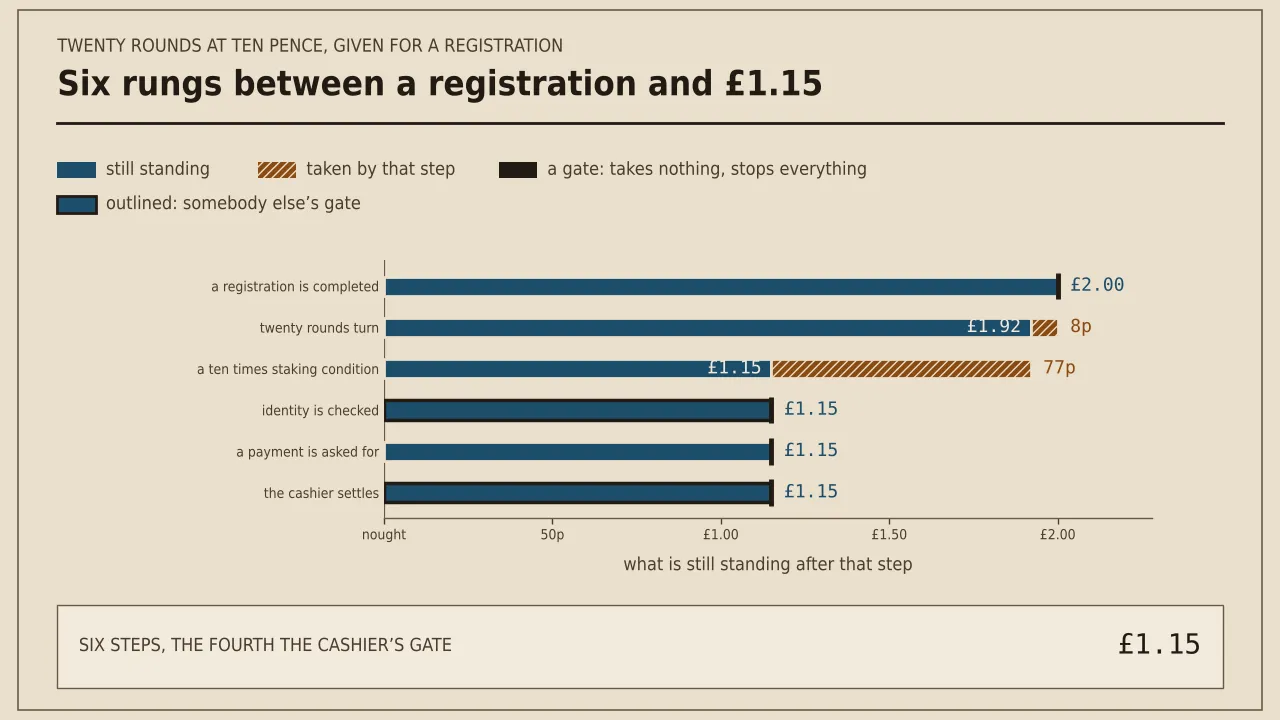
The staking condition takes 77p out of the £1.92 that twenty rounds produced, which is two fifths of what they made and well over a third of the £2.00 this ladder opened at
The second number under the multiple is the one worth carrying away from a page like this. £19.20 of wagering at the assumed stake is one hundred and ninety-two rounds, on top of the twenty that were given. So a headline offering twenty rounds is, read all the way through, an arrangement that asks for two hundred and twelve of them, and the number it prints is less than a tenth of the number it means.
Time makes the same point in a different unit. A game cycle under British licensing cannot run shorter than 2.5 seconds and wants a deliberate act to start each one off the rule sheet, claim 107, and it shuts automatic play out of online gaming altogether on the same principle off the rule sheet, claim 115. Two hundred and twelve rounds at that floor come to five hundred and thirty seconds, which is eight minutes and fifty seconds of uninterrupted pressing for £1.15.
Sixty times is on the regulator’s own record as a multiple in use among some licensees before any ceiling existed off the rule sheet, claim 94. Swap sixty in where the ten stands and the expression comes back under nought, a figure nobody owes and no account is short of. What the sum reports is that £1.92 would run out long before sixty turnovers of it were through, and on a chain with no deposit behind it there would be nothing else in the account at all.
4
Four rungs that take nothing, and the first one somebody else holds
Four of the six steps shift no money whatever, leaving £1.15 as the figure any one of the final three can halt outright. The reader holds two of the four. The registration itself is the first rung and the request for payment is the fifth, and neither is going anywhere until the reader acts. Two belong to the counter, and whichever of that pair comes sooner is this guide’s finding, which here is the fourth rung.
Where an identity check sits is the question that shapes this chain, and on a no-deposit key the answer has a peculiarity the deposit keys do not share. A licence would have put the check at the registration, the duty being one that attaches before any gambling of any kind and that draws no distinction according to whose money is funding the play off the rule sheet, claim 18. The first rung of this ladder and the fourth would have been the same rung.
That matters more here than anywhere else under this heading. On a deposit chain, moving the check to the top protects money. On this chain there is no money to protect, so moving the check to the top protects something else: it means the reader finds out whether they can be verified before spending eight minutes and fifty seconds pressing a control, rather than after.
The far end is shut as well under a licence. Turning a withdrawal request into an occasion for fresh demands is shut off where the asking could have been done earlier off the rule sheet, claim 11, the regulator tells players as much in plain terms off the rule sheet, claim 15, and a payment stalled for want of that material may put the operator in breach off the rule sheet, claim 16.
Outside the licence nothing fixes the ordering, and one rulebook read for this site shows how it comes apart. Nobody wagers there until the operator is content about the player’s age, a matter a birth date given at registration can settle, after which the full document check is tied to later money-laundering stages and comes forward only where age is doubted off the rule sheet, claim 146. This ladder is drawn on that arrangement, which is how £1.15 comes to be waiting at the fourth rung instead of a bare registration.
5
Four figures this guide will not invent
Four figures capable of shifting a number on this ladder are published nowhere, and naming them is the only honest alternative to filling them in.
First on that list is the worth of a round, settled above, where ten pence is a declaration off the rule sheet, claim 89. Second is the fate of what a round wins. The ten applies to winnings that land in an account as bonus funds, and whether a round is itself bonus funds has never been published off the rule sheet, claim 90. This page takes neither position, which is why the third rung is priced off a published ceiling rather than off a term anybody printed.
Third is how far the credit is allowed to run, a matter no published source puts a standard figure on off the rule sheet, claim 105. On a chain closing at £1.15 that silence looks harmless and is not, because a cap set anywhere above the closing figure has no effect at all and a reader cannot tell from the headline whether one exists. £1.15 is where arithmetic leaves the matter, and no counter has promised it.
A minimum payout is the fourth and it is the sharpest risk on this page. Nothing read for this guide bars a counter from refusing to process a request below some figure, and £1.15 is small enough that a floor of almost any ordinary size would strand it entirely, which would make the fifth rung unwalkable. This guide found no figure for any such floor, so the ladder shows none, and anybody who runs into one has run into something this page could not price.
Restrictions on an introductory offer are something the regulator does tell readers to hunt for, and the illustration offered is a spending threshold placed in front of a bonus off the rule sheet, claim 87. On a no-deposit key that advice has an odd shape: the restriction it names has already been ruled out by the headline itself, which invites a reader to suppose everything else has gone with it.
6
What a registration would have been worth under a licence
Every duty named above has been written conditionally, and this part is where the reason goes. On a key whose price is a registration rather than a sum of money, the duties that matter most are the ones about what happens to the registration.
Readers here are offered twenty rounds in exchange for a registration by counters lacking a Great Britain licence. Three of the duties that would have come with one are costed below against the single figure this chain produces. Identity comes first, and it is the duty this particular key turns on. A licensed check has a published minimum of personal details behind it and has to be discharged before anybody gambles off the rule sheet, claim 10, and the duty does not care whose money funds the play, and it reaches the stakeless versions a licensee puts on its own site as well off the rule sheet, claim 18. Under it the check at the fourth rung would have happened at the first. The staking ceiling is the second: ten times bonus funds has been the limit on a licensed incentive since the nineteenth day of January 2026 off the rule sheet, claim 91, making the 77p taken at the third rung the mildest reading available rather than a figure anything obliges. Self-exclusion is the third: the reach of the scheme is decided by a licence rather than by a website, so it covers everything licensed here off the rule sheet, claim 181 and, on its own published admission, nothing beyond its own membership off the rule sheet, claim 183. A registration spanning the whole licensed market spans not one rung of this chain, and no part of this site lays out a route round any of the three.
What the regulator has recorded about the market outside the licence bears directly on a key whose price is personal information. Its account is of controls that may not be up to the job, on money laundering and on social responsibility alike, with a customer carrying the exposure that leaves behind, and it adds that self-excluded people are often who such sites go after off the rule sheet, claim 130. On the way out it describes payment simply stopped, and ceilings set where nobody arrives, with data protection and identity theft named in the same breath off the rule sheet, claim 135.
It also warns that recognising a game proves nothing. Work supplied under licence has turned up on sites that carry no licence themselves off the rule sheet, claim 131, and that is not hypothetical: games from a single supplier were found on six unlicensed websites that consumers here could reach, with £4.75m settled afterwards, under a case bearing the date 23 July 2026 off the rule sheet, claim 132. What the regulator recommends instead costs a minute: check the entry on the register the regulator maintains, and see whether what it records, activities and domains alike, answers to the claims a site makes for itself off the rule sheet, claim 88.
One correction belongs at the end. The statutory offence attaches to whoever provides gambling facilities unlicensed, and Parliament wrote no answering offence for the person on the other side of the transaction off the rule sheet, claim 3. What goes missing is protection and not liberty, and the protection has been counted here item by item: an identity check fixed at the top of the chain, a ceiling over the staking, a published route for a complaint, and an exclusion scheme bolted to the licence off the rule sheet, claim 168. Six rungs in all, the fourth decided across a counter, £1.15 resting on that decision, and a registration surrendered before a single one of them began.
Recourse is the last thing worth setting out, and on a figure this small it matters more than the figure does. Inside a British licence a complaint runs to a published timetable, with an outer bound of eight weeks from the day it arrives off the rule sheet, claim 39, a window of at least six months after the incident in which it may be brought off the rule sheet, claim 40, and a closing letter that has to point the way onward to an adjudicator off the rule sheet, claim 42 that the regulator has approved and no other off the rule sheet, claim 43.
About its own limits the regulator is exact. Ombudsman is a word it refuses for itself; settling a gambling dispute is beyond it and so is getting a consumer’s money back; and no account is open to its inspection, which leaves it unable to work out what occurred inside one off the rule sheet, claim 46. Taking the complaint to the business first is its own direction to a player off the rule sheet, claim 47. Even inside the licence the road finishes with an approved adjudicator rather than with the regulator, and what lies outside the licence is something this page cannot set out, nothing read for it having set one out.
Set that against £1.15 and the arithmetic of pursuing it becomes plain without this page having to say anything about whether it is worth pursuing. An eight-week process, a six-month window and an adjudicator at the end are fixed costs. They do not shrink because the sum is small. A chain whose closing figure is a little over a pound is a chain where the machinery for disputing the closing figure is, by any measure of effort, worth more than the figure itself. That is not an argument against complaining. It is the reason a reader should know the figure before the registration rather than after it.
Asked at the booth
- Set out in order, what is in this chain
- Six steps: a registration, twenty rounds, a staking condition, a check on who the reader is, a request, and the counter’s answer.
- Where is the reader’s own money on this ladder
- Nowhere. Nothing is deposited, so every figure in the standing column came from the offer. The price here is a registration rather than a sum.
- Which rung is the first the counter decides
- The fourth. Identity is checked there and £1.15 is standing on it. Under a licence the same check would have sat at the first rung.
- Why is the closing figure £1.15 and not £1.152
- Because money on this site is carried to the penny. The expression returns £1.152 from £1.92 at ten times, and the page rounds it down and says so.
- How many rounds does the staking condition actually ask for
- A hundred and ninety-two at the assumed stake, on top of the twenty given, so two hundred and twelve rounds in all for a headline naming twenty.
- At the published minimum pace, how long is that
- Eight minutes and fifty seconds of uninterrupted pressing, which is the floor a licensed cycle sets rather than a duration anybody has published.
- Could a minimum payout strand £1.15
- Easily, and it is the sharpest unpublished risk here. Nothing read for this guide bars a counter from refusing a request below some figure.
- Does a registration cost nothing
- It costs the personal details a licensed check would have to establish. Nothing published prices those, and the regulator records identity theft and data protection among the risks outside the licence.