Terms read 26 October 2026 Counted in 2026
200% deposit bonus: £18.00 standing at the fourth of six rungs
Doubling a deposit doubles the staking with it, which is the arithmetic a percentage hides. £15.00 of a reader’s own money brings £30.00 of bonus credit, and credit goes into a requirement at the value stated because no game has touched it. Ten times means £300.00 put through, £12.00 of the bonus goes, £18.00 comes out, and the three rungs under it hold that figure without shifting it by a penny.
How many steps six Open, pay in, put £300.00 through, be verified, claim, be settled. The first gate somebody else holds the fourth A desk reads documents on a timetable nothing published fixes. Standing when it is reached £18.00 Three fifths of the credit, with the deposit kept out of it.
| What has to happen | Who takes this step | What it leaves standing | Printed where |
|---|---|---|---|
| An account is opened | the reader | £30.00, or nought unopened | the offer’s own headline |
| A deposit is funded | the reader | £30.00, or nought unfunded | the offer’s own headline |
| £300.00 is put through | the house’s arithmetic | £18.00 | the published British ceiling |
| Identity is verified | the cashier | £18.00, or nought unverified | a licence condition, not a term |
| A payment is asked for | the reader | £18.00, or nought unasked | the cashier’s withdrawal form |
| The cashier settles | the cashier | £18.00, or nought unpaid | nothing published behind this |
| What six rungs leave | two gates the cashier holds | £18.00 | this page |
1
Thirty pounds of credit for fifteen of a reader’s own
Two hundred per cent is a relation between two figures and not a value. On a deposit of £15.00 it produces £30.00 of bonus credit. On a deposit of £1.50 it would produce £3.00. The percentage decides nothing until a reader has chosen how much of their own money to put behind it.
This page chooses £15.00, and says so rather than implying it. The figure is an assumption made here for the sake of having one, exactly as the 10p round further down is, and every sum below can be rebuilt at any other deposit by multiplying.
Two quantities now sit in one account and this site refuses to add them. Fifteen pounds belongs to the reader and did before the offer existed. Thirty pounds is credit a cashier has created, worth nothing until a condition is cleared. Added together they make £45.00, a figure that describes neither the gift nor the money at hazard, and the instrument above therefore prices the £30.00 alone.
At two hundred per cent something happens that does not happen at a smaller multiplier, and it is worth noticing early: the bonus is larger than the deposit that bought it. Thirty pounds of credit against fifteen pounds of a reader’s own. By the foot of the ladder £18.00 of that credit survives, which is still more than the £15.00 that went in.
That observation is the whole attraction of a large multiplier and it is also where the care is needed, because being ahead in a balance is not the same as holding money. The £18.00 is not spendable until three further rungs have been passed, two of which belong to somebody else, and the £15.00 is not retrievable until the same three have been passed.
The deposit does appear on the ladder, at the second rung, because the chain stops without it. What it does not do is change the bonus figure, which is why that row carries £30.00 across unaltered. Two rungs into this chain, nothing at all has come off the thing being measured.
A reader can test the whole of this page from two multiplications. Two hundred per cent of £15.00 is £30.00; ten times £30.00 is £300.00; four pence in every pound of £300.00 is £12.00; and £30.00 less £12.00 is £18.00. Four steps of arithmetic, each of them printed, and no figure arriving from anywhere a reader cannot check.
So the plain reading of a 200 per cent banner is this. A reader is lent £30.00 of playable credit against £15.00 of their own, on terms requiring £300.00 to be staked, and the bonus is what this guide counts because the bonus is the thing the offer supplied.
2
Three hundred pounds of staking against fifteen deposited
The figure a 200 per cent banner does not print is £300.00. That is the staking the requirement asks for, it is twenty times the deposit that triggered it, and it is the number deciding how long an evening this offer is.
Twenty to one is the figure worth keeping. A reader parts with £15.00 and agrees to send three hundred pounds through a reel. Neither figure is secret and the second is never on a banner, because it is arrived at by two multiplications rather than printed anywhere.
The first multiplication is the match. Two hundred per cent of £15.00 is £30.00. The second is the requirement: ten times £30.00 is £300.00. Both are sums anybody can repeat, and together they turn a modest deposit into a commitment twenty times its size.
Credit does the whole of that work because credit enters the requirement at the value stated. Nothing comes off £30.00 on the way in, no game having had it, which is the rule this site applies to every sum of credit and which the page about counting a chain sets out.
Watch what that does to the ratio as the multiplier moves. At a hundred per cent a £15.00 deposit would carry £15.00 of credit and £150.00 of staking, which is ten to one. At two hundred it is £300.00, twenty to one. At three hundred it would be £450.00, thirty to one. The staking per pound deposited rises in step with the percentage, and that is the quantity a bigger headline actually buys.
A second quantity moves at the same time and it moves the reader’s way. Three fifths of £30.00 is £18.00, against three fifths of £15.00 at a hundred per cent, so the surviving figure doubles too. A larger multiplier is more credit, more staking and more survival, all in one proportion, and the proportion is fixed by the ceiling rather than by the offer.
One more comparison belongs in this part because it is the one a percentage invites and never answers. Two offers at two hundred per cent are not the same offer: one on a £15.00 deposit asks £300.00 of staking and one on a £50.00 deposit asks a thousand. The percentage is identical and the commitment is not, so a reader comparing banners is comparing multipliers while the quantity that matters sits in the deposit box.
Which is why this page prints £300.00 as prominently as it prints £30.00. The credit is what a banner advertises. The staking is what a reader actually agrees to, and on a doubled deposit it is twenty times what they handed over.
3
Twelve pounds gone at the third rung, and nothing anywhere else
£30.00 is what the requirement works on and ten is the multiple it is set at. Software and technical licences aside, that ten reaches every remote casino in the country off the rule sheet, claim 93, and ten has been the lawful ceiling since 19 January 2026 off the rule sheet, claim 91. The staking comes to £300.00, which is ten of those balances.
With B at £30.00, W at ten and the share whole, E = B × (1 − W × (1 − RTP) ∕ g) gives £18.00. The thing being priced is defined as wagers adding up to a stated value off the rule sheet, claim 92, which fixes a size and leaves the pace and the divisions of it unwritten.
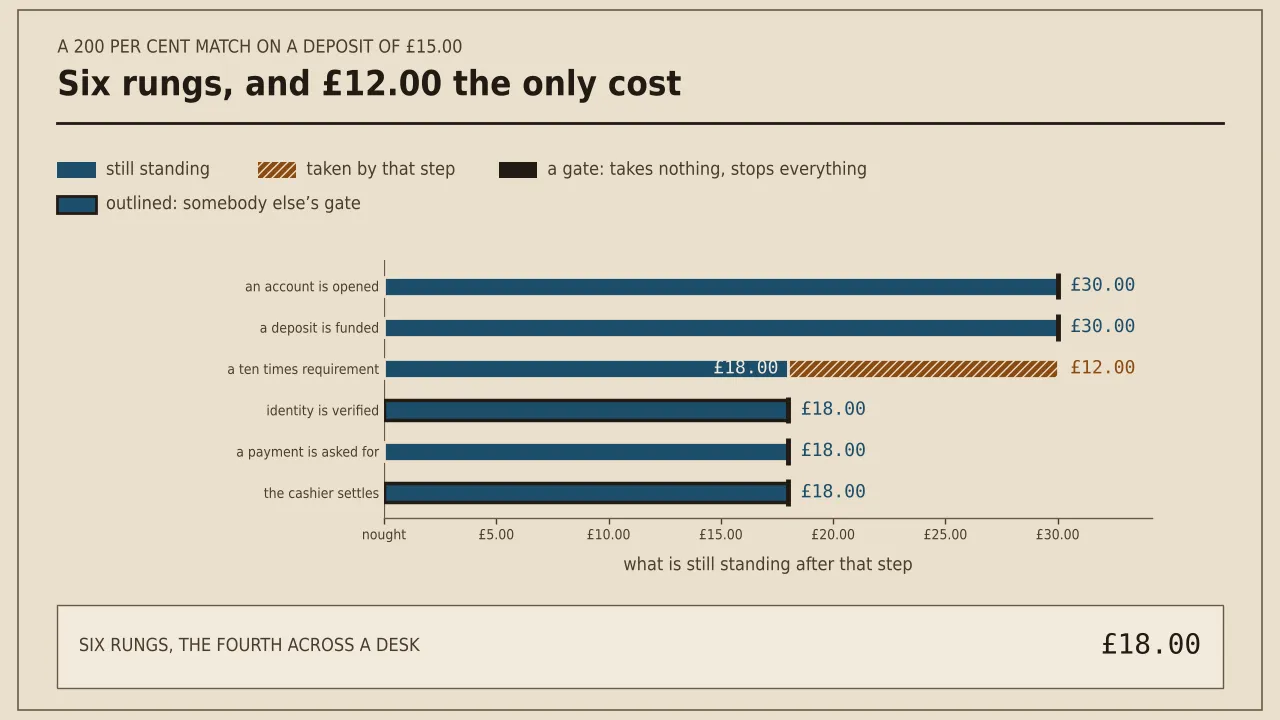
The requirement takes £12.00 out of the £30.00 of credit, two fifths of it and the only money this chain takes at any point
One deduction, at one rung, with two rungs above it and three below it that take nothing at all. By the shape of the column that is as plain as a chain gets on this site, and the plainness is worth distrusting rather than enjoying: a chain losing money in one place loses the rest of its value where somebody decides.
Set the £12.00 against the £300.00 that generates it and the rate never varies. Four pence goes in every pound put through, three hundred pounds pass, £12.00 is the cost. No accelerating charge, nothing added at the end, and no rung slipping one in. One row therefore carries the deduction honestly.
Put the cost against the deposit rather than against the bonus and the offer reads differently again. Clearing this requirement is expected to cost £12.00, against £15.00 of a reader’s own money committed to the account while it is cleared. The exercise is expected to consume four fifths of the deposit in cost terms and to return £18.00 of credit if every later rung goes the reader’s way.
Raise the multiple and the credit runs dry. Twenty-five passes over £30.00 at four pence in the pound use up the whole bonus, so expectation reaches nought at twenty-five. Sixty times has been recorded in the market off the rule sheet, claim 94, and sixty against £30.00 drives the expression below nought: a statement about what is expected, not a debt owed by anybody.
4
Three thousand rounds, and two published floors
£300.00 has to be staked through something, and a 10p round is assumed here to turn it into a count. Three thousand rounds. Six rungs stand on the ladder and the third of them is taken three thousand times over.
The two counts stay separate. Six marks this chain off from the one beside it. Three thousand says what the third rung costs in attention. Adding them would give a number describing neither.
A bonus of credit may be cleared on more than one sort of game, so two floors under the pace are published rather than one. Slots: no cycle may start inside 2.5 seconds of its predecessor off the rule sheet, claim 107. Other casino games, poker between players excepted: five seconds off the rule sheet, claim 108, a figure carrying the date 17 January 2025 off the rule sheet, claim 114. In both cases the player has to commit to each cycle individually off the rule sheet, claim 115.
Work both out. Three thousand rounds at 2.5 seconds cannot be done inside two hours and five minutes. At five seconds the floor is four hours and ten minutes. Where the staking is done decides which figure applies, and a banner about a doubled deposit says nothing about the choice existing.
Both are floors rather than forecasts, and the multiplication is this page’s own laid over published seconds. A real evening runs longer, since nobody plays at a minimum. What the pair establishes is that £300.00 of staking costs between two and four hours before anything else on this chain has been attempted.
Divide the cost by the rounds and the charge disappears into the noise. Three thousand rounds carry £12.00 between them. Four tenths of a penny apiece. Nothing a reader could feel. Added up across the lot they make two fifths of the bonus, which is why this page counts instead of trusting a feeling.
A row on the instrument covers the £300.00 rather than appearing three thousand times. The requirement is a single condition with a quantity attached to it, and the quantity has just been counted in prose, where a reader can see both numbers and neither is impersonating the other.
5
The fourth rung, where the bonus is larger than the deposit
At the fourth rung two figures sit in one account and neither is the reader’s to move. £18.00 of surviving credit, and £15.00 of a reader’s own money. On a doubled deposit the first is larger than the second, which makes this rung worth more attention here than on a smaller multiplier.
A verification stands there and it takes nothing. £18.00 goes through in one piece or stays put, and the same holds at the sixth rung. Those two between them carry all of the surviving credit, while the claim at the fifth rung is the reader’s to make whenever they like.
No licensed account gambles before its holder has been identified off the rule sheet, claim 10, incentive money included off the rule sheet, claim 18. A licensee also has to say, before a deposit is taken, which documents might be wanted and when off the rule sheet, claim 12. Both duties would have moved this rung above the first on a licensed chain, and would have given a reader notice of what it was going to want.
Paperwork produced for the first time at the cash desk is refused off the rule sheet, claim 11. The wording addressed to players puts laundering checks at the beginning off the rule sheet, claim 15, and treats a payment stalled for want of them as a possible breach off the rule sheet, claim 16.
Nothing in that reaches a cashier working without the licence. Refused payments and limits set out of reach appear in the published account off the rule sheet, claim 135, and with them unfair play, money lost, and no route to a complaint off the rule sheet, claim 134.
Now the arithmetic that makes this rung particular at two hundred per cent. A reader stopped here loses £18.00 of credit, more than the £15.00 they deposited. At a hundred per cent on the same deposit the surviving credit would have been £9.00, less than the deposit. A larger multiplier therefore puts more at this rung than the reader put in, and the party standing at it works to no published timetable.
Nothing on this chain pays part of £18.00. The outcome at the fourth rung is the whole figure or none of it, and the same is true at the sixth, so what stands at the foot of this ladder is £18.00 or nought with no third possibility. The £12.00 above behaved quite differently: a fixed fraction of a fixed balance, taken by arithmetic with no opinion in it.
Which is why the finding is the fourth rung rather than the third. The £12.00 that went at the third went because four pence in every pound of £300.00 is £12.00, with nobody choosing it. A choice is what happens at the fourth, with £18.00 of credit and £15.00 of deposit both inside one account while it is made.
6
What doubling changes, and the three things it leaves alone
Two hundred per cent raises the bonus and the staking in step and changes their relation by nothing. On £15.00 the bonus is £30.00 and the staking is £300.00. A hundred per cent on the same deposit would give £15.00 of bonus and £150.00 of staking. Three hundred would give £45.00 and £450.00. The ratio between what is lent and what has to be staked is ten to one in every case off the rule sheet, claim 103, and the ceiling is what fixes it.
So a percentage is not a measure of generosity in any sense a reader can bank. A bigger number means more credit and proportionally more staking, so proportionally more time and proportionally more expected cost. Two hundred per cent is £300.00 of staking where a hundred would have been £150.00, and three thousand rounds where it would have been fifteen hundred.
A second thing the percentage leaves alone is the count of rungs. Six, at any multiplier, a chain being made of conditions rather than of money: an account, a deposit, a requirement, a verification, a claim, a settlement. The sums scale and the structure does not.
The third is the rule about mixing, which governs what a match may be bundled with. Products of two different types may not share one single incentive off the rule sheet, claim 99, a rule arriving with the ceiling, and the four named types divide the market by what is being played rather than by who is playing it. Slots count as casino, so a match beside free rounds is one type while a match beside bingo entries is two of them off the rule sheet, claim 102.
Three exceptions to it run against a reader’s expectations and are worth having before reading a bundled banner. Two products of one type together are permitted. Two products offered separately in a single email are permitted where the customer opted into both. And a credit a customer may spend on whichever product they choose falls outside the ban entirely off the rule sheet, claim 100.
Three further things bear on £18.00 and nothing published settles any of them. Whether a requirement swallowing the deposit alongside the bonus is caught is unaddressed either way off the rule sheet, claim 104, and a term of that shape would put £450.00 behind this offer rather than £300.00. No limit on what bonus money may win is published off the rule sheet, claim 105, while the protection against capped withdrawals is written about a deposit balance off the rule sheet, claim 34, so a cap on the one with a free hand over the other breaks nothing. And contribution rates came through the consultation unaltered off the rule sheet, claim 97, the quoted rate being thirty pence in the pound off the rule sheet, claim 96, which would put £1,000.00 of staking behind the same £300.00 of credit.
Each of those three would move the figure the wrong way for a reader and not one can be given a number from a citable source. So £18.00 is an upper bound on what this offer leaves rather than an expectation of it, and the two unpriced rungs underneath are why the distinction is not academic.
7
£18.00, £15.00, and no licence over either of them
Every figure above is the gentlest the published rules will bear, and the gentleness comes entirely from conditions attached to a British licence. There is no Great Britain licence over any of this.
A 200 per cent match reaches British readers from beyond the Great Britain licensing regime. Three duties inside that regime can be set against the chain above. Marketing is the first, and it is the duty most likely to have put the offer in front of anybody at all: direct marketing has needed its own opt-in, product by product and channel by channel, since 1 May 2025 off the rule sheet, claim 50, with consent informed and specific before a customer is contacted electronically off the rule sheet, claim 81. A banner arriving by some other route answers to neither. Bundling is the second: one incentive may not carry two product types off the rule sheet, claim 99, which governs what £30.00 of credit may be tied to and binds nothing here. Exclusion is the third. A British licence carries scheme membership with it off the rule sheet, claim 181, and the scheme says it is powerless where an operator has not joined off the rule sheet, claim 183. Registering is therefore a consequence rather than a remedy at this end of a chain, and no procedure of any kind is described on this site.
Two of those three change what reaches a reader rather than what the ladder says, which is exactly why they are priced here. The marketing rules decide whether a £30.00 banner arrives and on what consent. The bundling rule decides what else may be attached to it. Neither applies, so both the arrival and the contents are unconstrained.
A fourth duty touches the closing pair of rungs rather than either figure, and it earns a line for settling what remains open to a reader when the answer comes back no. A licensed complaint has eight weeks as its outer limit off the rule sheet, claim 39, six months is how long one has to be accepted for off the rule sheet, claim 40, and the closing letter names an adjudicator from a list the regulator approves off the rule sheet, claim 42 off the rule sheet, claim 43. The regulator declines the ombudsman role in its own words off the rule sheet, claim 46. So £18.00 would finish in front of an adjudicator under the licence, and outside it nothing read here points anywhere at all.
A notice carrying 20 January 2025 sets out what such a site may lack, and the whole of it reads as one sentence: nobody out here is obliged to look after a customer, a customer’s money or a customer’s grievance. It also records that people who have excluded themselves make frequent targets for such sites off the rule sheet, claim 130, and that work from licensed suppliers has appeared on sites without a licence off the rule sheet, claim 131, so a familiar reel is evidence of nothing whatever.
There is a number for what that absence costs, and the number is the whole of £18.00. Not a slice of it, not a fraction: the two rungs bound by no British condition carry the entire surviving figure between them, and the £15.00 a reader deposited sits beside it in the same account the whole time.
One fact belongs on the other side of the ledger or the page leans. The Act writes the offence against whoever provides the facilities and against nobody who plays off the rule sheet, claim 3. A reader gives up protection out there rather than permission. Six rungs on a doubled deposit, the fourth settled elsewhere, £18.00 of bonus standing at it, and £15.00 of a reader’s own money in the same account.
Asked at the booth
- What does a 200 per cent match on £15.00 leave
- Thirty pounds of credit goes into the requirement whole, £12.00 of it is spent clearing the staking, and £18.00 survives.
- Does doubling the percentage double what a reader keeps
- It doubles the credit and the staking together, so the proportion kept is unchanged at three fifths. The pounds rise and the ratio does not.
- How much staking does the offer ask for
- Three hundred pounds, which is twenty times the £15.00 deposited and three thousand rounds at the 10p this page uses for counting.
- How long is that at the published floors
- Two hours and five minutes on slots, or four hours and ten minutes on other casino games, and both of those are minimum times.
- Why is the bonus larger than the deposit here
- Because the multiplier is above one. Thirty pounds of credit against fifteen deposited, and £18.00 of credit still standing at the rung a cashier decides.
- Which rung is reported here
- The fourth, where identity is verified and £18.00 is standing. It is the first rung on the chain settled by a party the reader has no hold over.
- Can a match be bundled with bingo entries
- Not by a licensee. A single incentive cannot carry two product types, and a match with bingo entries crosses two of the four named.
- Is there a British licence behind it
- No. Three duties a British licence imposes were priced above: the marketing consent rules, the mixed-product ban, and membership of the national exclusion scheme.