Terms read 26 October 2026 Counted in 2026
Casino welcome bonus: seven rungs, and £20.88 at the fifth
A welcome package is two offers under one headline, and the two halves are not counted the same way. £30.00 of credit enters at its stated figure. £5.00 of rounds enters at what the rounds are expected to give back, which is 20p less. The condition then measures itself against the pair of them and takes £13.92, leaving £20.88 to reach the fifth rung, where the counting stops and a stranger answers.
How many steps seven Open, fund with twenty pounds, play the rounds, stake £348.00, be checked, ask, be paid. The first gate somebody else holds the fifth Documents are weighed by a cashier with no published timetable. Standing when it is reached £20.88 Three fifths of a package worth £34.80 once the rounds have run.
| What has to happen | Who takes this step | What it leaves standing | Printed where |
|---|---|---|---|
| An account is opened | the reader | £35.00, or nought unopened | the package headline |
| Twenty pounds is paid in | the reader | £35.00, or nought unfunded | the qualifying deposit |
| Twenty rounds turn | the house’s arithmetic | £34.80 | this publisher’s assumed return |
| £348.00 is staked over | the house’s arithmetic | £20.88 | the published British ceiling |
| Identity is checked | the cashier | £20.88, or nought unverified | a licence condition, not a term |
| A payment is asked for | the reader | £20.88, or nought unasked | the cashier’s own form |
| The cashier settles | the cashier | £20.88, or nought unpaid | nothing published behind this |
| What seven rungs leave | two gates across the counter | £20.88 | this page |
1
Two kinds of money under one headline
£30.00 of credit and twenty rounds priced at 25p are what this headline contains. Twenty rounds at 25p is £5.00. £35.00 is the sum a reader is being shown.
Then the halves part company. £30.00 of credit is a sum already, and £30.00 is what enters the counting. £5.00 of rounds has to be played out, and what arrives at a balance is what the reels give back, so £4.80 enters. £34.80 is the package once it is one pot.
Twenty pence separates those two readings. Charge the credit four per cent as well and another £1.20 goes, which is six times the real deduction. The rule behind it, and the reason credit is not charged for a journey it never made, is set out on the page about counting a chain.
Mixing is permitted here and this page should say why. One incentive may not reach across two product types off the rule sheet, claim 99. Slots are a casino product, so a casino match beside casino rounds stays inside a single type off the rule sheet, claim 102.
Which leaves a bundle that is lawful for a licensee and still carries two arithmetics inside it. The mixing rule governs product types. The ceiling governs a multiple. Nothing read for this page governs how unlike halves are to be valued before the multiple arrives, and four per cent of every figure below turns on that valuation.
£34.80 is therefore the figure to hold on to. It is the one quantity here that no banner printed, and it is the quantity the rest of the ladder is built from.
Twenty pounds of the reader’s own sits in the same account and stays out of the counting. It arrived as money and it would be money with no offer at all. £55.00 is a figure about nothing, so the instrument above prices the package and leaves the deposit beside it.
One headline, two halves, two ways in, one pot of £34.80, and a tenner twice over that answers to no condition below. That is the position before any requirement is read.
2
One condition, two halves, and why the sums agree
Ten is as high as a requirement may go under a British licence off the rule sheet, claim 91, a ceiling dated 19 January 2026, and the two licence types left out of it are technical and software off the rule sheet, claim 93. Ten times £34.80 puts £348.00 of staking on the chain.
A requirement laid over a bundle can be read two ways, and a page using one of them should show both. Against the pot: ten times £34.80. Against the halves: ten times £30.00, plus ten times £4.80. £348.00 either way.
One multiple is why they agree. A single figure applied to a sum gives what it gives applied to the parts, so the two readings are one reading written out twice.
A term could break that in a line. Fifteen times on the credit beside ten on the rounds makes the staking £498.00, and no sum against the pot would ever reach that figure. Nothing consulted here requires one multiple across a bundle, and nothing forbids two.
Put B at £34.80 and W at ten, with nothing divided: E = B × (1 − W × (1 − RTP) ∕ g) returns £20.88. The published definition of a requirement runs to wagers adding up to a stated value off the rule sheet, claim 92, and it stops there.
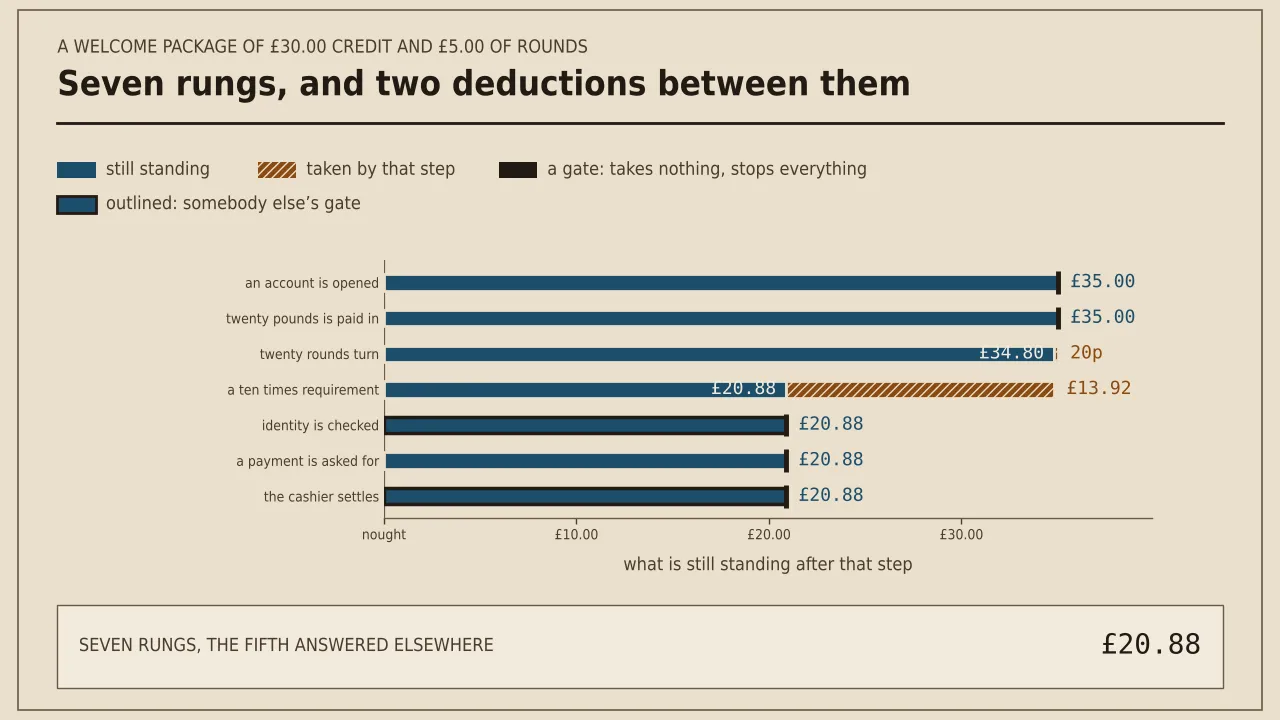
£13.92 of a £34.80 package goes on clearing the condition, which is two pounds in every five of it
Four pence to the pound is the rate underneath, and it holds across all £348.00. Nothing quickens, nothing waits until the end, and the three rungs below take not a penny between them.
Lift the multiple and the package runs dry. Twenty-five passes at four pence a pound finish £34.80, and the twenty-fifth is where expectation reaches nought. Multiples of sixty are on the regulator’s record off the rule sheet, claim 94, and sixty here puts the expression under nought, reporting what is expected rather than what anybody owes.
3
Twenty rounds, then one thousand three hundred and ninety-two
Two counts of rounds sit on this page. Twenty rounds are the gift. £348.00 at 25p is one thousand three hundred and ninety-two rounds, and those are the work.
Seventy times the gift, put another way. The multiple and the round decide that ratio between them, and neither of the two is printed on a banner next to the word welcome.
Seven rungs are on the ladder and not one thousand four hundred and twelve. Kinds and instances are different quantities. The second belongs in prose where the first can be read beside it.
Reels carry a published floor under their pace. A reel may not restart within 2.5 seconds off the rule sheet, claim 107, the control released and pressed for each round, and automatic play is barred off the rule sheet, claim 115. Five seconds is the figure once the game is not a reel at all, player-against-player poker excluded off the rule sheet, claim 108, dated 17 January 2025 off the rule sheet, claim 114.
Fifty-eight minutes is one thousand three hundred and ninety-two rounds at the shorter floor. One hour and fifty-six is the same count at the longer one. A package saying nothing about where the staking happens is a package that doubles or halves an evening without mentioning it.
Against the shorter figure the offer pays about 36p a minute of pressing. Against the longer one it pays about 18p. Both are rates at the fastest the floors allow, and nobody plays at that speed for an hour.
A penny a round is what the cost comes to. £13.92 divided between one thousand three hundred and ninety-two rounds is a penny each, and a penny is beneath anybody’s notice. Two fifths of a package leaves by that route.
The twenty given rounds have their own arithmetic and it is finished already. £5.00 of face, 96 pence back in the pound, £4.80 landing. Fifty seconds of pressing at the published floor, for a fifth of a pound.
4
What each half would be worth on its own
A bundle invites a question nobody answers on the offer page. Thirty pounds of credit on its own, and five pounds of rounds on its own: what does each come to once a ten times condition has been over it?
Credit first. B is £30.00, nothing having played it. £300.00 is the staking, £12.00 is the expected cost of pushing it through, and £18.00 is what comes out at the far end.
Rounds second. £5.00 of face returns £4.80 at 96 pence in the pound. £48.00 is the staking, £1.92 the cost, and £2.88 the survivor.
Add the two answers: £18.00 and £2.88 make £20.88. Which is the figure the bundle gave, to the penny, and the agreement is not a coincidence.
It holds because every operation on this chain is a multiplication. Each half is multiplied by the same return, the same multiple and the same rate, and a sum of products equals the product of the sum when the factors are shared. The bundle is worth its parts added up and not a penny more.
Which is worth knowing before a reader compares two offers. A package described as credit plus rounds is not a bigger thing than the two offers separately. It is the two offers separately, printed on one banner, under one condition.
The arithmetic also shows where a difference could hide. £300.00 and £48.00 add to £348.00 only because both halves carry ten times. Put fifteen times on the credit and the credit half alone asks for £450.00, its expected cost rises to £18.00, and £12.00 survives instead of £18.00. The pot reading cannot reach that figure at all.
There is a second comparison the two figures make available, and it costs nothing to run. £18.00 against £300.00 of staking is six pence of survivor for every pound staked. £2.88 against £48.00 is the same six pence. The rate is identical on both halves because the ceiling and the return are, so a reader choosing between credit and rounds is choosing between sizes and not between rates.
So a reader with a bundle in front of them has two things to look for and one of them is invisible. The valuation of each half is the first, and this page has shown both. Whether one multiple covers the whole package is the second, and nothing read here obliges a cashier to say.
5
The limit that belongs at the first two rungs
Rung one is a registration and rung two is a first deposit. Those two moments are where a licence puts one particular duty, and this chain carries it at neither.
A licensed system has to give a customer somewhere to set a money limit of their own, open from registration onwards off the rule sheet, claim 23, at account level at least and typed in rather than picked off a list off the rule sheet, claim 25. Reaching it has to be easy: a link off the home page, a route from a deposit screen, as few clicks as can be managed off the rule sheet, claim 28.
Exactly when the prompt is owed is put differently on two of the regulator’s pages, and the difference is substantive off the rule sheet, claim 55. The live standard names the sign-up or the opening payment off the rule sheet, claim 23. Both of those are rung one or rung two here.
So this is a comparison with a place on the ladder rather than a general complaint. Licensed, a reader meets a box for their own ceiling as the twenty pounds goes in. Here they meet a package valued at £34.80.
What such a ceiling does once set is published as worked arithmetic. A daily £10 beside a weekly £100 leaves £70 available in the week off the rule sheet, claim 27, the tightest figure governing throughout. No figure of that sort governs the deposit on this chain.
The same two rungs are missing something about disclosure as well. Players are told to hunt for the restriction an introductory offer keeps quiet, and a spend owed before a bonus lands is the example given off the rule sheet, claim 87. No such figure turned up in the reading, so no rung carries one.
A package this size also runs near a rule about who is offered what. Where a licensee has marked a customer high value, an incentive has to square with what the licence exists to protect, and the guidance written on that has to be taken into account off the rule sheet, claim 59. A welcome offer is aimed at the opposite case, somebody with no record at all, and out here the label reaches neither end.
Four duties, all of them landing on the two rungs where this chain wants a registration and a sum of money. Not one of the four is a figure, which is why not one of them is on the ladder. All four would have changed what a reader saw before agreeing to £348.00.
6
How a package like this has to be shown, where it is shown at all
£348.00 is the figure that decides this offer and it is on no banner. That is a fact about presentation rather than arithmetic, and the rules about presentation are published.
A condition counts as significant when leaving it out would mislead, and the code then wants it where a reader will meet it off the rule sheet, claim 61. For a casino promotion the conditions likely to count are the ones a reader would need to work out what the offer costs them off the rule sheet, claim 71. The base duty under the same code is simply not to mislead off the rule sheet, claim 80.
Where they sit is addressed too, and distance from the offer is what the guidance treats as the test off the rule sheet, claim 63. A significant term is meant to travel with the offer rather than a page away from it off the rule sheet, claim 79.
Both of those are rules about where a reader is standing when the condition reaches them. Inside the advertisement is one place. Beside the offer on the page where an account is opened is the other. £348.00 appears in neither on this chain, which is why a reader finds it here instead.
Lay that over the package. £30.00 and twenty rounds are the headline. £348.00 of staking and a figure of ten are the conditions, and both are arithmetic a reader cannot do without them. On the test above they are significant on any reading.
The code also governs who may appear in such an advertisement. Nobody who is or looks under twenty-five may be shown gambling or in a significant part off the rule sheet, claim 76, and material must not have strong appeal to children or young people off the rule sheet, claim 75. Away from an operator’s own site, including on social media, the under-twenty-fives stay out off the rule sheet, claim 80.
None of those four reaches the cashier behind this chain, and one detail of the sourcing should be said plainly. The code section carrying them has no publication or revision date on it, only a copyright line off the rule sheet, claim 77, and the advice page dated 11 September 2025 does not call that a last-updated date off the rule sheet, claim 68. The rules are quoted here as they were read.
A fifth rule comes from the advertising regulator rather than from the licence, and it is why two particular words are absent from this page. Calling an offer free is ruled out where qualifying costs the customer anything of their own off the rule sheet, claim 60. Twenty pounds goes in before any of this starts, so the word has no business near the package.
Which is the whole of the presentation question. Four duties about what has to be shown and where, one about a word that may not be used, and a chain that answers to none of them. £348.00 is still the figure that decides the offer, and this page is where a reader meets it.
7
The fifth rung, where £20.88 stops being arithmetic
£20.88 reaches the fifth rung whole, and the check standing there takes nothing off it. Every figure above was a sum a reader could repeat. From that rung down, none is.
Under a licence three items are settled before play off the rule sheet, claim 10, and incentive money buys no exemption off the rule sheet, claim 18. What may be asked for, and when, is told to a customer before a deposit off the rule sheet, claim 12. Licensed, this rung would be the first on the chain with its appetite already on the record.
Asking at the moment of payment instead is shut off off the rule sheet, claim 11. Read from the player’s side, laundering checks belong at the start off the rule sheet, claim 15, and a settlement postponed over them is capable of being a breach off the rule sheet, claim 16.
Out here the rung has no settled position, no clock and no list. Blocked payouts and ceilings nobody reaches are recorded off the rule sheet, claim 135, with unfair dealing, money and recourse all named in the same place off the rule sheet, claim 134.
Three rungs sit at the fifth and below. The sixth is the reader’s: ask today or ask next month, and £20.88 is there either way. The fifth and the seventh belong to the cashier on any reading, and the figure is in their keeping.
Part payment is not on offer at either. £20.88 goes whole or it does not go, and two outcomes are all this chain has, with no third between. The £13.92 higher up was another kind of thing entirely: a fixed proportion of a fixed pot, taken by a calculation with no judgement in it.
Hence the fifth rung and not the fourth. £348.00 at four pence to the pound is £13.92, and nobody picked that. The fifth rung is picked, and £20.88 is what lies in front of whoever picks it.
A licence would also have said where a refusal goes next. An approved dispute body has to be used off the rule sheet, claim 45, and a player is directed to the business first off the rule sheet, claim 47. Both presuppose the licence this chain has not got, so a refusal at the fifth rung closes the matter.
8
£20.88 behind a counter nobody licenses
The figures above are read as kindly as the published rules permit, and the kindness is borrowed from a licence. This desk carries no Great Britain licence.
British readers are shown a welcome package of this shape by a cashier that holds nothing from the regulator here. Three duties of a British licence can be set against the chain above. The limit facility is one, and it belongs where this chain starts: open from the point of registration off the rule sheet, claim 23, at account level, typed in rather than chosen from a list off the rule sheet, claim 25. Identity is another, settled before play rather than at the payout off the rule sheet, claim 10, with the documents named in advance of a deposit off the rule sheet, claim 12. The exclusion scheme is the third: joining it is part of being licensed here off the rule sheet, claim 181, and the scheme says it cannot reach beyond its own membership off the rule sheet, claim 183. Registering in it is a result down here and not a remedy, and this site sets out no procedure for anything.
The first of those three would have altered rungs one and two. The second would have altered rung five. Neither alters a money figure, and that is the straight way to put it: the sums above are what the package is worth, and a licence would have changed when a reader met the conditions rather than what meeting them cost.
A fourth duty bears on the hour of pressing rather than on the package. A licensed game may not celebrate a return no better than the stake off the rule sheet, claim 112, so the noise and the animation come off an outcome that gave nothing back. Across one thousand three hundred and ninety-two rounds, that rule does most of the work separating an honest balance from a flattering one.
One published consequence falls on the cashier rather than on the reader. Trading unlicensed is illegal, and two things may follow: the regulator may act, and the big payment organisations may pull the payment facilities off the rule sheet, claim 129. Anybody with £20.88 sitting behind the fifth rung has an interest in the second.
An industry notice of 20 January 2025 reads best as one proposition rather than as a run of entries, since every entry describes a thing a regulator insists on and nothing here is obliged to do. Customers who have shut themselves out are frequently sought off the rule sheet, claim 130, and games from licensed suppliers have been seen where no licence is held off the rule sheet, claim 131.
One fact leans the other way and the page would tilt without it. An unlicensed provider is who the statute reaches off the rule sheet, claim 3, and no answering offence is written for a customer. Protection is what a reader gives up with the licence. Seven rungs over a package of £34.80, the fifth answered by a stranger, £20.88 waiting at it, and the reader’s twenty pounds lodged alongside.
Asked at the booth
- What is a welcome package of credit and rounds actually worth
- The credit enters at £30.00 and the rounds at £4.80, so £34.80 goes into the condition and £20.88 comes out of it.
- Why do the two halves enter at different figures
- Credit is handed over as a sum. Rounds have to be played before anything reaches a balance, so what enters is what they are expected to give back.
- How much staking does the package carry
- £348.00, which is ten times £34.80 and one thousand three hundred and ninety-two rounds at the 25p this page counts with.
- Does it matter whether the multiple is applied to the pot or to the halves
- Not at ten times on both: either reading gives £348.00. A term setting fifteen times on the credit and ten on the rounds would give £498.00.
- Which rung does the page report
- The fifth. Identity is checked there, £20.88 is standing, and the answer is given on the far side of the counter.
- How long is the staking at the published floors
- Fifty-eight minutes on a reel. One hour and fifty-six under the five second figure, which governs the casino games that are not reels.
- What would a deposit limit have done here
- A licensed system puts the facility in front of a customer as they sign up or as the first money goes in, which is rung one or rung two here. Neither carries one.
- Is the £20.00 deposit counted anywhere on the ladder
- It is not. The money was the reader’s already, and £55.00 would describe neither the gift nor the amount at risk.
- Is a package worth more than the two offers separately
- No. £30.00 of credit alone leaves £18.00 and £5.00 of rounds alone leaves £2.88, and those add to the £20.88 the bundle gives.
- Why is £348.00 not on the banner
- Nothing read for this page requires it there. The presentation rules that would have required a significant condition to be shown prominently bind licensees only.
- Is a British licence behind any of this
- There is none. Three duties of one were priced above: the limit facility, the identity requirement, and compulsory membership of the exclusion scheme.