Terms read 26 October 2026 Counted in 2026
Bingo sign up bonus: £23.04 at the fifth of seven rungs
The labour on this key cannot be turned into minutes, because nobody has published a floor under the pace of a bingo game. £40.00 is the face: two hundred tickets at 20p, bought with a first deposit of £15.00. A prize fund of 96 per cent brings £38.40 to the account. A ten times condition keeps £15.36 and £23.04 travels to the fifth rung, where somebody else answers.
How many steps seven Open, deposit fifteen pounds, play the tickets, stake £384.00, be checked, ask, be paid. The first gate somebody else holds the fifth A check whose list and whose clock are both unpublished. Standing when it is reached £23.04 Three fifths of the £38.40 the tickets are expected to return.
| What has to happen | Who takes this step | What it leaves standing | Printed where |
|---|---|---|---|
| An account is opened | the reader | £40.00, or nought unopened | the offer’s own count |
| Fifteen pounds is paid in | the reader | £40.00, or nought unfunded | the qualifying deposit |
| Two hundred tickets are played | the house’s arithmetic | £38.40 | this publisher’s assumed fund |
| £384.00 is staked over | the house’s arithmetic | £23.04 | the published British ceiling |
| Identity is checked | the cashier | £23.04, or nought unverified | a licence condition, not a term |
| A payment is asked for | the reader | £23.04, or nought unasked | the cashier’s withdrawal form |
| The cashier settles | the cashier | £23.04, or nought unpaid | nothing published behind this |
| What seven rungs leave | two rungs across the counter | £23.04 | this page |
1
Two hundred tickets, and the fifteen pounds underneath them
Two hundred is the count and twenty pence is the price. The price is a figure this publisher has had to supply, no published rule putting a value on a given ticket off the rule sheet, claim 89. Multiplied together they make £40.00.
Both of those are declarations and both are made before any arithmetic happens, which is the only order in which an arithmetic page is worth reading. Halve the price and the face halves to £20.00. Raise the count to three hundred and the face goes to £60.00. The method holds through either change and every figure below moves.
Nothing of that £40.00 is in an account yet. A ticket buys an entry to a game, so the money appears only once all two hundred entries have been played, and what appears is whatever the prize fund returns.
£38.40 is the return at 96 per cent. That is the second figure this page supplies, and of the two it is the harder to verify, for a reason two parts below, which is that no rule obliges a bingo room to print a percentage anywhere.
Fifteen pounds buys the tickets and then drops out of the arithmetic, having been money all along and needing no offer to make it so. A total of the two would describe nothing anybody holds, so the instrument prices the entries and lets the deposit stand to one side.
Two rungs go by before anything moves. Opening an account costs nothing off the face and paying fifteen pounds in costs nothing off it either, so £40.00 crosses both unchanged. Both are drawn because there is no chain at all without them.
Whether a ticket’s winnings count as bonus money or as cash has never been settled anywhere off the rule sheet, claim 90. The ten times ceiling catches what lands as bonus funds, and says nothing about the standing of the entry, which is why the fourth row names its ceiling as a borrowed one.
A deadline would have been a rung and there is no figure for one. The advertising code counts a limit on claiming time as a significant condition off the rule sheet, claim 62, and the reading turned up no such limit here, so the ladder leaves the rung out rather than drawing an empty one.
Two hundred entries, twenty pence each, £40.00 of face, £38.40 landing, and fifteen pounds of the reader’s own alongside. The whole position rebuilds in two multiplications.
2
Ten times £38.40, and the £15.36 it takes
A condition measures against £38.40 and not against £40.00, since £40.00 never reached anywhere it could be staked from. A requirement under a British licence stops at ten times off the rule sheet, claim 91, on a ceiling carrying the date 19 January 2026, and the licences held out of that rule are the technical and the software ones off the rule sheet, claim 93.
Ten times £38.40 is £384.00 of staking. Set B at £38.40 and W at ten, with nothing divided: E = B × (1 − W × (1 − RTP) ∕ g) answers £23.04. A requirement is wagers reaching a value somebody has stated off the rule sheet, claim 92, and the definition holds nothing else.
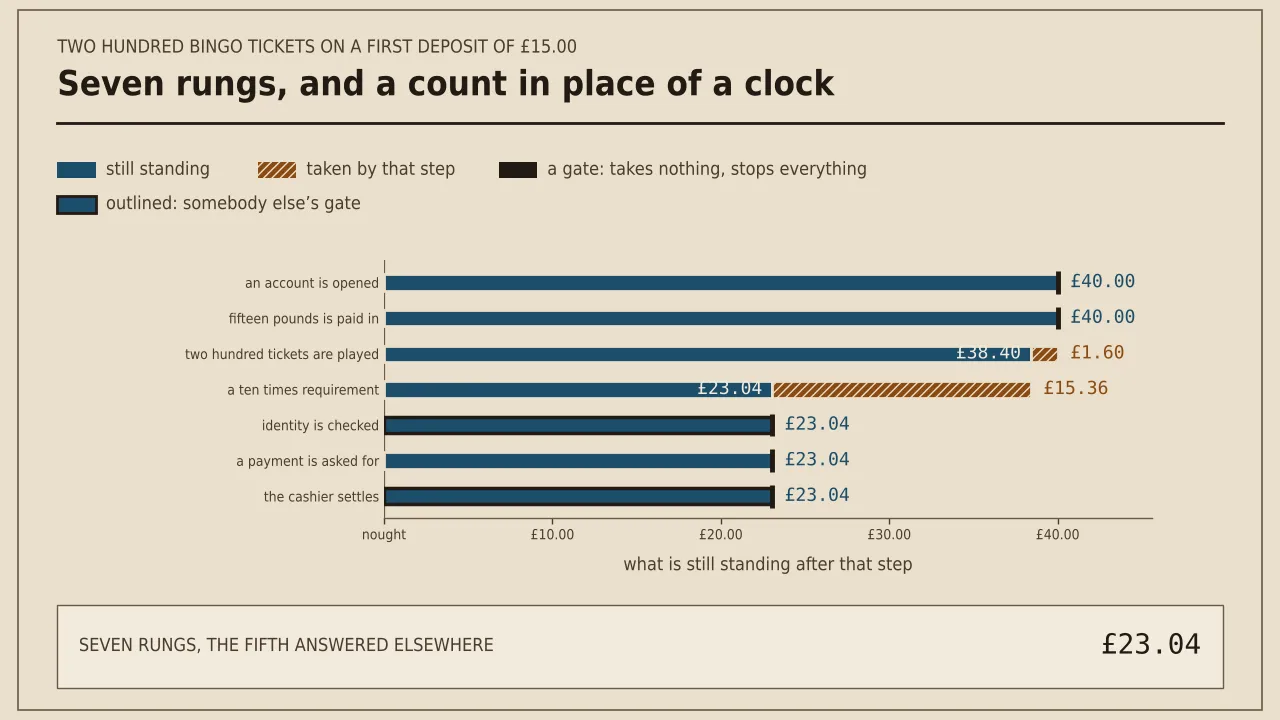
£15.36 of the £38.40 the tickets returned is spent on the condition, two fifths of it and the largest single deduction on the chain
Money moves at two of the seven rungs and stands still at five. The entries take £1.60, which is what a 96 per cent fund keeps of £40.00. The condition takes £15.36. Both arrive on schedule with nobody weighing anything, and that is precisely why neither can be this page’s finding.
Behind £15.36 is a rate of four pence in the staked pound, level over the whole £384.00. No charge is saved for the end, no rate steepens with the count, and the last three rungs take nothing between them.
£23.04 describes the middle of many runs rather than the result of one. Two hundred entries can come back whole and can come back with nothing, and the instrument prints where a great many of them average out. Every money figure here is that kind of figure.
Raise the multiple and £38.40 runs out. At four pence a pound, twenty-five passes account for all of it, so nought arrives on the twenty-fifth. Sixty times sits on the regulator’s record off the rule sheet, claim 94, and sixty here drives the expression below nought, which describes an expectation and never a debt.
One comparison belongs here. The expected cost of qualifying, £15.36, is a little more than the £15.00 the reader actually risked, and the cost is taken out of the entries rather than out of that fifteen pounds. On a sign up offer the cost of qualifying is the figure a banner never carries.
3
Nineteen hundred and twenty entries, with nothing to time them by
£384.00 at twenty pence an entry is nineteen hundred and twenty entries. A count is all this page can give, because the published floors under pace are written for other products.
Two floors exist. Slots have 2.5 seconds between cycles off the rule sheet, claim 107. Games in the casino category other than slots have five, with player-against-player poker set aside off the rule sheet, claim 108, dated 17 January 2025 off the rule sheet, claim 114. Bingo stands as a category in its own right off the rule sheet, claim 99, so neither figure is addressed to it.
Hence no sentence on this page saying how long nineteen hundred and twenty entries take. A duration has to be computed from a floor and there is no floor here to compute it from. A figure put there anyway would rest on nothing, and this page does not do that.
The absence is not neutral, and its direction is worth stating. On a reel chain the floor protects somebody: it bounds how fast a condition can be worked through and so how long an evening runs. On a bingo chain nothing was put there to remove, and a room may serve entries as quickly as a screen will carry them even with a licence in hand.
A second gap sits next to it. Those stake caps of £5 and £2 belong to online slots off the rule sheet, claim 124 and go no further off the rule sheet, claim 127, so the twenty pence here is under no published limit even where a licence applies. Two of the figures a reader might go looking for were never written for this product.
What is published for bingo is the bar on anything running unattended off the rule sheet, claim 115, which addresses automatic play rather than speed, and which belongs to the same licence this chain stands outside.
So the honest statement about the labour is a count. Nineteen hundred and twenty entries is the figure, it is nine and a half times the two hundred given away, and how long it takes is the room’s business and nobody else’s.
There is a comparison the missing floor makes impossible, and saying so is part of being honest about it. On a reel chain this publisher can set a sum of money against a count of minutes and get a rate per minute, which is the most useful figure such a page produces. Here the denominator does not exist, so no rate of that kind appears anywhere above, and a reader comparing this key with a slots key has one fewer column to compare.
Cost per entry survives the absence, being arithmetic rather than timing. Nineteen hundred and twenty entries share £15.36, which is four fifths of a penny apiece, and nobody playing could perceive four fifths of a penny going.
The same absence is why the row on the instrument reads £384.00 rather than nineteen hundred and twenty times twenty pence. One condition takes one rung, its size belongs in prose, and its duration belongs nowhere until somebody publishes a floor.
4
What a licensed bingo game owes a player before the first entry
Three published duties govern what a player sees before and during a licensed bingo game. All three cover bingo. None of them covers the room behind this chain.
The rules are the first of the three. A licensee has to make the rules of the game reachable before anybody commits, has to make them accurate and complete, and has to try to make them comprehensible off the rule sheet, claim 122. Those are three separate burdens inside one duty and the chain above carries none of them.
The state of the game is the second. A licensed system has to keep a player informed of where the game has got to as it runs, a duty the guidance lifts off lotteries and leaves on bingo off the rule sheet, claim 122.
The prizes are the third. What may be won, or the method by which it is worked out, has to be within reach before a commitment off the rule sheet, claim 123, and the standard carrying that duty stops there with no further limb. It is addressed to gaming, which takes bingo in.
Then the duty a reader expects to help and which does not. Four items will satisfy the obligation to let somebody judge their chances off the rule sheet, claim 120, and any one of them will do rather than all four off the rule sheet, claim 121. On bingo the guidance goes further still: a description of prize allocation will do by itself off the rule sheet, claim 121.
Which means a licensed bingo room can discharge every one of those duties and publish no percentage anywhere. The 96 per cent on this page could not be verified against a licensed game, let alone this one, and that is a limit on this publisher’s arithmetic rather than an accusation about anybody.
Keep the two findings apart. Three duties would have handed a reader the rules, the running state of the game and the prize structure, and all three are missing here because the licence is missing. A fourth would have handed over a figure only if the room felt like it, and that one would have been missing in any case.
So £38.40 rests on a declaration, stated at the top of this page and used in one multiplication. A reader who prefers 94 per cent can take £37.60 through the same three steps and finish at £22.56, and the shape of the answer will not move.
5
One category, and the line a bundle would have crossed
Two hundred bingo tickets are one kind of thing, which keeps this offer clear of a rule that catches a good many welcome packages.
An incentive may not take in more than one product category off the rule sheet, claim 99, and bingo is named as a category of its own by that rule off the rule sheet, claim 99. Entries by themselves therefore occupy one category and the rule finds nothing to object to.
Put anything from another category alongside and the position turns at once. Bingo entries beside a casino match make two categories inside one incentive off the rule sheet, claim 102, which is the arrangement the rule exists to prevent.
The aim is narrower than it looks at first. What gets caught is a single incentive whose conditions are bound to each other and run in common off the rule sheet, claim 101, not every offer a room happens to be running on the same morning. Two offers, separately conditioned, remain two offers.
None of that binds this chain, and the reason for setting it out anyway is arithmetical. A bundle across two categories would have carried two valuations, because entries give up a share before any condition begins and credit does not. One category here means one valuation and one multiplication.
£38.40 is that single valuation. £384.00 is ten times it, £15.36 is the four per cent that £384.00 of staking costs, and nothing has to be split between halves that behave unlike one another.
So the plainness here is a property of the offer and not of the writing. Seven rungs, two deductions, one kind of money, one multiple, and a count of entries standing in for a duration nobody has published.
A reader comparing this against a package should keep that in view. The same headline figure spread over two categories would not arrive at £23.04 by this route, and on this heading the route is the only part a reader can check for themselves.
One further consequence of staying inside a single category is worth a line, and it concerns what can be compared with what. Two hundred entries at twenty pence and a thousand entries at four pence have the same face, the same £38.40 landing and the same £23.04 at the end of it. The count and the price can be traded off against each other without touching a money figure on the ladder, which is why the face and not the count is what a reader should be comparing between two bingo offers.
That is a sharper test than it looks. A room advertising five hundred entries has advertised a count and nothing else. At eight pence each those five hundred are the same £40.00 of face as the two hundred counted here, and the arithmetic below the face would be identical to the penny.
6
The fifth rung, and what £23.04 is waiting on
£23.04 reaches the fifth rung undiminished, and the check waiting at it removes nothing. Up to that point every figure was one a reader could arrive at alone. From it onwards, not one of them is.
Under a licence three items are closed before anybody plays off the rule sheet, claim 10, and an incentive is no reason to leave them open off the rule sheet, claim 18. The papers that might be wanted, and the moment they might be wanted, go to a customer ahead of a deposit off the rule sheet, claim 12. Licensed, this rung would be the first one, and what it wanted would be on the record before anybody paid anything in.
Keeping the demand back for the payout is ruled out off the rule sheet, claim 11. Seen from where a player stands, the laundering checks belong at the beginning off the rule sheet, claim 15, and a payment held up over them may be a breach by itself off the rule sheet, claim 16.
Beyond the licence the rung has no anchor. No source read for this guide fixes where a room without one puts the check, what it will accept, or how many days £23.04 sits there while it decides. Payouts stopped, and withdrawal limits pitched where nobody arrives, are both on the record off the rule sheet, claim 135, and the same source puts the loss on the dealing, on the money and on the remedy together off the rule sheet, claim 134.
Of the three rungs from the fifth down, one belongs to the reader. A request can be lodged this evening or next month and £23.04 waits through either. The fifth and the seventh are the room’s on every reading of the chain.
Neither of those two pays a portion. Either the whole £23.04 moves or it stays, so this chain finishes at one of two numbers and never between them. The £15.36 above it was a different kind of thing: a settled fraction of a settled sum, lifted off by a calculation that exercises no judgement.
A minimum payment is the one thing that could swallow a figure of this size, and no minimum turned up in the reading. None is drawn, therefore, and a minimum pitched above £23.04 would finish this chain at nought without breaching a single published rule.
Which puts the finding at the fifth rung rather than the fourth. £15.36 is four pence in the pound over £384.00 and no person settled on it. The fifth rung is settled on, and £23.04 is the figure in front of whoever settles it.
The sizes are what make the rung worth the attention. £23.04 of winnings is more than half again the fifteen pounds that qualified for them, and that fifteen pounds is sitting in the same place while the question is decided. What becomes of a deposit held by a room under no British condition is something no source consulted here addresses.
7
£23.04, and nothing licensed behind the tickets
Every doubt on this page has been resolved in favour of the published rules, and those rules come out of a licence. These tickets are covered by no Great Britain licence.
A bingo sign up offer of this shape is put before readers in Great Britain by a room answering to nobody here. Set three licence duties against the chain above. The duty about the rules bites hardest on a bingo chain: the rules of the game within reach before anybody commits off the rule sheet, claim 122, with the prizes and the way they are arrived at within reach too off the rule sheet, claim 123. Identity is the second, closed before play and not at the payout off the rule sheet, claim 10, with the papers named ahead of a deposit off the rule sheet, claim 12. The exclusion scheme is the third: it comes with a British licence off the rule sheet, claim 181, and operators outside its membership are stated to be past what it can do off the rule sheet, claim 183. Joining is an outcome rather than a cure, and no procedure of any sort is set out on this site.
The first of those three has no substitute on a game of this kind. Somebody at a reel can at least watch it and count. Somebody at a bingo game has only the rules to tell them what £384.00 of entries is buying, and the duty to supply those rules belongs to a licence this room does not hold.
More than the word unlicensed has been published about this market, and a case closed on 23 July 2026 is the clearest of it. A supplier settled at £4.75m over games of its own reaching six sites that held no licence and were open to customers here off the rule sheet, claim 132. What the findings in that case had in common was a loss of control over where the games went and over who was playing them off the rule sheet, claim 133.
Another case went further and required an outside audit, commissioned independently, over the operator’s laundering and safer gambling controls off the rule sheet, claim 85. The common thread in both is that controls of that sort exist because somebody can be held to them, and nobody behind this chain can be.
A notice of 20 January 2025 is best read as a single proposition rather than as the entries it carries, each entry being a thing a regulator demands of a licensee and nobody out here demands of anyone. One of the things it records is that a customer who has shut their own account is a target off the rule sheet, claim 130, and another is that a licensed supplier’s work has been seen on sites holding nothing off the rule sheet, claim 131.
A fact pointing the other way keeps this page upright. It is the provider of the facilities that the statute reaches off the rule sheet, claim 3, and nothing in it is written against a customer. What is lost with the licence is protection: seven rungs over two hundred entries, the fifth of them answered by a stranger, £23.04 held at it, and fifteen pounds of the reader’s own money lodged in the same room.
Asked at the booth
- What does a bonus of two hundred bingo tickets come to
- A face of £40.00 at the figures declared here puts £38.40 in an account, and the condition leaves £23.04 of it.
- How much staking does the bonus ask for
- £384.00, which is nineteen hundred and twenty entries at twenty pence and nine and a half times the two hundred given away.
- How long would that take
- Nobody has published a figure it could be worked out from. The floors under pace belong to slots and to the casino category, and bingo is neither.
- Why does the ladder carry no duration
- Because a duration would have to come from a published floor. There is none for bingo, and a figure put there anyway would rest on nothing at all.
- Can the 96 per cent be checked against a bingo game
- Not even a licensed one. Describing how prizes get allocated is enough to satisfy the standard, so no percentage need appear anywhere.
- Which of the seven rungs carries the finding
- The fifth, with £23.04 standing and a document check in the way. It is the first rung answered by somebody the reader never deals with.
- Does qualifying cost more than the deposit
- By a little. £15.36 is the expected cost against £15.00 paid in, and the cost comes out of the entries rather than out of the deposit.
- Is there a ceiling on what a bingo ticket may cost
- None that is published. The £5 and £2 caps were written for online slots, so twenty pence answers to no limit even under a licence.
- Could this bonus be bundled with casino rounds
- Not by a licensee. One incentive may not take in two product categories, and bingo entries beside a casino match are two of them.
- Does anybody hold a British licence for this
- Nobody does. Three duties of one were set against the chain: supplying the rules of the game, settling identity before play, and joining the exclusion scheme.