Terms read 26 October 2026 Counted in 2026
Mastercard casino: eight rungs, and rung two belongs to the scheme
Eight things have to hold before a matched offer bought with plastic turns into money, and the first of them outside the reader’s hands is not the bank. It is the network the card runs on. Twenty pounds at a one for one match puts £20.00 of credit on the table, and the play-through is reckoned to leave £12.00. Rung two asks whether the cashier may still take cards at all, which is a question about the cashier, settled by a company that has never heard of the reader and will never explain itself to them.
How many steps eight Serve, authorise, credit, stake, check, request, remit, with the opening. The first gate somebody else holds rung two A payment network either keeps serving that merchant or stops. Standing when it is reached £20.00 The whole promise, rung two arriving before any staking begins.
| What has to happen | Who takes this step | What it leaves standing | Printed where |
|---|---|---|---|
| An account is opened | the reader | £20.00, or nought unopened | the offer’s own headline |
| The scheme still serves the cashier | the card scheme | £20.00, or nought withdrawn | the regulator’s own warning |
| The card is authorised | the issuing bank | £20.00, or nought declined | nothing published behind this rung |
| The matched credit lands | the cashier | £20.00, or nought withheld | nothing published behind this rung |
| Ten times is played through | the house’s arithmetic | £12.00 | the published British ceiling |
| Identity is checked | the cashier | £12.00, or nought unverified | licence condition 17.1.1 |
| A payment is asked for | the reader | £12.00, or nought unasked | the cashier’s withdrawal form |
| The cashier sends it back | the cashier | £12.00, or nought unpaid | nothing published behind this rung |
| What eight rungs leave | five gates, three deciders | £12.00 | this page |
1
Eight rungs, and the party that has never heard of the reader
Most readers asked to name the companies in a card payment would name two: the bank and the shop. A chain counted properly has three, and the third one is the subject of this guide. A network sits between the other two, decides which businesses its rails may be used for, and is the only party on this chain with no relationship to either the reader or the reader’s bank.
So the eight rungs divide like this. Two are the reader’s, at the top and at rung seven. One is a network’s, at rung two. One is a bank’s, at rung three. Three belong to the cashier, at rungs four, six and eight. Rung five belongs to nobody, being arithmetic rather than anybody’s call. Five of the eight take nothing at all and can still finish the chain, with three different companies holding those five between them.
Three deciders on one chain is the most this publisher counts under this heading anywhere outside the keys naming a coin, and the count is what this guide reports. The column, the inks and what a gate mark means are explained on their own page, which leaves this guide free to spend its words on the network.
Why count rung two separately from rung three at all. Because they answer different questions about different parties. Rung three asks whether this account may spend twenty pounds. Rung two asks whether this merchant may be sent twenty pounds by anybody using these rails. A reader who passes the first and fails the second has done nothing wrong and has no chain, and no amount of money in the account will change the answer.
The regulator puts that second question on the record, which is why rung two has a source in its fourth column and rung three does not. A business found trading unlicensed may be cut off from taking payments at all, the regulator naming the large payment systems organisations as the parties able to do the cutting and giving a card network as its instance off the rule sheet, claim 129. That is the whole published basis for rung two, and it is a sentence about what may be done to a cashier rather than a rule about what a reader may do.
One consequence follows for anybody reading a payment screen. A network’s mark beside a box is evidence that the rails were open when the page was built. It is not evidence that they are open now, and it is not evidence of anything at all about who is behind the box. The count of eight rungs holds either way, which is the advantage of counting rungs rather than reading logos.
Eight is also a count worth setting against its neighbours, since the only way to read a number like this is next to another one. Counted without the network as a party of its own, the same plastic gives seven. Counted with a wallet in front of the card, it gives eight again by a different route, the second outside rung then sitting at the far end rather than the near one. Counted with a voucher that cannot receive a payment, it goes to eight with the extra rung belonging to the reader. The number alone is therefore nearly useless, and the number with its owners attached is the whole finding.
Why this guide counts the network where the card page does not is a question of evidence rather than of taste. Rung two is here because the regulator has published a consequence that attaches to it, and a rung with a published consequence behind it is a rung this site will count. Nothing equivalent is published about a network and a licensed cashier, which is why the shorter count is the right one when the cashier holds a licence and this one is the right count when it does not.
2
£20.00 of credit, and the £12.00 ten times is expected to leave
Twenty pounds buys £20.00 of credit at a one for one match, and the twenty the reader paid stays the reader’s own and out of the column. £20.00 is what has been promised, and eight rungs stand in front of it.
Twenty pounds is a figure this publisher chose, with no published floor underneath it, so it is declared here and carried through every sum below. What the match does to the staking is not a matter of choice: a one for one match on twenty pounds means £200.00 has to go through a game, and a louder headline would raise both halves of that in step off the rule sheet, claim 103.
Ten is the multiple at rung five, that being where a licence stops a multiple off the rule sheet, claim 91. Four per cent of £200.00 is £8.00, this publisher putting a reel’s return at ninety-six per cent as a general figure and reading it off nothing in particular. So E = B × (1 − W × (1 − RTP) ∕ g) gives £12.00, and £8.00 is the only sum this chain loses without a decision behind it.
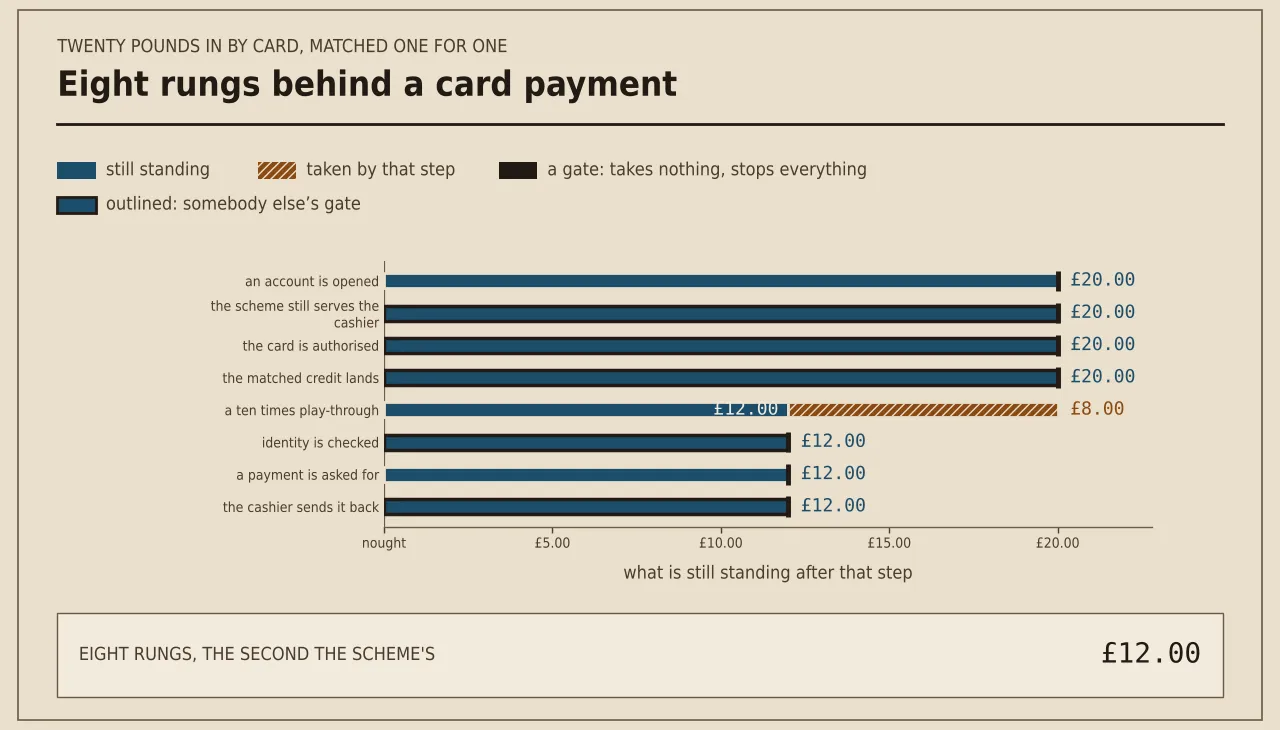
£8.00 of the £20.00 goes at rung five, two fifths of the promise, and the seven rungs around it move the figure by nothing
Two numbers, then, and they answer different questions. Eight is how many things can stop this chain. £200.00 is how much staking one of those eight things asks for. Mixing them would turn an obligation into a count of conditions, and reporting either alone would flatter the offer in a different direction.
Nothing in the eight depends on the twenty. Ten pounds of credit would leave £6.00 after the same multiple and the chain would still be eight rungs with a network at rung two. That is the result a key naming a card scheme actually supports: the money is a choice this publisher made, and the chain is a property of the rails.
3
Rung two: a verdict on the cashier, delivered to the reader
£20.00 is standing at rung two and the rung is not about the reader. It asks whether a named merchant may still be paid over these rails, and the party answering has no account with the reader, no contract with the reader and no duty to tell the reader anything. A reader learns the answer by watching a payment fail.
Every other rung has somebody on the far side of it wanting something from the reader. The bank wants an account in order. The cashier wants an identity and £200.00 put through a game. At rung two nobody wants anything from the reader whatever, who is a bystander to a judgement passed on somebody else and can lose the chain by it with the promise entire.
What makes this publishable rather than speculative is that the consequence is on the record while the rule is not. The regulator says that a business operating unlicensed may lose its payment facilities and names the networks as the parties who may withdraw them off the rule sheet, claim 129. What no source available here sets out is when that happens, on what notice, or by what test. So rung two carries a sourced entry in its fourth column and an unanswerable question beside it, which is the honest state of the evidence.
Hold rung two beside rung four for a moment, because the pair of them is the whole of what a card key can teach. At rung four a cashier decides whether to hand over a credit it advertised. At rung two a network decides whether that cashier may be paid by anybody. One of those is a decision about the offer. The other is a decision about the market the offer sits in, and the reader is the only party to it with twenty pounds at stake.
A withdrawal of service costs the reader twenty pounds of nothing: the money stays where it was and the chain never starts, which is why £20.00 crosses that rung unaltered. There is also nobody to complain to, since the party that decided had promised the reader nothing in the first place.
Payments stop for other reasons too, and the consequence is the whole of what gets printed. A bank’s own block, or a registration with the national exclusion scheme, ends this chain at rung two or rung three with nothing lost. Neither has a way past it set out on this site. The scheme in particular is not something a later change of mind switches off: it runs to the end of the period chosen off the rule sheet, claim 185, and the helpline on this page is for anybody meeting that fact at an awkward moment.
4
Rung three, and the difference between a network and a bank
£20.00 is still standing at rung three, and rung three is the familiar one: an authorisation. The reader’s own bank is asked whether twenty pounds may leave this account for this merchant, and answers in a fraction of a second without reasons.
Two rungs, two questions, two parties, and the order is the point. Rung two is about whether the road is open. Rung three is about whether this journey may be made along it. Treat them as one and a refusal gets misread, since a bank can decline a payment the network would have carried and a network can shut a road the bank was content to pay along.
What distinguishes rung three for a reader is reachability. The bank at rung three holds the account, knows the customer and can be telephoned about it. The network at rung two cannot be telephoned by a customer about a merchant, and would have nothing to say if it could. So of the three deciders on this chain, exactly one is a party the reader can ask a question of, and that one is not the one deciding the earliest rung.
Neither rung comes with a rule a reader can look up here. Operating rules for a network and payment conditions for a bank are both outside the material behind these pages, so the fourth column at rung three is blank, and the blank is the evidence rather than an apology for the lack of it.
One small practical consequence of the ordering is worth a line. Because rung two is about the merchant and rung three is about the account, a reader cannot distinguish the two from the message on a screen. Both arrive as a payment that did not go through. Counting them separately is therefore something a page can do and a reader cannot, which is a reasonable description of what this whole site is for.
5
What the enforcement record prices, and what it cannot
A licence is worth something measurable, and the measure is published in pounds. The regulator’s own enforcement listing carries penalties running from £122,835 up to £10m, and alongside it a list of outright suspensions of operating licences off the rule sheet, claim 137. Suspension is the sharper instrument of the two, and five of them stand on that record off the rule sheet, claim 138.
Hold that against the £12.00 at the foot of this page’s column and the comparison is not about size. It is about who can be made to answer. A licensee that mishandles £12.00 is inside a system with published penalties and a published list of suspensions. A cashier with no licence is outside it, and the £12.00 rests at rungs six, seven and eight on decisions nothing in that record reaches.
Two of the regulator’s own figures should be read together rather than separately. Traffic fell by thirty-two per cent across the hundred and sixty sites it went after, and it says the ecosystem will probably never be taken apart completely, the revenue being what it is off the rule sheet, claim 136. Enforcement therefore moves traffic. It does not make one cashier answerable to one person, and £12.00 at rung eight needs the second thing rather than the first.
A caution rides with that list, of the sort a page ought to carry beside its source. Its dates come out of a different field from the dates on the operator’s own register entry, and a divergence between the two makes neither of them wrong; naming an operator means working from the entry off the rule sheet, claim 137. No operator is named anywhere on this page, so the list is cited for the shape of a record and for nothing more.
What a reader can do with a minute is narrower and more useful than any of that. The regulator tells people to look for the restrictions on an introductory offer before committing, naming a minimum level of spending before a bonus pays as the example of what a headline hides off the rule sheet, claim 87. On this chain that minimum is £200.00 at rung five, and the reason this page can print the figure is that the ceiling it was drawn from is published while the cashier’s own term is not.
6
Rungs six to eight, where £12.00 stops falling and starts waiting
After rung five the figure stops moving. £12.00 is what rungs six, seven and eight pass along between them, and two of those three are the cashier’s.
Rung six is an identity check standing at position six. A licence would not have allowed that: the check belongs ahead of any play off the rule sheet, claim 10, which would have put it above rung one with nothing promised and nothing at stake. Here it sits with £12.00 behind it and no published statement of when it happens or what it asks.
Rung seven is the reader’s and is the only rung on the back half of this chain that waits as long as the reader wants it to. Rung eight is the cashier’s, and it is the rung every reader thinks of as the one that matters. On this count it is the last of five decisions rather than the only one, which is the useful thing a count does to an expectation.
| Rung | Who settles it | What a reader can read first, and what a refusal costs |
|---|---|---|
| Two | A payment network | A published consequence and no published rule. A refusal costs nothing and ends the chain before £20.00 has been promised to anybody. |
| Three | The issuing bank | Nothing citable. The one decider on the chain the reader can telephone, and the refusal arrives in the same words as rung two’s. |
| Four | The cashier | Nothing citable. £20.00 is advertised and withheld at this rung or granted at it, and the ladder carries the sum either way. |
| Six | The cashier | A British condition says where this rung belongs, and the condition reaches nobody here. £12.00 waits on it. |
| Eight | The cashier | Nothing citable, and no published duration. The last of the five, and the only one most readers expect. |
Taken downwards, that table shows something other than a long chain. It is that four of the five rungs nobody controls have nothing published behind them, and the one that does, rung two, has a consequence published without a rule. A reader who wanted to know in advance what would happen at any of the five would come away with one sentence from a regulator’s warning page and nothing else.
No duration for rung eight is published, so none appears here. No ceiling over what the credit might win is published either, so no rung carries one, and £12.00 remains an expectation produced by arithmetic rather than a sum promised by anybody.
One asymmetry on the back half deserves stating, because it is particular to plastic and not to a wallet. On this chain the network at rung two never reappears. Money coming back at rung eight is pushed by the cashier along the road it arrived on, and no third party has to agree to receive it. Three deciders stand before the money arrives, then one after it, which puts every decision that can hold the £12.00 in the hands of the party that owes it.
That concentration is the thing a reader should weigh when a count of eight looks longer than a count of seven. Length is not the only measure. A chain of eight with one decider at the end is more exposed at the end than a chain of eight with two, and this guide prints both numbers so that neither has to stand in for the other.
7
Eight rungs with no licensee anywhere on them
Three of the eight rungs carry a figure or a position that came out of a British licence condition. None of those conditions reaches this chain, which is the last thing this guide has to say and the thing that governs all eight.
Readers in Great Britain are shown offers of this shape by cashiers lacking any Great Britain licence, and three of the eight rungs can be priced against what a licence would have brought. Rung five is drawn at ten because the January of 2026 closed a licensee’s multiple at ten off the rule sheet, claim 91, so the £8.00 it takes is a borrowed kindness and not an obligation anything imposes. Rung six would stand above rung one under a licence, identity being owed ahead of play off the rule sheet, claim 10, which would leave the back half of this chain carrying two decisions rather than three. And rung two has a published consequence without a published rule: losing the ability to take card payments is named by the regulator as something that may follow from trading unlicensed off the rule sheet, claim 129, which is a thing that can happen to this chain and not a thing the reader can find out about in advance. What a reader gives up away from a licence is cover and not liberty, and this page has priced the cover rung by rung off the rule sheet, claim 168. Nothing here describes a way past any of it.
One practical consequence of three deciders is that a reader stopped somewhere on this chain has to work out which of them stopped it, and the screen will not say. Rung two and rung three both arrive as a payment that failed; rung four, rung six and rung eight all arrive as a balance that does not move. Five of the eight rungs are therefore invisible to the person they happen to, which is a reason to count them rather than a reason to despair of them.
One thing can be done before any of the eight, and the regulator recommends it rather than this publisher: look for whatever a headline leaves out, its own instance being the staking a bonus has to wait behind off the rule sheet, claim 87. On this chain that level is £200.00 and it sits at rung five. The figure can be printed here only because the ceiling it was taken from is published; the cashier’s own version of it is not, and a reader finding a larger one against a live offer should read every sum on this page as the gentlest version of itself.
And one more thing about the twenty pounds, which is the sum a reader actually parts with. It is gone at rung three, before the credit exists and before any of the five decisions above has been taken. The £20.00 in the third column is a promise made against it rather than a copy of it, and the reader’s own twenty pounds appears nowhere on the ladder because nothing on the ladder can give it back. That is the plainest difference between what this guide counts and what a headline counts.
Which leaves one question a reader is entitled to put to a page like this: what use is a count. The answer is that it is the only thing about an offer of this shape that can be established before any money moves. The credit cannot be established: it depends on a cashier granting it at rung four. The staking cannot be established at a figure the cashier owns, only at the gentlest figure a published ceiling will support. The payout cannot be established at all, since nothing fixes a duration or a ceiling anywhere on this chain. What can be established is that three companies and one piece of arithmetic stand between twenty pounds and anything spendable, that the earliest of the three has never heard of the reader, and that the figure in front of the first of their decisions is the whole promise rather than a fraction of it.
That last point is what the whole of this section was set up to find, and plastic puts it more sharply than most things do. Where a chain is measured on a turnover, the first decision somebody else takes tends to arrive after the staking has eaten part of the promise, so the sum at risk at that moment is smaller than the headline. Here it is not smaller. Rung two arrives before a penny has been staked, which stands every penny of the £20.00 in front of a decision taken by somebody with no stake in the offer, no acquaintance with the reader and no duty owed to either of them.
So the eight rungs are worth one closing sentence each in the order they fall. An account gets opened, which nobody can stop. A network decides whether this merchant is still served, which nobody can appeal. A bank decides whether this account may pay, which can at least be asked about. A cashier decides whether the credit it advertised arrives. Arithmetic takes £8.00 and chooses nothing. A cashier decides whether the reader has proved who they are. The reader asks to be paid, whenever they like. And a cashier decides whether £12.00 goes back down the road it came up.
Eight rungs, then. Rung two is settled by a company that has never heard of the reader and will not be told of them. Rung three is settled by a bank that knows the reader and nothing about the offer. The remaining five are split between arithmetic and a cashier, and £12.00 is standing at the end of the column with three of those five still to come.
Asked at the booth
- What are the three companies in a card chain
- A payment network, the bank that issued the card, and the cashier. The network decides rung two, the bank rung three, and the cashier three more.
- Which rung leaves the reader first
- Rung two, where the network either keeps serving that merchant or stops, with the whole £20.00 of credit riding on the answer.
- Why is a network counted ahead of the bank
- Because its question comes first. Rung two asks whether the road exists at all, and rung three asks whether this journey may be made along it.
- What is £20.00 of credit reckoned to leave
- Twelve pounds. £200.00 goes through a game first, and a ninety-six per cent return takes £8.00 of the credit along the way.
- Who picked twenty pounds
- This publisher, and no source at all. Change it and every sum here changes with it, while the count of rungs stays at eight.
- Does a network mark on a payment page prove anything
- Only that the rails were open when the page was built. It says nothing about who stands behind the box or whether they are licensed.
- How much is a licence worth in published money
- The enforcement record runs from £122,835 to £10m in penalties, with five licence suspensions beside it, and none of that reaches a cashier without one.
- Does a licence stand behind any of the eight rungs
- None of them. Ten times, and a check that comes before play, are things a licensee owes, and no licensee appears on this chain.