Terms read 26 October 2026 Counted in 2026
MuchBetter casino: eight rungs, and the one rulebook that mentions paying
Fourteen pounds through a wallet, matched one for one, makes £14.00 of credit and eight rungs. The play-through is reckoned to leave £8.40. Rung two is where a wallet releases the money to the merchant, the earliest rung settled by anybody but the reader, and the full £14.00 is promised and unstaked at that point. One offshore rulebook can be read at source, and it is the only document in this whole section that says anything at all about how a payment bears on who a player is.
How many steps eight A wallet at two rungs, a cashier at three, arithmetic once. The first gate somebody else holds rung two A wallet with its own balance releases the money, or holds it. Standing when it is reached £14.00 All of it. Rung two arrives two rungs before any staking.
| What has to happen | Who takes this step | What it leaves standing | Printed where |
|---|---|---|---|
| An account is opened | the reader | £14.00, or nought unopened | the offer’s own headline |
| The wallet releases the money | the wallet | £14.00, or nought held | nothing published behind this rung |
| The matched credit lands | the cashier | £14.00, or nought withheld | nothing published behind this rung |
| Ten times is played through | the house’s arithmetic | £8.40 | the published British ceiling |
| Identity is checked | the cashier | £8.40, or nought unverified | a Curaçao policy milestone |
| A payment is asked for | the reader | £8.40, or nought unasked | the cashier’s withdrawal form |
| The wallet accepts the return | the wallet | £8.40, or nought refused | nothing published behind this rung |
| The cashier releases it | the cashier | £8.40, or nought unpaid | nothing published behind this rung |
| What eight rungs leave | five gates, two deciders | £8.40 | this page |
1
Eight rungs, and the only rulebook in this section that mentions paying
Fifteen other keys in this section describe chains whose cashiers publish nothing a reader can read. This one is different in a narrow and useful way: there is a real offshore rulebook, obtainable at source, and it is the only document behind any page of this site that connects a method of payment to the question of who a player is.
Begin with the count, since that is settled first. Eight rungs. The reader holds two of them, the opening and the request. A wallet holds rung two and rung seven. The cashier holds rungs three, five and eight. Rung four is arithmetic. That puts five rungs beyond the reader, shared by two companies rather than three, which is the difference between a wallet that holds a balance and a wallet laid over a card. The column itself is described on another page.
Curaçao is the jurisdiction, its Gaming Authority was incorporated as a foundation in 1999, and it stands as regulator for online gaming from the island off the rule sheet, claim 139, working under an ordinance effective from the December of 2024 off the rule sheet, claim 140.
Eight rungs on a wallet with a balance is also the longest chain in this section that has only two companies in it, and that combination is worth a line. Length usually comes from parties: the handset keys reach eight by adding a third company, and the card key with a network reaches eight the same way. This one reaches eight with two, because the same company is counted twice, once letting money out and once letting it back in. A reader comparing counts should therefore read the owners beside the number, since eight with two companies and eight with three are different objects wearing the same figure.
A caution rides with that date. Two of the authority’s own pages disagree about it, and the earlier reading has two statements behind it against one off the rule sheet, claim 157, which this page records rather than smoothing over.
Something else about that authority bears on whether a reader can check anything. Its site reported its own online gaming portal as offline at the time of reading off the rule sheet, claim 141. So the single offshore regulator in this section with a readable rulebook had an unreachable register, and a register nobody can reach settles nothing for anybody.
Three custodies, two companies and eight rungs, which is what a wallet with a balance produces, and the sequence deserves laying out before any figures arrive. Fourteen pounds sits in a payments company’s keeping. At rung two it passes into the cashier’s. At rung seven it passes back into the payments company’s. Only after rung eight is any of it the reader’s to spend. No other key under this heading has the money changing hands three times, and the sheets behind this site describe the obligations of none of the three holders.
That sequence has a consequence a reader can act on, which is rare enough on this key to deserve its own sentence. The two rungs that bracket the chain belong to the same company. Whatever that company decides at rung two it will be deciding again at rung seven, in the opposite direction, with the money on the other side of a cashier. A reader who has been served at rung two therefore knows something about rung seven, which no chain with different parties at its two ends can offer.
It is only something, though, and not much. Nothing read for this page says a wallet that releases money to a merchant will accept money from one, and the two decisions are not the same decision. The honest position is that rung two is weak evidence about rung seven and that weak evidence is the most this section can offer about any rung whose fourth column is blank.
So this page has something no other page in the section has, and it is less than it sounds. A rulebook exists and can be quoted. It is not Britain’s, it is not the cashier’s own terms, and nothing on it tells a reader what will happen at rung two or rung seven, both of which belong to a payments company that no gaming regulator licenses at all.
2
£14.00 of credit, and the £8.40 reckoned to remain
Fourteen pounds leaves a wallet balance, the cashier matches it, and £14.00 of credit stands at the top of the column. The fourteen is spent and the column follows the credit alone.
Fourteen is a figure this page settled on, with nothing published anywhere behind it, and the honest way to treat such a figure is to say so in the paragraph that spends it. Any other figure would move every sum below and leave the ladder at eight rungs, with rung two still a wallet’s, which is the whole reason a count is reported before a sum.
£140.00 is the staking at rung four, ten times over, ten being the licensed limit off the rule sheet, claim 91. Four per cent of £140.00 is £5.60, out of the ninety-six per cent this publisher adopts for a reel as a general figure, and E = B × (1 − W × (1 − RTP) ∕ g) comes to £8.40.
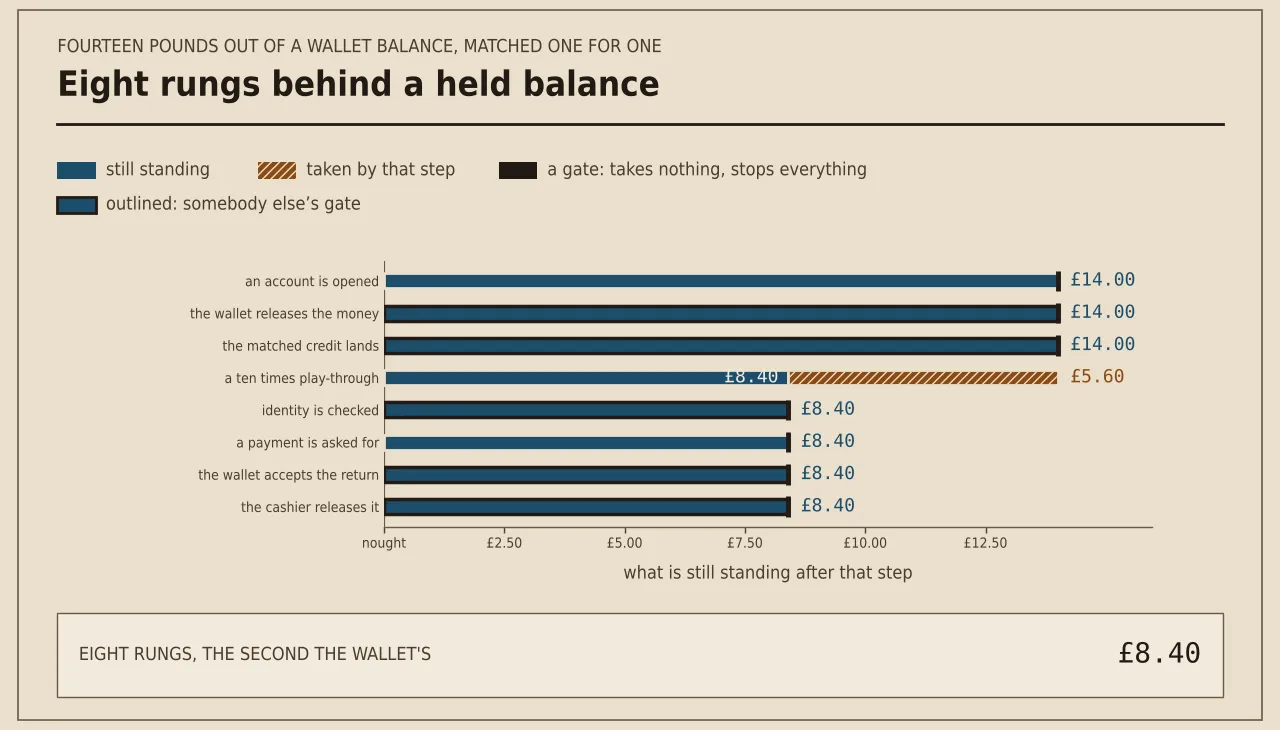
£5.60 of the £14.00 goes at rung four, and the five rungs after it hold £8.40 without moving it a penny
A further comparison belongs here because it is the one this section exists to make, and on this key it can be made twice over. Two rungs have a rulebook behind them, rung four and rung five, and the rulebook is not the one that governs the cashier. Two rungs have a payments company behind them, rung two and rung seven, and nothing published governs either. One rung, rung three, is where a credit is granted that no term obliges anybody to grant. That is five rungs accounted for and five different kinds of silence behind them, which is a more useful description of an offer than any figure on the page.
Two figures in the third column and no others: £14.00 for the first three rungs, £8.40 for the last five. £5.60 is the whole of what the chain loses to anything other than somebody’s decision, and the five rungs standing after it are about whether any of £8.40 moves rather than about how much of it there is.
One entry on this ladder earns a sentence, being the only one taken from the island’s policy rather than from Britain’s. Rung five is marked in the fourth column as a milestone rather than a moment, and the milestone is the island’s word. Every other sourced entry on this ladder came from a regime the cashier is not in, which means that of eight rungs, exactly one carries a reference to a rule that might actually apply to it.
Keep the staking and the rung count apart. £140.00 is a quantity of wagering. Eight is a quantity of things that can stop the chain. A reader told only the first would think the obstacle was effort; a reader told only the second would not know that one of the eight rungs asks for a hundred and forty pounds to be put through a game.
3
Rung two, where a balance of its own makes a difference
The whole £14.00 turns on rung two, and the party deciding it is a wallet holding a balance rather than a layer over somebody else’s card. That structural detail is what makes this chain eight rungs with two companies instead of eight rungs with three.
Three more consequences follow from the wallet holding a balance, and they are the whole of what distinguishes this key from the two handset keys beside it. The first is that nothing underneath has to answer, so there are two companies rather than three. The second is that the bank the money came out of parted with it before this chain even began, so a refusal at rung two leaves the fourteen pounds in a third place rather than in an account. And the third is that the same company stands at both ends, which is the only symmetry anywhere in this section.
What follows from a balance of its own is that the money has already moved once before the cashier sees it. Fourteen pounds sat in a wallet; at rung two it leaves for a merchant. There is no second company underneath to authorise anything, which removes a rung and concentrates the decision: one party, one judgement, and nothing read for this page says on what basis it is made.
Nothing is charged at rung two. A wallet that holds the money leaves a reader with fourteen pounds in a balance and no chain, so the figure crosses the rung unaltered. There is nobody to take it up with either, a payments company having made no promise about merchants to anybody.
The blank in the last column at rung two wants one sentence, standing as it does on every wallet page in this section. Conditions exist and are published by payments companies. They are not among the sources available here. A blank cell is the result of measuring, not a failure to measure.
Payments stop for other reasons and the outcome is all that gets said of them. A block somebody has arranged ends this chain before the credit exists. So does an entry on the national register. This domain sets out no way past either. The helpline further down the page is the number for anybody meeting one unwillingly.
One more property of a wallet with a balance belongs here because it has no parallel elsewhere in this section. The money at rung two is already inside a payments company when the chain starts, which means that between the reader’s bank and the cashier there are two separate custodies rather than one transfer. This guide cannot price either custody, and the sheets behind it carry nothing on what a payments company owes a reader whose balance it holds.
4
Rung five under two rulebooks, and a tick box about a card
£8.40 waits at rung five, and rung five is the one rung on this chain that two different rulebooks address. Britain’s answer and the island’s answer are not the same, and what separates them is when the check falls rather than whether one happens.
The island’s floor is an age rather than an identity, and a payment is one of the things that may help satisfy an operator about it at registration, a card being the example its policy gives; full identity checking waits for a later milestone off the rule sheet, claim 146.
That clause earns this key its page, so read it twice. A way of paying is doing duty there as a signal about a person. No British condition gives a payment any such role, and none of the other fifteen keys in this section has a rulebook that mentions one.
Britain settles identity before play rather than at a milestone off the rule sheet, claim 10, and the duty covers incentive-funded play as squarely as it covers a customer’s own stake off the rule sheet, claim 18, which is the half that counts on a page about a matched credit.
Two readings of that clause are possible and only one of them is fair. The uncharitable one says a payment is being treated as proof of an age, which the policy does not quite say. The fair one says a payment is one of several things that may help an operator satisfy itself, alongside a stated birth date and a box to tick, the real check being put off until later. This guide takes the fair reading and notes that even on the fair reading no British condition gives a payment any part in the question at all.
Against rung five of this ladder the position is exact. A licensed rung five would sit at the top of the chain, nothing promised and nothing at risk. The island’s version may sit where this ladder puts it, with £8.40 behind it and a milestone rather than a moment behind that. Which regime governs any given cashier is not establishable here, no source available naming the licence a site holds off the rule sheet, claim 158.
One consequence of that uncertainty deserves recording, because it limits what the comparison in this part is worth. Everything set out above describes a regime. Whether the cashier behind any particular chain is inside it cannot be established from here, so the comparison tells a reader what the better of the available offshore rulebooks asks for, and not what their own cashier is held to.
Say that plainly rather than leaving it as a technicality. Describing what a Curaçao licence demands is possible. Saying that a given cashier holds one is not, and no count of how many do can be sourced either. Naming a licence for a brand would mean inventing the most checkable fact on the key.
5
Where that rulebook is stricter than Britain, and where it says nothing
Having a rulebook to read makes one comparison possible that no other page in this section can offer, and the result runs against expectation in one place.
Begin with what the island does better, since a page that only listed deficiencies would be arguing rather than comparing. Three of its requirements are at least as demanding as Britain’s and one is plainly more so, which matters on this key because it is the only key in the section where such a comparison can be made from a document rather than from an assumption.
Deposit limits are where the island is the tighter of the two: a week’s wait before one goes up, against a day at the least in Britain off the rule sheet, claim 145 off the rule sheet, claim 29. Fourteen pounds a week, set as a ceiling under that policy, could be cut this afternoon and could not be raised until next week.
Cooling-off is handled generously as well: four lengths, one button, no approval and no delay, with an operator barred from talking anybody out of taking one off the rule sheet, claim 144.
Self-exclusion is where the comparison turns over. An exclusion there binds the operator that took it, across whatever domains it runs, with nothing but encouragement offered for the rest of the market off the rule sheet, claim 142. No register sits behind it. A reader who excludes themselves on this chain has excluded themselves from this chain.
Put the two schemes side by side on one measure and the gap is countable. A British registration reaches every online gambling business the regulator licenses, because joining is a condition of the licence off the rule sheet, claim 181. An exclusion under the island’s policy reaches one. So the same act of self-protection covers a market in one jurisdiction and a single counterparty in the other, and on this chain it would cover neither the wallet at rung two nor the wallet at rung seven, no gaming regulator licensing a payments company at all.
Carry that final clause away from this part, because it holds on all sixteen keys in the section. Whatever a gaming regulator requires, anywhere, it requires of cashiers. The companies standing at the payment rungs of these chains are not cashiers, are not licensed by any gaming authority, and are not addressed by any rulebook this publisher has been able to read. A reader protected at every rung a gaming regulator can reach is still unprotected at rung two and rung seven.
Its periods run the other way too. A year is the island’s shortest long-term option, with longer ones above it and no revoking before the end off the rule sheet, claim 143, where Britain’s shortest is half that off the rule sheet, claim 184. The shortest exclusion available is therefore six months in one market and twelve in the other.
Its silence is the part that bears on the money. Two lines in that policy deal with bonuses, one on transparency and one on aggressive promotion, and a ceiling over a multiple is nowhere in it off the rule sheet, claim 148. The ten at rung four is therefore borrowed from Britain, and the rulebook that may actually govern a cashier of this kind offers nothing to put there instead.
6
Rung seven, where the wallet has to agree to take the money back
£8.40 stands at rung seven, the wallet’s other rung and the one readers consider least. The question is whether a payments company will accept money coming the other way, and it is a question about the wallet rather than about the cashier.
A wallet with its own balance has to receive before a reader can spend, which is the precise difference from a card. Money pushed back to a card arrives whether anybody at the card’s end wants it or not. Money pushed back to a wallet has to be taken into a balance by a company that may or may not take it, and nothing read for this page says which.
One more thing about rung seven, and it is the question a reader asks last and ought to ask first. If the wallet will not take the money, where does it go. Nothing read for this page answers that, and the possibilities are not symmetrical: the money may stay with the cashier, in which case the reader is back at rung six with a different destination to nominate and two further rungs to walk, or it may sit in transit, in which case nothing in this section describes who is holding it. Eight rungs is therefore the count for a chain that works, and no count at all is available for a chain that stalls at rung seven.
So the chain has two companies and five decisions, and the two rungs the wallet holds sit at opposite ends of it. One decides whether anything starts. The other decides whether anything finishes. A reader comparing this key with a card key is choosing between one company with two opportunities and two companies with one each, and no source available here says which arrangement pays out more often.
Durations for rung seven are published by nobody, so none is printed. Ceilings over what a credit may win are published by nobody either, so no rung carries one, and £8.40 belongs to this site’s arithmetic and to no undertaking.
A count rather than a sum closes this part. Of the eight rungs on this chain, three are held by a cashier, two by a payments company, two by the reader and one by arithmetic. Of the five that are nobody the reader’s, not one has a duration published against it, and exactly one has a rulebook behind it that might apply. That is the state of the evidence on the best-documented key in this section, which is worth knowing before reading the fifteen where no rulebook can be read at all.
Two rungs stand between rung seven and the money being spendable: rung seven itself and rung eight. Both are somebody else’s. The arithmetic finished at rung four, which means every penny that remains is resting on two decisions and neither of them has a published rule behind it.
One observation closes this part and it is specific to a balance. From rung three onwards the £14.00, and then the £8.40, is in a cashier’s keeping; at rung seven it passes into a payments company’s keeping; and only after rung eight is it the reader’s to spend. Three custodies in one chain, and the sheets behind this site describe the obligations of none of the three.
7
Two rulebooks, and neither of them Britain’s
One figure and one position on this page came from British licence conditions, and one requirement came from an island’s policy. Neither set reaches the wallet at rung two or rung seven, and whether the island’s set reaches the cashier at all is not establishable here.
Behind a chain of this shape, where a British reader meets one, is a cashier lacking any Great Britain licence at all. Three features of this ladder follow from that single fact. Rung four is at ten because a licence stops there off the rule sheet, claim 91 and the island’s policy puts nothing in its place off the rule sheet, claim 148. Rung five is at position five because the island’s full check waits for a milestone off the rule sheet, claim 146 where Britain’s comes before play off the rule sheet, claim 10. And an exclusion on this chain stops at one operator off the rule sheet, claim 142 where Britain’s covers the licensed market by condition off the rule sheet, claim 181. Each is a consequence, printed as one, with no way round it described here.
A complaints framework does exist there, and on the one key where that can be checked it should be said. Six months to bring a complaint off the rule sheet, claim 151, four weeks for an answer and one written extension to eight off the rule sheet, claim 152, and an authority that declines individual disputes much as the British regulator does off the rule sheet, claim 153.
Who writes the terms of the appeal is where the two divide. Britain approves the adjudicating bodies and lets a licensee use only an approved one off the rule sheet, claim 43. The island makes adjudication compulsory and free, the operator paying, and then lets the operator set its parameters, a minimum claim value among them off the rule sheet, claim 154.
Hold that against £8.40. A claim of that size is precisely the kind a minimum claim value would exclude, and the policy names low-value claims as a case where it might understand an operator’s concern about misuse. So the one offshore rulebook a reader can actually read contains the mechanism by which a dispute over the sum at the foot of this ladder could be put out of reach, and it contains no mechanism at all for rung two or rung seven.
Asked at the booth
- Why does this key have a rulebook when the others do not
- Because one offshore regulator publishes its policies and they can be read at source. It is the only such document behind any page of this site.
- Which rung is settled first by somebody other than the reader
- Rung two, where a wallet releases fourteen pounds to the merchant or holds it, with the whole £14.00 of credit promised and unstaked.
- What does that rulebook say about paying
- That confirmation of a payment method can form part of what satisfies an operator about a player’s age at registration, with a card given as the example.
- Does Britain use a payment that way
- It does not. Identity is settled before play, incentive-funded play included, and nothing about a payment stands in for settling it.
- Is that rulebook stricter than Britain anywhere
- On deposit limits. A week has to pass before one goes up there, against a day at the least under a British licence.
- How far does a self-exclusion reach on this chain
- As far as the operator taking it and the domains it runs. Nothing registers it across the market, and encouragement is what the policy offers for the rest.
- What is £14.00 of credit reckoned to leave
- Eight pounds forty, after £140.00 of staking and the £5.60 that a ninety-six per cent return accounts for.
- How many companies are in this chain
- Two, which is one fewer than a handset key and the same as a plain card key, with the wallet counted at both rung two and rung seven.
- Where is the money between rung three and rung eight
- In the cashier’s keeping, then briefly in a payments company’s, and the material behind this site describes the obligations of neither holder.
- Could a dispute over £8.40 be heard
- Adjudication there is compulsory and free, and yet the policy lets an operator set a minimum claim value, which is the kind of rule a sum that size meets first.