Terms read 26 October 2026 Counted in 2026
Paysafecard casino: eight rungs, and the second one may disqualify you
A voucher bought for cash is the one way of paying in this section with no company standing behind it, and that absence moves the finding. Thirty pounds matched one for one makes £30.00 of credit and the play-through is reckoned to leave £18.00. Rung two is the first rung with somebody else’s hand on it, and that somebody is the cashier, ruling on whether a voucher counts towards the offer at all. The whole £30.00 is riding on that, and an advertising ruling is the only published thing anywhere near it.
How many steps eight Buy, qualify, be credited, stake, be checked, nominate, be accepted, be paid. The first gate somebody else holds rung two A cashier decides whether a voucher counts towards the offer. Standing when it is reached £30.00 The promise entire, two rungs before any staking begins.
| What has to happen | Who takes this step | What it leaves standing | Printed where |
|---|---|---|---|
| A voucher is bought | the reader | £30.00, or nought unbought | the offer’s own headline |
| The voucher qualifies for the offer | the cashier | £30.00, or nought excluded | an advertising ruling, not a term |
| The matched credit lands | the cashier | £30.00, or nought withheld | nothing published behind this rung |
| Ten times is played through | the house’s arithmetic | £18.00 | the published British ceiling |
| Identity is checked | the cashier | £18.00, or nought unverified | licence condition 17.1.1 |
| A payout method is nominated | the reader | £18.00, or nought unnominated | nothing published behind this rung |
| That method’s holder accepts it | a bank or a wallet | £18.00, or nought refused | nothing published behind this rung |
| The cashier releases it | the cashier | £18.00, or nought unpaid | nothing published behind this rung |
| What eight rungs leave | five gates, two deciders | £18.00 | this page |
1
A voucher goes one way, and the chain has to find its own way back
Every other key under this heading has a company at the payment rung. A voucher bought for cash does not: thirty pounds crosses a counter, a code comes back, and the code is spent at a cashier. No bank authorises anything and no wallet releases anything, so the first rung outside the reader’s hands falls to the cashier, no intermediary being present to take it.
That is this key’s finding, and no other key in the section produces one of that shape. Rung two is the cashier asking whether a voucher counts towards the offer, and £30.00 of credit is riding on the answer before a penny has been staked.
Four rungs in one party’s hands is the highest concentration anywhere in this section, and it is worth pausing on before the figures. On a card chain the decisions are split between a bank and a cashier. On a wallet chain they are split between a payments company and a cashier. Here the cashier rules on whether the voucher counts, on whether the credit lands, on who the reader is, and on whether the money is released, with one ouitside rung at the end belonging to whoever holds the destination. A reader with a complaint on this chain has, for four rungs out of five, exactly one party to complain to, and it is the party that owes the money.
The absence of a company at the front creates a presence at the back. Cash goes one way: a voucher is bought, spent and gone, and nothing about it is a destination money can be sent to. So when the time comes to be paid, the reader has to nominate something else, and whoever holds that something else has to agree to receive it. Those are rungs six and seven, and no other chain in this section has that pair.
So the eight divide like this. The reader takes rung one and rung six, buying the voucher and nominating a destination. The cashier takes rungs two, three, five and eight. Rung seven belongs to whoever holds the destination, a bank or a wallet depending on what was nominated. Rung four is arithmetic. Five rungs are settled by somebody other than the reader, four of the five by the cashier, which is the highest concentration in one party anywhere in this section. The column itself is explained on its own page.
There is a second thing cash removes and it is worth naming because it cuts against the reader rather than for them. On every other key in this section a payment leaves a record with a company that has a relationship with the reader: a bank, a wallet, a platform. A voucher bought over a counter leaves the reader with a code and the seller with a sale. Whatever happens at rungs two to eight, there is no third party holding a record of the transaction that the reader could ask to see.
That absence is not a small thing when the only published material touching this chain is an advertising ruling about prominence. A reader disputing rung two has the cashier’s account of what the terms said, their own memory of what the offer page showed, and a voucher code. On a card chain they would at least have a transaction a bank recorded.
Eight is also worth reading against the other counts. A card used both ways gives seven. A wallet gives eight, with two rungs belonging to the payments company. This key gives eight too, and the arithmetic of how it gets there is different: one rung fewer at the front, two rungs more at the back. A reader comparing numbers should notice that the same total conceals a very different distribution.
Thirty pounds has no bearing on the count. Fifteen pounds of credit would leave £9.00 under the same multiple, and the eight rungs would stand exactly where they are, with rung two still the cashier’s. The figure was chosen on this page; the shape of the chain belongs to the voucher.
2
£30.00 of credit, and the £18.00 reckoned to remain
Thirty pounds buys a voucher, and the voucher buys credit of £30.00 on a match of one for one. The thirty is gone from the moment it crossed the counter, which is more final than on any other key in this section, and the column follows the credit alone.
A voucher also makes the spending of the thirty pounds more final than it is anywhere else in this section, and the ladder should be read with that in mind. Money paid by card or from a wallet leaves a trail somebody keeps. Money handed over a counter for a code has left, and the code is the whole of what the reader holds until rung three. So the interval between rung one and rung three is the one stretch on this chain where a reader has parted with money and holds nothing a third party would recognise.
Thirty pounds was settled on here and nothing published supports it. The honest thing is to say so in the sentence that spends it, and to note that every money figure below moves with the choice while no rung does.
Rung four asks £300.00 to be staked, at a multiple of ten, which is where a licence stops one off the rule sheet, claim 91. Ninety-six per cent is the long-run return this publisher adopts for a reel, from no particular machine, making £12.00 the four per cent of £300.00 and E = B × (1 − W × (1 − RTP) ∕ g) a figure of £18.00.
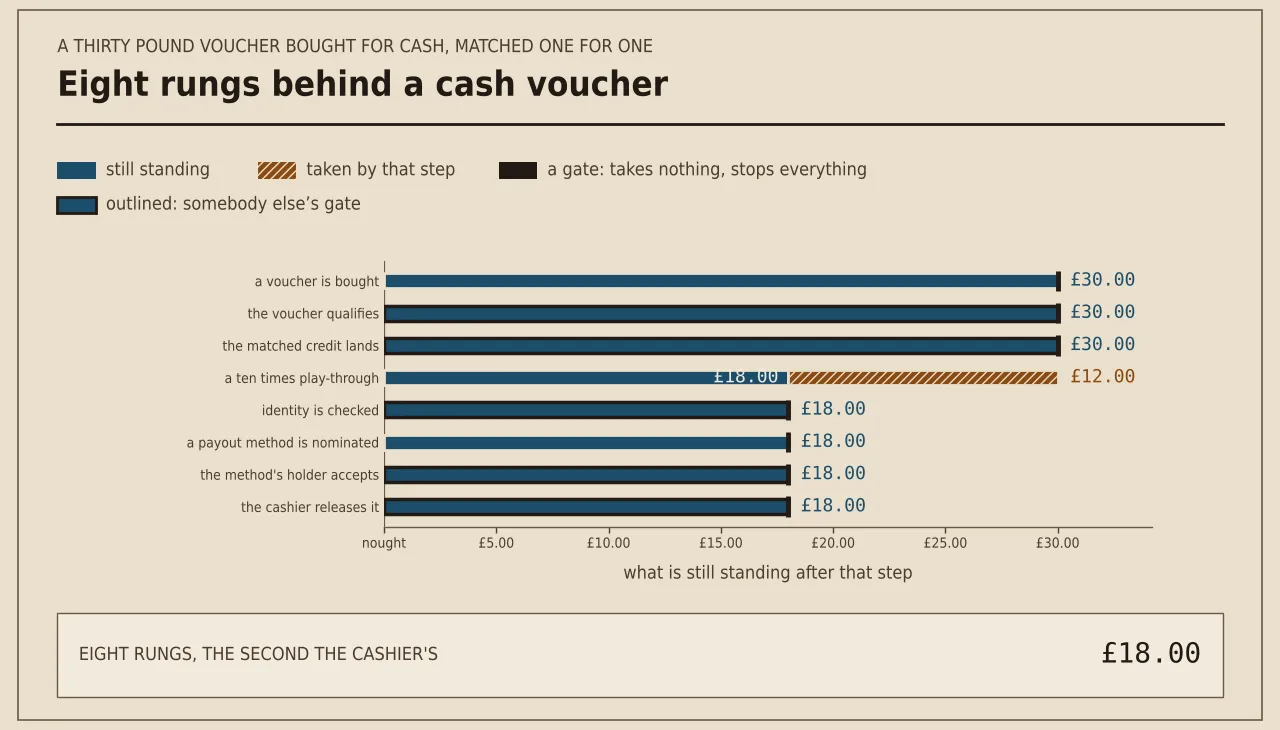
Rung four accounts for £12.00 of the £30.00, and the five rungs below it each carry £18.00 without disturbing it
Three rungs read £30.00 and five read £18.00, which is the whole content of the third column. £12.00 covers everything the chain parts with that nobody chose, and the five rungs below rung four bear on whether £18.00 travels rather than on its size.
The two counts want separating, and this key invites the confusion more than most. Eight things can stop the chain. One of the eight wants £300.00 put through a game. Thirty pounds of cash therefore bought a promise carrying ten times its own value in staking, with the request for payment arriving as late as rung six.
3
Rung two, the one rung in this section with a ruling behind it
£30.00 stands at rung two and the cashier settles it. The question is whether a voucher counts towards the offer, and this is the one rung in the whole of this section with something published that bears on it directly.
In the July of 2024 a ruling went against an offer that had shut out one way of paying, the exclusion having been left down among the full terms where its prominence was judged insufficient off the rule sheet, claim 66. Three usable things come out of that: such exclusions are real, they rank as significant conditions, and burying one has counted against an advertiser.
What it does not establish is anything about this chain. The ruling binds advertisers under a code. The cashier at rung two is not inside that code, so the exclusion may exist, may be anywhere, and may not be stated at all. The fourth column at rung two therefore reads that a ruling rather than a term stands behind it, which is the most this section can honestly print about any payment rung.
A second ruling from the same source sharpens the shape of the risk, and the instrument in it was a voucher too. Five pounds of voucher turned out not to work on one named day, because of a race meeting, and the voucher said nothing of it; the code was breached off the rule sheet, claim 67. It is also the one ruling on that sheet where the word breach belongs to the source rather than to this publisher’s summary of it.
Significant conditions include a time limit, standing in that list next to eligibility and wagering off the rule sheet, claim 62, with full terms expected roughly one click away instead of in a footer off the rule sheet, claim 61. This page read no figure for a deadline, so none sits on the ladder. A deadline found against a live offer makes this chain nine rungs, the ninth of them taking nothing at all.
Three rulings, then, and between them they establish the only published footing this key has: exclusions by method are real terms, a voucher can carry a restriction it does not state, and both failures are failures of prominence rather than of substance. None of the three says anything about what an offer may contain. All three say something about where it has to be written down, and the party they bind is an advertiser.
One prohibition from the same body concerns a word rather than a figure. Calling something free is out where a customer’s own money has to be put at stake to qualify, and the phrasing that pairs an absence of risk with an absence of cost is out too, save where no funds of the customer’s can possibly go off the rule sheet, claim 60. Thirty pounds handed over a counter is a reader’s own money on any reading, so whatever rung three is called, the thirty pounds was not.
4
What one set of published terms shows, and what it cannot
One set of published welcome terms was read at source for the sheets behind this site, at a licensed British operator, in the October of 2026. It is the only live offer term this publisher holds, and three of its figures bear on this ladder.
They were a tenfold multiple, a hundred pound ceiling on winnings, and the exclusion of one prepaid method from the deposits that qualify off the brand sheet, entry 9. All three were in the key terms rather than buried, while the promotion page the key terms linked to returned an error, leaving the longer terms unread off the brand sheet, entry 9.
Set those against this ladder one at a time. The tenfold multiple is the figure rung four is drawn at, which is useful corroboration: ten is not only the licensed ceiling but a multiple a licensed operator was actually applying. The hundred pound ceiling is the thing no rung here carries, and the next part is about why. And the exclusion is rung two, named in a real set of terms by a real licensee.
What it cannot show is what any cashier is doing now. A term is the most perishable thing a sheet can hold, so the arithmetic of a kind of term is what gets priced here and no claim is made about anything running today. A date sits on the reading. Different terms against a live offer mean a different offer, not an error on this page.
Nor is it a fact about the chain counted here. A British licence sits behind the operator whose terms were read, and no licence sits behind the cashier at the foot of this ladder. The reading proves that an exclusion by method is a term a real licensee writes into real key terms, which beats an assumption and falls short of a rule.
A further element of the code bears on rung three and is easily missed. Terms attached to an inducement owe clarity, transparency and fairness, and have to be easy to reach for anybody they are put to off the rule sheet, claim 57. One sentence of duty therefore covers the exclusion, the ceiling and the multiple together, and it reaches licensees. At rung three of this chain an advertised figure stands with nothing enforceable behind it.
5
Rung six and rung seven, and the method that has to be found
£18.00 stands at rung six, and rung six exists on this key and on no other in this section. A voucher cannot receive a payment, so the reader has to put forward something that can, and whoever holds that something has to agree to take it at rung seven.
Three questions arise at rung six and the material behind this site answers none of them. Whether a cashier allows a destination other than the method that paid in. Whether it requires that destination to be in the reader’s own name, which would make rung six a document question as well as a nomination. And whether a reader with no bank account and no wallet has anywhere at all to nominate, and that one bears hardest on the very people most likely to be buying vouchers for cash.
That last question deserves to be left exactly as unanswered as it is, rather than guessed at one way or the other. The arithmetical part can be said: a chain that begins with cash ends with something that is not cash, and the eight rungs counted here assume the reader has that something. A reader who does not is not looking at a longer chain. They are looking at a chain whose end this page cannot count.
Two consequences follow and the first is about the count. Eight rungs is what this chain comes to when the reader has a destination to hand. A reader who has none is not at eight rungs; they are at a chain that cannot be finished, and nothing in this section describes what a cashier does with money in that position.
The second is about who the new party is. Rung seven belongs to a bank or a wallet depending on what gets nominated, which means this key inherits whichever payment rung the reader picks. Nominate a card and rung seven behaves like the card key’s last rung. Nominate a wallet and it behaves like the wallet key’s. The voucher decides the front of the chain and decides nothing at all about the back of it.
That inheritance has a practical edge worth stating plainly. A reader who chose a voucher in order to keep a bank out of the arrangement will meet a bank at rung seven anyway, or a wallet, because £18.00 has to arrive somewhere. The anonymity of cash at rung one is spent by rung six, and the chain is two rungs longer for having had it.
What nobody publishes about either rung is anything at all. Whether a cashier permits a destination different from the method that paid in, how long rung seven takes, and what happens if the holder refuses are three questions the material behind this site does not answer. The fourth column says so at both rungs, and the saying so is the measurement.
One more count belongs here. Three rungs stand between the reader asking and the money being spendable: nominating, being accepted, and being released. Two of the three are somebody else’s. By that point the arithmetic has finished, so the whole £18.00 is resting on two decisions with nothing published behind either of them.
6
The ceiling nobody publishes, and the one that was published once
£18.00 at the foot of this column is the arithmetic’s expectation. Whether a cashier would hand over all of it turns on whether a roof sits over the credit, and the state of the evidence about such roofs is the most instructive thing on this key.
A standard maximum over bonus winnings is in no source available here, and neither is any rule turning such winnings into bonus funds off the rule sheet, claim 105. No rung therefore carries a ceiling, and the foot of the column holds an expectation rather than a promise.
One real figure sits against that absence, and it is a hundred pounds, taken from the key terms of a licensed operator as read in the October of 2026 off the brand sheet, entry 9. One reading is not a standard and this guide does not treat it as one. What it does is settle a question that would otherwise be open, which is whether ceilings of that kind are written into live terms at all.
Two further things about that reading should be said before it is used, because a single reading is easy to over-work. It came from one operator, on one day, at a site that holds a British licence, and the longer terms behind it could not be opened. So it is evidence that such a ceiling exists in the market and evidence of nothing about its typical size, its frequency, or its presence anywhere outside the licence.
Hold the hundred pounds against this page’s figures and the comparison is worth having. £30.00 of credit staked ten times over is £300.00 through a game, with £18.00 expected to survive. A hundred pound ceiling would not bite on £18.00 at all. It would bite on a reader who did unusually well, which is precisely the reader a ceiling is written for, and it would bite invisibly, since nothing on this chain obliges anybody to state one.
A second reason for putting the two side by side concerns what this site may and may not assert. Ceilings are not rungs. Nothing happens at one, and a reader either wins enough to meet it or does not. So it belongs in prose, as one figure read in one place, with the ladder holding at eight rungs and no row given to it.
One more prohibition rounds out what a licensed offer owes and this one does not. Encouraging frequent or repeated play is out, and so is encouraging anybody to spend past what losing would cost them off the rule sheet, claim 64. Three hundred pounds of staking against a thirty pound voucher is repeated play on any account of the words, and the duty naming it falls on advertisers rather than on cashiers.
7
Eight rungs, bought over a counter
Two figures and one position on this page came out of British material, and none of it binds the cashier that holds four of the eight rungs. That is the last thing to say and it governs the rest.
No Great Britain licence stands behind a voucher chain of this shape, and three of its rungs can be priced against what one brings with it. Ten is the licensed limit on a multiple off the rule sheet, claim 91, so the £12.00 at rung four is the kindest arithmetic going rather than a figure imposed by anything. Rung two would fall inside a duty making an inducement’s terms clear and reachable off the rule sheet, claim 57 and inside the prominence a significant condition is owed off the rule sheet, claim 61, where on this chain the exclusion may be stated anywhere at all or nowhere. And rung five would be above rung one, a licence wanting identity ahead of play off the rule sheet, claim 10, instead of sitting fifth with £18.00 behind it. Consequences, printed as consequences, with no route round any of them described here.
One summary comparison belongs at the close, since this key is the only one in the section where no company stands at the payment rung. Removing the company did not shorten the chain. It moved the finding from an intermediary to the cashier, raised the cashier’s share of the decisions from three rungs to four, and added two rungs at the far end to find a destination the cash could not supply. On every measure this site uses, paying in a way that involves nobody made the arrangement more dependent on one party rather than less.
One caution about cash belongs on this key and it is a consequence rather than a procedure. Buying a voucher with cash leaves no payment for anybody to decline, which means a block arranged by a bank does not reach rung one at all. This page states that fact and stops there. It describes no way past a block, suggests no instrument for a payment that has been refused elsewhere, and names no route whatever for a person who has joined the national scheme. A reader who registered and then found a chain still open is looking at a gap in the protection rather than at an opportunity, and the helpline on this page is the number to ring.
A word about the thirty pounds before any of that, since the figure might look load-bearing and is not. Vouchers are sold in set denominations and this page uses one of a convenient size; another denomination alters every entry in the third column and disturbs none of the eight rungs.
One figure sums up what this key costs a reader in information, and it is a count of blank cells. Five of the eight rungs are settled by somebody else. One of those five, rung two, has a published ruling standing near it. The other four have nothing at all behind them. That is the best ratio anywhere in this section and it is still four rungs out of five with no source.
So the honest summary of a voucher is that it trades a company at the front for two rungs at the back. Thirty pounds of cash reaches a cashier without anybody’s permission. £18.00 comes back only if a destination is found, a holder accepts it and a cashier releases it, and the cashier that decides the last of those also decided whether the voucher counted in the first place.
Eight rungs, then, with four of them in one party’s hands. Rung two is the earliest one the reader has no hand in, and it is the single rung in this section with a published ruling touching the question, which is the whole of this key’s advantage over the other fifteen.
Asked at the booth
- Why does a cashier settle the earliest outside rung on this key
- Because cash puts nobody in the path. Thirty pounds crosses a counter, and the first rung out of the reader’s hands is a cashier ruling on whether the voucher counts.
- What is published about that rung
- A ruling from July 2024. An offer had excluded a method down among its full terms, and the prominence of that condition was judged insufficient.
- Does that ruling bind the cashier on this chain
- No. It binds advertisers under a code, so the exclusion may be stated anywhere, or nowhere, and the ladder records a ruling rather than a term.
- Why does the chain need two rungs at the end
- Nothing can be paid into a spent voucher. Somewhere else has to be put forward, and whoever keeps that somewhere else has to take the money.
- What is £30.00 of credit reckoned to leave
- Eighteen pounds. £300.00 goes through a game first, and £12.00 of the credit covers what a ninety-six per cent return takes of that staking.
- Does anything cap the winnings on this credit
- None is published as a standard. One licensed operator’s key terms, read in October 2026, carried a hundred pound ceiling, which is a reading rather than a rule.
- Does cash make the chain anonymous
- Only at the front. £18.00 has to arrive somewhere, so a bank or a wallet appears at rung seven whatever was used at rung one.
- Can a reader dispute rung two with anybody
- Only with the cashier. No bank and no wallet took part in the payment, so nothing outside the chain holds a record a reader could ask to see.
- What happens if the reader has nowhere to be paid
- This page cannot say. The eight rungs assume a destination exists, and a chain without one has an end this guide is unable to count.
- Who holds most of these rungs
- The cashier, with four of the eight. That is the highest concentration in one party anywhere in this section.