Terms read 26 October 2026 Counted in 2026
Twenty rounds on Big Bass Bonanza, and a condition with no size written anywhere
Twenty rounds at the 10p this guide declares amount to £2.00 of face, and £1.92 of that reaches a balance once a reel has taken 8p. Nothing else on the chain can be priced. The fourth of the seven steps is a turnover, and no source read for this page attaches a size to it, so £1.92 is carried through the fourth rung and the three after it with a word against each saying that nothing is published behind it. Whoever drafts that condition decides what it costs, which puts the first gate held away from this side of the counter at the fourth step rather than the fifth.
How many steps seven Open, claim, spin twenty, satisfy a turnover, verify, request, collect. The first gate somebody else holds the fourth A condition drafted, sized and judged on the other side of the counter. Standing when it is reached £1.92 What twenty rounds leave, and the last sum any source stands behind.
| What has to happen | Who takes this step | What it leaves standing | Printed where |
|---|---|---|---|
| An account is opened | the reader | £2.00, or nought unopened | the headline itself |
| The offer is claimed | the reader | £2.00, or nought unclaimed | nothing published behind this rung |
| Twenty rounds turn | the house’s arithmetic | £1.92 | nowhere, declared on this page |
| A turnover is satisfied | the cashier | £1.92, or nought unmet | nothing published behind this rung |
| Identity is checked | the cashier | £1.92, or nought unverified | nothing published behind this rung |
| A payment is asked for | the reader | £1.92, or nought unasked | the withdrawal form |
| The cashier settles | the cashier | £1.92, or nought unpaid | nothing published behind this rung |
| What seven steps leave | three gates across the counter | £1.92 | this page |
1
Two pounds of face, and the 8p a reel accounts for
Twenty rounds is twenty of something. Turning that into a sum needs two quantities the headline withholds: what one round stakes, and what fraction of all staking a reel sends back over a long run.
No rule sets the first. No published figure attaches to a round’s cash value, no published rule names who attaches one, and no published duty obliges a cashier to explain the choice off the rule sheet, claim 89, which makes the figure a trading matter settled offer by offer. 10p is therefore this page’s own declaration, and twenty of them come to £2.00 of face.
The return is the second quantity, and 96 per cent is what a reel of ordinary build gives back over a long run. That figure is an assumption of this publisher’s, standing for the industry at large and fastened to no machine, since this site keeps no sheet of readings behind a title. Against a £2.00 face it leaves £1.92, with 8p the difference. Why the third column falls there and holds level afterwards is the subject of a standing page on counting a chain.
Nor can a reader go and verify the 96 per cent for a licensed game, which is worth saying because the opposite is widely assumed. The duty is to put something within reach that lets somebody judge their chances, and and any one of four things satisfies it: a plain account of the mechanism and the allocation of prizes; or a house edge; or a returned share; or the chances of a winning event off the rule sheet, claim 120. A licensee choosing the first has complied, and a return percentage is nowhere compulsory off the rule sheet, claim 121.
Both numbers are this page’s and neither is a term. Drop the round to 5p and the face is £1.00 with 96p reaching a balance. Hold the round at 10p and take the return to 94 per cent and £1.88 arrives instead of £1.92. Those substitutions move every figure below in step and leave the method and the step count exactly where they are.
2
The fourth rung, where a size ought to be and is not
A turnover obliges somebody to stake the same money repeatedly, a stated number of times over, before any part of it may be taken out. What the regulator defines is the kind of obligation and not the size of one: wagers totalling a particular value, and withdrawal available only once the total is reached off the rule sheet, claim 92.
The rung is counted because two regulators say a condition of that kind belongs to an offer of this shape. For a casino promotion the terms counted as significant are likely to run to minimum stakes, the method of entering, and any wagering requirement off the rule sheet, claim 71, and a player is told separately to go and look for the level of spending a bonus waits on off the rule sheet, claim 87. Neither statement is about twenty rounds in particular, and neither carries a multiple.
So the fourth rung holds £1.92 level with its fourth column saying that nothing stands behind it. The sum is not a prediction. It is the last quantity on this chain anything published supports, and the four rungs under it are where the falling would have happened if the falling had been written down.
The question of who takes that step settles the finding. A multiple on paper would make the staking a matter of the house’s sums coming out, and nobody decides a sum. A multiple nowhere on paper is somebody’s choice: it gets drafted, it gets applied to £1.92, and somebody then says whether it has been met. Those are decisions taken away from this side of the counter, which is why the fourth rung is the finding and not the identity check beneath it.
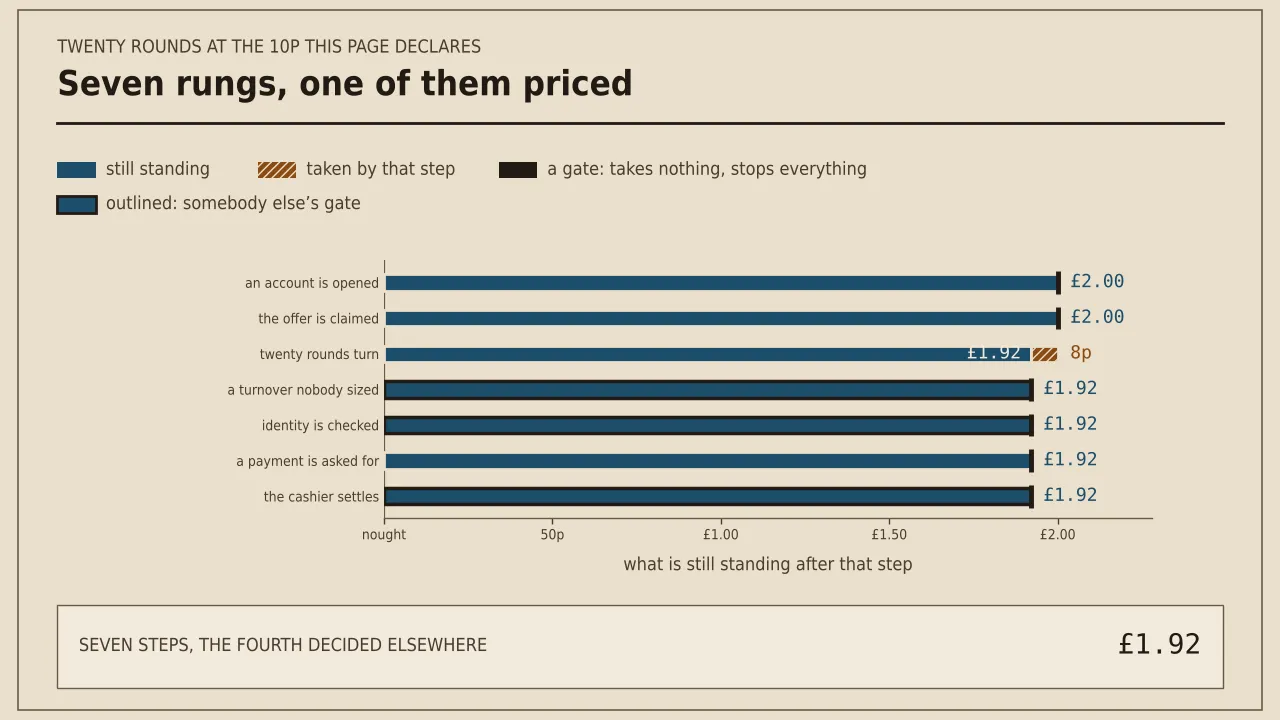
8p off a £2.00 face is every penny this chain can account for, one twenty-fifth of what the headline promised, and the four rungs below it carry no published figure at all
Getting from a new account to twenty rounds also takes an act, and what the act is goes undescribed. It might be a code, a tick, a reply or a button. Taking part is one of the things an advertisement is expected to set out plainly off the rule sheet, claim 71, which is why the second rung is counted, and the rung belongs to whoever is reading, because they do it at whatever moment suits them. A rung waiting on the reader cannot be the finding however vague the route across it.
3
What £1.92 comes down to at ten times and at twenty-five
The missing size is worth showing as a range rather than describing as a gap. Britain holds a licensee to ten times the bonus funds at most off the rule sheet, claim 91, and ten against £1.92 leaves £1.15 after £19.20 has gone through a reel, which is a hundred and ninety-two rounds at 10p. Twenty-five against the same balance leaves nothing at all.
The rows below are this site’s own working, each one putting a multiple through E = B × (1 − W × (1 − RTP) ∕ g) the qualifying share at full weight, nothing else being published to put in that position. Money is given to the nearest penny, and the top row is the gentlest of them, ten being a ceiling on licensees and an obligation on nobody else.
| Multiple asked | What survives | Staking behind it | Presses at 10p |
|---|---|---|---|
| Ten times | £1.15 | £19.20 | 192 |
| Fifteen times | 77p | £28.80 | 288 |
| Twenty times | 38p | £38.40 | 384 |
| Twenty-five times | nought | £48.00 | 480 |
| Sixty times | minus £2.69 | £115.20 | 1,152 |
Two things in that table matter more than any single row. The first is that the kindest supported multiple already removes 77p of £1.92, which is almost ten times what the reel took, so the one deduction this page can account for is the smallest of the deductions in play. The second is that the bottom four rows are closed to a British licensee and open to the counter behind twenty free rounds, every remote casino licence having sat inside the ceiling since 19 January 2026 off the rule sheet, claim 93.
Sixty is in the table because the regulator put that number on the practice the ceiling was brought in to end, recording play-through at that level among licensees beforehand off the rule sheet, claim 94. Minus £2.69 is not a debt and nobody is owed it: the expression is saying that £1.92 is expected to be spent before sixty turnovers of it are complete, and twenty-five is the multiple at which that begins to be true.
Per round, the range reads like this. Twenty rounds declared at 10p are worth 5.76p each at the kindest multiple, 3.84p at fifteen times, 1.92p at twenty, and nothing at twenty-five. A headline counting rounds is counting the only quantity on the offer that the unwritten condition cannot reach.
One consequence of the range deserves its own sentence. At the kindest multiple any source supports, this chain ends holding £1.15, and whether £1.15 can be collected at all is a separate unpublished question: a floor under what may leave in one go is a term, no source read for this page states one for any cashier, and the enforcement record notes payout thresholds set so far above a player that they are never arrived at off the rule sheet, claim 135. So the smallest standing figure in this heading is also the one likeliest to sit under a threshold nobody has printed, and this page can name the hazard without naming the number.
4
A whole face worth less than half of one licensed press
£2.00 is a small face and smallness has consequences the arithmetic above does not show. One licensed cycle may cost £5 at most, or £2 at most where the player has not turned twenty-five off the rule sheet, claim 124. So the entire promise here is two fifths of what a single licensed press is allowed to cost an older player, and exactly the whole of what one press may cost a younger one. Twenty rounds at 10p is the same money as one spin at the ceiling, spread thin.
Put the same comparison the other way and the chain’s effort appears. The staking a ten times obligation would want, £19.20, is nearly four licensed presses at the £5 ceiling, or a hundred and ninety-two presses at the 10p this page declares. The obligation is small in money and long in instances, and the instances are what a reader spends an evening on.
Proportionality is the one published idea that bears on an offer this size, and it bears on it from the advertising side. A reward is meant to stay in proportion to what has been spent, in money and in hours alike, rather than growing at a steeper rate than the spending it answers to off the rule sheet, claim 69. The published worked example runs the other way round from this key, naming fifty pounds of wagering as the sort of outlay a single free bet might fairly answer, with a condition attached about what is usual at that level off the rule sheet, claim 70. The example is conditional, and nothing in it tells anybody what twenty rounds given before any staking at all ought to ask for in return.
What it does supply is a yardstick this page can hold its own figures against. A £50 wager earning one free bet is a ratio of fifty to one. Twenty rounds carrying a ten times obligation on the balance they leave is £19.20 of staking for £2.00 of face, which is nearly ten to one against the reader before a single published condition has been applied. At twenty-five times it is £48.00 of staking for nothing. Neither ratio is anybody’s rule, and both are this site’s arithmetic.
The offer itself lasts fifty seconds. Nothing may set a licensed cycle going until two seconds and a half have passed since the one before it began, no held button may start one off the rule sheet, claim 107, and nothing may run a sequence of them unattended off the rule sheet, claim 115. Twenty presses at that floor occupy fifty seconds, which is the whole of what the headline gives away. An unlicensed counter owes neither rule, so fifty seconds is the shortest a licensed version of this offer could possibly take and not a guess about any particular one.
Set the same floor against the staking and the shape of the chain changes entirely. The hundred and ninety-two presses a ten times obligation would want take eight minutes, so the chain runs to nine minutes in all, of which fifty seconds were free. At twenty-five times, five hundred presses take twenty-one minutes and finish at a balance of nought. At the sixty the regulator named, one thousand one hundred and seventy-two presses take forty-nine minutes. Every one of those durations is this site’s multiplication over the interval the regulator fixed, and no real evening runs at a floor.
There is a reading of those minutes worth stating plainly. The free part of the chain is fifty seconds and the obligated part is between eight and forty-nine minutes, so the proportion of a reader’s time that the headline accounts for is somewhere between a tenth and a sixtieth. Which of those it is depends on the figure the fourth rung does not carry.
A licensee also watches what goes into an account, and this chain gives it nothing to watch. Light-touch financial checks turn on a net deposit above a monthly figure, and that figure dropped to £150 a month from the end of February 2025 off the rule sheet, claim 48. A reader taking twenty rounds deposits nothing, so no net deposit exists, and £2.00 of face is a seventy-fifth of the level at which a licensee would start looking in any case. The monitoring the licence builds around money going in has no purchase on a chain that begins with none, which is a fact about the shape of a no-deposit offer rather than about any cashier behind one.
Put the 8p in proportion before leaving it. Eight pence off £2.00 is four per cent, which is the complement of a 96 per cent return, so the only deduction this page can account for is also the only one whose size follows from a stated quantity rather than from somebody’s choice. Every later rung either passes £1.92 whole or stops it, and nothing read here decides which.
5
Twenty rounds on a named machine, weighed as evidence
This key names a machine and the name does exactly one thing: it tells a reader which lobby tile to look for. No figure on this page comes off that title, nothing here says what it returns or how often it pays, and no such figure could honestly appear, because this publisher keeps no sheet of primary readings behind any game and will not build arithmetic on one.
Nor is a recognisable tile evidence about the counter behind it. Casino games supplied by licensed firms have been found on websites that hold no licence at all off the rule sheet, claim 131, and the regulator followed that up with money: £4.75m was agreed by one supplier after its games showed up across six sites with no licence at all, every one of them reachable from Great Britain, in a settlement dated 23 July 2026 off the rule sheet, claim 132. The duties that control how a machine may behave belong to the licence and not to the title off the rule sheet, claim 168.
Twenty rounds is also too few to be evidence of anything about a machine. That is arithmetic rather than opinion: a hundred per cent return would be a chain that left £2.00 at the third rung, and a return of nought would leave nothing there, so the whole spread of what twenty rounds can do sits between the face and zero while the declared 96 per cent puts the expectation at £1.92. Twenty outcomes cannot distinguish those cases, and a page that read a figure off them would be reading noise.
A reader is pointed at the register instead, which should hold a licence whose listed activities and domains answer to what a site claims off the rule sheet, claim 88. That is a check on the counter. A tile is not one, and the gap between them is what this part was for.
6
Four conditions with no size, and what each one withholds
Four further conditions bear on twenty given rounds. None earns a rung, since nothing read here attaches a number to any of them, and each is set out beside the figure its absence keeps off this page.
A date by which the rounds expire is the first. Time limits on claiming or using an offer are among the things an advertisement has to make plain off the rule sheet, claim 62, and an advertising ruling at the end of August 2025 concerned a £5 voucher, unusable on one day of the racing calendar for a reason the voucher never gave off the rule sheet, claim 67. What a window would have supplied is a daily pace: four hundred and eighty rounds inside a seven-day window is sixty-nine rounds a day. No window is stated for this key, so the pace stays unprinted.
A ceiling on what the rounds may pay is the second. Nothing published gives a standard one, and nothing published turns what a round wins into bonus funds off the rule sheet, claim 105. What may not be capped is a deposit balance, and the forbidden specimen the regulator prints pairs a fifty pound day with a five hundred pound week off the rule sheet, claim 35, so a roof over a bonus payout is not the same object as a roof over a deposit balance. On a chain whose whole face is £2.00 the absence of a ceiling is of little consequence, which is itself worth saying: this is the one silence on this key that a reader can afford.
Third comes a payment method the cashier declines to send money back to, and this one can cost everything. An advertising ruling of 31 July 2024 concerned a method excluded from an offer and left inside the full terms, where the regulator thought it stood out too little off the rule sheet, claim 66, which is the prominence rule doing the work it exists for off the rule sheet, claim 61. Nothing read for this page names the methods a cashier behind twenty free rounds will or will not pay to, so the last rung keeps £1.92 against it and no reduction.
Game weighting is the fourth, and on a balance this small it is decisive. Thirty per cent stands on the regulator’s consultation record as a rate respondents described and not one the regulator fixed, and at it a staked pound discharges thirty pence of an obligation off the rule sheet, claim 96. Weighting was left untouched when the ceiling was settled off the rule sheet, claim 97, and no current table of contributions appears in any citable source off the rule sheet, claim 105. Applied to the top row, thirty per cent turns £19.20 of required contribution into £64.00 of staking, which is six hundred and forty rounds instead of a hundred and ninety-two, and takes what the formula leaves from £1.15 to minus 64p. The term on the offer would still read ten.
Each of the four is a gate wherever a reader finds it written against a particular offer, and none of them is a deduction. Supplying a number for any one of them would put a figure on this page that no reader could check against anything.
7
Eight weeks of complaint for £1.92, and the floor nobody prints
Suppose the seventh rung goes against a reader and £1.92 is not paid. What recourse costs is a question the size of this chain makes sharper than any other on the heading, and the British answer is published to the week. Eight weeks is the whole of a licensed complaints process, escalation within the firm included off the rule sheet, claim 39, no window for bringing one may be shorter than six months off the rule sheet, claim 40, and a closing letter has to name the way on to an independent adjudicator off the rule sheet, claim 42. Only an approved adjudicator will serve, and eight of them are published off the rule sheet, claim 43.
The regulator is equally clear about what it will not do. By its own account it is no ombudsman: neither settling a complaint nor recovering somebody’s money lies within its powers, and it cannot look inside an account to find out what took place off the rule sheet, claim 46. So even the licensed route for £1.92 runs operator, then approved adjudicator, and stops there.
Offshore the paper looks similar and parts company at one point that matters for a sum this small. The nearest rulebook that could be read gives a player six months to complain, free of charge, and sets the operator a four-week response extendable once to eight off the rule sheet, claim 151, which is the British clock almost exactly off the rule sheet, claim 152. Adjudication is mandatory there and the operator bears its cost. What the same rulebook also contemplates is the operator setting the parameters, expressly including whether a dispute has to be worth some minimum before adjudication will take it off the rule sheet, claim 154.
That is the figure this part exists to leave blank. A minimum claim value is a number, it would sit squarely across the end of this chain, and no source read for this page states one for any operator. £1.92 is the smallest standing figure anywhere in this heading, which makes it the balance most easily put under a threshold and the one where a threshold would most plainly decide the outcome. The page can say the threshold is permitted and cannot say what it is.
One further limit binds a reader rather than an operator. Once an adjudication has run its course it cannot be started again with a different adjudicator, and a player who drops out of one part way through should not expect to raise the dispute later off the rule sheet, claim 155. Complaint volumes that might show how often any of this happens are reported to that regulator twice a year and no aggregate of them has been published, so nothing here can say how common a refused £1.92 is off the rule sheet, claim 156.
8
What a licence would have written into the blanks
Every reading taken above has been the one most favourable to the offer, and the thing that governs all of them has been kept until last. The duties that would have put figures on the blank rungs are conditions of a British licence, and no such licence sits behind twenty rounds given away.
Twenty free rounds, advertised to readers in Great Britain, come from cashiers without a Great Britain licence, and three of that licence’s duties can be measured against the rungs counted here. Start with the fourth. The most play-through a licensee may require is ten times the funds, and so it has been since 19 January 2026 off the rule sheet, claim 91; on £1.92 that duty would have written £1.15 into the third column, where a blank stands instead. Take the stake next. £5 is the ceiling over one licensed cycle above the age of twenty-five, and £2 the ceiling below it off the rule sheet, claim 124, so the £2.00 face here is one younger player’s single permitted press, and the cap reaches no cashier outside the licence. Take self-exclusion last. Every online gambling business Britain licenses has to be in Gamstop off the rule sheet, claim 181, while its own terms are explicit that an operator outside the membership lies beyond its reach off the rule sheet, claim 183, so a registration that covers every licensed cashier covers none of the seven steps on this page. A reader who has registered should treat that as the consequence it is; no way past it is described here or anywhere else on this site.
Seven rungs, with no size written against the fourth, and £1.92 waiting on three of them that no published term governs. The offence in operating without a licence falls on the operator, the Act having created none for the customer off the rule sheet, claim 3, so what a reader gives up at this end is cover rather than lawfulness. Five figures went unprinted on this page, and that count is the most useful thing it has to report.
Asked at the booth
- How many steps does this chain run to
- Seven. Opening an account, claiming, spinning twenty rounds, satisfying a turnover, verifying, requesting, and collecting.
- Which step is the first one decided elsewhere
- The fourth. A turnover with no published size, reached with £1.92 standing and nothing to reduce it by.
- What are twenty given rounds worth
- £2.00 of face at the declared 10p, with £1.92 reaching a balance. Nothing below that can be priced from any source.
- Why not just assume a wagering multiple
- Because an assumed one is unverifiable. The range runs from £1.15 under the British ceiling to nothing at all at twenty-five.
- How much staking would ten times require
- £19.20 of staking, a hundred and ninety-two rounds at 10p, against £2.00 of face. Twenty-five times would want £48.00.
- Is £2.00 a lot for one spin
- It is the whole of what one licensed press may cost a player under twenty-five, and two fifths of the £5 allowed above that age.
- Does the machine in the key change any figure
- None of them. No return is attributed to any title here, and twenty outcomes could not establish one in any event.
- What happens if £1.92 is refused
- A licensed complaint runs eight weeks and ends at an approved adjudicator. Offshore, a minimum claim value may apply and none is published.