Terms read 26 October 2026 Counted in 2026
10 free spins: six rungs on 96p, and a chain that never gets shorter
Ten turns at 10p is £1.00 of face and 96p once the reel has kept its 4p. That is the smallest sum anywhere under this heading, and the chain carrying it is exactly as long as the chain carrying twenty times as much: six rungs, with the third settled by whoever runs the offer and 96p standing on it. A count shrinks. A chain does not.
How many steps six The same six a far larger count walks, on a twentieth of the money. The first gate somebody else holds the third What 96p turns into is decided where the offer lives and nowhere else. Standing when it is reached 96p Small enough that an unpublished floor under payouts would swallow it whole.
| What has to happen | Who takes this step | What it leaves standing | Printed where |
|---|---|---|---|
| A reader joins | the reader | £1.00, or nought unjoined | the offer as it is advertised |
| Ten turns go by | the house’s arithmetic | 96p | no term, a figure set here |
| The 96p becomes something | the cashier | 96p, or nought if voided | no published source whatever |
| Papers are checked | the cashier | 96p, or nought unchecked | only a British licence condition |
| A payout is requested | the reader | 96p, or nought unrequested | the cashier’s withdrawal page |
| The payout goes out | the cashier | 96p, or nought withheld | nothing published behind it |
| Six rungs on 96p | the cashier holds three | 96p | this page |
1
A pound of face and the 4p that stays behind
Ten turns at the 10p set on this page make a pound exactly, which is a convenient face value to think with. Ninety-six per cent of a pound is 96p. The 4p left behind is the reel’s keep, and on this key it is everything that anybody takes.
Neither of those two numbers is the offer’s, and both are stated here rather than buried. Anybody holding real terms should substitute whatever turn value those terms give, which may be nothing like 10p; the 96 per cent is a general figure for the industry, assumed on this page and never lifted off a particular machine. Everything below follows from the pair of them and from nothing else, which is why both are named before any of it.
Both inputs are this publisher’s own. Nothing anywhere fixes the cash value of a given turn off the rule sheet, claim 89, and the duty behind the second figure is satisfied four different ways, of which a percentage is only one off the rule sheet, claim 121. So the pound is a convenience and the 96p follows from it, and a reader with an offer in front of them should put their own value in.
A pound is a useful face because every later number reads straight off it as a percentage. The reel keeps four in the hundred. A ten times obligation, had there been one, would have left 58p of the 96p and taken 38 of those hundred. The whole of the arithmetic on this site fits inside a pound, and that is why the smallest count under this heading is a good place to look at it. The column itself and the formula under it are described once at counting a chain.
2
Why a smaller count buys no shorter chain
Here is the finding this key exists for, and only a count can show it. Ten turns and two hundred turns walk the same six rungs. Twenty times the money sits behind one of them. The number of separate things standing between that money and a pocket differs by nothing at all.
Nothing on a chain is sized to the headline, which is the whole of the reason. Joining happens once whatever the count. The turns are one rung whether there are ten of them or ten thousand. Whatever settles the proceeds settles them once. The check, the request and the settlement are each single events.
A sibling pricing the two ends of those two offers would report a pound against twenty pounds and stop, which is true and leaves out what somebody about to spend an evening on it needs. Six rungs apiece is the comparison, and it is flat across the whole of this heading: no key here buys a shorter chain by being smaller, and none buys a longer one by being larger.
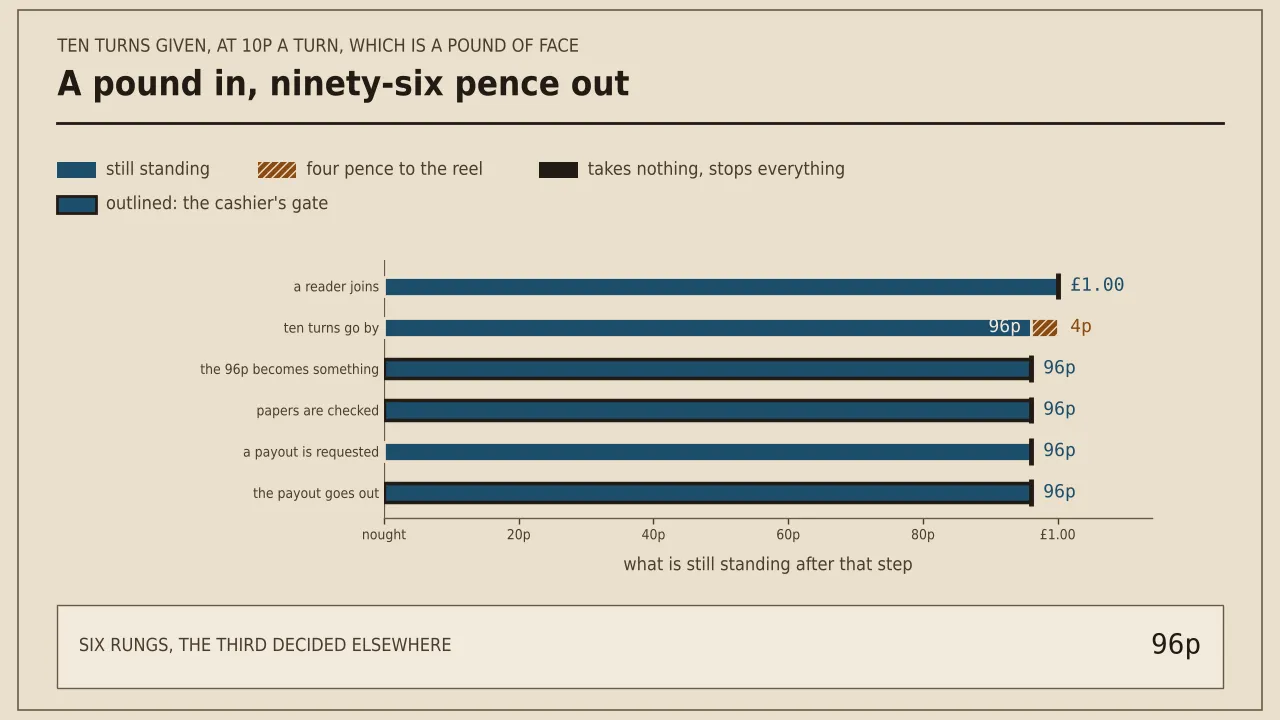
4p of a pound stays with the reel, and six separate things still have to happen before the other 96p is money anybody can spend
Turn that round and it becomes a way of reading any headline. A chain has a fixed cost in events, and the smaller the prize the worse that cost looks against it. Six rungs for twenty pounds may be a fair exchange of effort. Six rungs for 96p is the same effort for a twentieth of the return, and nobody advertising ten turns mentions that the paperwork is identical.
Six rungs for a pound and six rungs for twenty pounds is the same labour against twentyfold the return, and nobody advertising ten turns says so. The labour is not large on either: a registration, some turns, some paperwork and a request. What it is, is fixed, and a fixed cost against a shrinking prize is the oldest arithmetic there is.
This is also the reason a short chain is worth counting rather than waved through. Short is a property of the chain and not of the offer. On this key the chain really is short, the arithmetic really does reduce, and the honest closing figure really is 96p. None of which makes the six rungs go away.
3
The rung that settles what 96p is
When the tenth turn stops, 96p exists in some form. Whether it is cash, or a balance with a string on it, or something a term gives another name to, is settled by the offer’s own side and by nobody else, and nothing published says which it will be off the rule sheet, claim 90.
A word on why this is a rung rather than an omission. Something happens to the proceeds of ten turns, invariably: they are credited somewhere under some label, and a label is a decision. A page leaving that out would be saying the chain runs from the last turn straight to the paperwork, which is not how any account works. A page pricing it would be inventing a term. Counting it and carrying the figure through is the only reading that is neither.
So the rung is counted and the figure crosses it whole, with the last column saying no source stands behind the step. That makes it the first rung on this chain that somebody else decides, and 96p is standing when it is reached. Nobody has published a roof over proceeds of this kind either off the rule sheet, claim 105, which on a sum of 96p is a silence with almost nothing left to cover.
At 96p the question is not what a term takes but whether anything comes out at the far end at all. That is a different question from the one the rest of this site answers, and a smaller count is where it starts to be the only question worth asking. On a balance of twenty pounds a ten times obligation would be the headline fact. On a balance of 96p the headline fact is the existence of four more rungs after the money has stopped moving, three of which belong to somebody else.
It is worth saying what this is not. Nobody is being accused of anything, and no estimate has been dressed up as a rung. The chain has a step there because something happens there, and the page has no figure for it because nobody has printed one. On a sum this small the practical reading is blunt: whatever the convention is, it will not be worth anybody’s while to argue about.
4
What an unpublished floor would do to 96p
The silence that matters most on a small sum is not about obligations. It is about the smallest payment a cashier will make, and that is where 96p is unusually exposed.
A ceiling over what somebody draws out of their own deposited money is forbidden to a licensee off the rule sheet, claim 34. That protection is about a ceiling and about a deposit balance, and this chain has neither: no deposit has been made, so there is no deposit balance, and the thing that would hurt here is a floor and not a roof. No source publishes a floor, and no rule read for this page forbids one.
And the reason it bites here and not elsewhere is pure scale. A floor set at a round figure is a small inconvenience against twenty pounds and an absolute barrier against 96p. Any threshold at all above a pound ends this chain, and a threshold above a pound is an unremarkable thing for a cashier to have. That is the honest reading of the smallest key under this heading: the chain is short, the arithmetic reduces, and the sum at the end of it is small enough to fall through the gaps in what nobody has published.
Put numbers to it. A floor at £10 leaves 96p unpayable and the chain ends at the sixth rung with every word of the offer honoured. A floor at £5 does the same. A floor at 50p lets it through. The arithmetic above the sixth rung is identical in all three cases, which is the clearest demonstration this site can offer of why the two ends of an offer are not the whole of it: £1.00 in and 96p out describes every one of those outcomes equally well, and only the rung count distinguishes them.
No rung goes on the instrument for a floor. No figure for one exists in any source open to this publisher, and this site does not draw rungs it cannot number. The paragraph is the honest alternative. Where a reader finds a minimum payout stated against a particular offer, it is a rung, and on a balance of 96p it is very likely the rung that ends the chain.
5
Two design rules worth more than the money
On a key worth 96p, the duties worth naming are not the ones about money. They are the ones about what the ten turns look like while they happen, that being the part somebody actually sits through.
Where a licensed game pays back the stake or less, it is required to say so quietly: nothing that marks a win may be used on such a result off the rule sheet, claim 112. On ten turns at 10p that rule earns more than any sum printed here: most results on a short run are small, and the difference between a muted credit and a fanfare over a loss is the difference between an accurate impression and a false one.
The second is sharper still. Dressing one losing outcome up as a near thing, so that a player reads the odds wrongly, is barred by name off the rule sheet, claim 116. Ten turns is too few to learn anything from, which is precisely the situation in which an impression formed by design rather than by probability does the most damage.
There is an arithmetic behind that, and it travels to any offer a reader meets. Ten turns is a sample of ten. The 96 per cent is an average taken over a very long run, and ten of anything says next to nothing about such an average: what actually comes back from ten turns ranges from nothing whatever up to many times the face. Somebody finishing those ten turns with £4.00 has learned nothing about the game, and somebody finishing with nothing has learned nothing either. The only honest figure after ten turns is the one this page started with, which is the expected 96p, and it is the figure least likely to be the one on the screen.
Which bears directly on the third rung. A reader whose ten turns came back with £4.00 has a figure four times the one on this page, and the same six rungs under it, and the same unwritten convention settling what it is. The arithmetic on this guide is the expectation and not a promise, and nothing about the count of rungs depends on which way the ten turns actually fell.
Neither rule puts a penny on or off the 96p. Both change what somebody believes after ten turns, and what somebody believes after ten turns is what decides whether they deposit. That is the real exchange rate on a key like this, and no figure on the instrument captures it.
6
Ninety-six pence outside the licence
Both design rules in the part above, and the protection over a deposit balance in the part before it, hang on the same thing.
Ten turns are offered to readers here without a Great Britain licence anywhere in the arrangement, and on 96p the consequences show more plainly than they would on a larger sum. The pair of design rules just cited reach licensed products and nothing else, so nothing obliges the ten turns on this chain to stay quiet about a result at or under the stake. Then there is the money’s standing. A business holding customer funds under a licence owes its customers a written account of whether those funds survive an insolvency, how far, and by what arrangement, and has to collect an acknowledgement before anybody gambles with them off the rule sheet, claim 54a; the ratings run from none at all through to high off the rule sheet, claim 54c. No such statement is owed here, so 96p sitting in an account between the second rung and the sixth is money of unstated standing. And the exclusion scheme covers every licensed online gambling business off the rule sheet, claim 181 while saying in terms that it cannot reach past its own membership off the rule sheet, claim 183, so a Gamstop registration stops where this chain begins. No route across that boundary is set out anywhere here.
Set against the whole of that, one fact goes the other way, and it is printed on every guide here. The offence falls on whoever provides the gambling, and Parliament wrote no matching one for the person at the other end off the rule sheet, claim 3. Protection goes and liberty does not, and the going can be listed item by item rather than asserted off the rule sheet, claim 168. So: six rungs, 4p of real loss, and 96p resting on a rung with no rule behind it.
Asked at the booth
- What are ten turns worth here
- A pound of face at the value this page sets, and 96p once the reel has kept 4p. The 96p does not change again.
- Does a small count mean a short chain
- No. Ten turns and two hundred walk the same six rungs. What differs is the money behind them, and it differs twentyfold.
- Who settles what the 96p actually is
- Whoever runs the offer, at the third rung, with nothing published about which way it goes and the whole sum riding on it.
- Could a minimum payout swallow the whole 96p
- Yes, and nothing read for this page forbids one. No figure for a minimum is published either, so no rung is drawn for it.
- Is there a rule against capping what comes out
- There is, and it is about a ceiling over a deposit balance. This chain has no deposit balance, and a floor is not a ceiling.
- Which licensed duties matter most at this size
- The design ones. A licensed reel keeps quiet about a return at or under the stake, and may not pass a plain loss off as a near thing.
- Why bother counting a chain worth under a pound
- Because the chain is the same length as on an offer worth twenty times more, and that comparison is the one no headline makes.