Terms read 26 October 2026 Counted in 2026
Non Gamstop PayPal casinos: seven rungs, and the sixth is not the reader’s
Paying in and being paid out are two different problems, and a chain that needs a destination for the second has a rung the others do not. A 70 per cent match on a £20 deposit makes £14.00 of credit, a ten times obligation leaves £8.40 of that, and £8.40 then waits at four rungs in a row. The sixth of the seven is where the deciding stops being the reader’s.
How many steps seven Open, deposit, clear the obligation, request, give a destination, be checked, be paid. The first gate somebody else holds the sixth A check falls after the asking, and no published rule puts it earlier. Standing when it is reached £8.40 What the obligation left of the credit, with the deposit counted apart.
| What has to happen | Who takes this step | What it leaves standing | Printed where |
|---|---|---|---|
| An account is opened | the reader | £14.00, or nought unopened | the offer’s own headline |
| Twenty pounds goes in | the reader | £14.00, or nought unmatched | the written terms |
| Ten times is turned over | the house’s arithmetic | £8.40 | a British ceiling, read across |
| A payment is asked for | the reader | £8.40, or nought unasked | the cashier’s own form |
| A way back is supplied | the reader | £8.40, or nought unrouted | nothing published names a method |
| Identity is checked | the cashier | £8.40, or nought unverified | no published rule places it |
| The payment is settled | the cashier | £8.40, or nought unsettled | nothing published behind it |
| What seven rungs leave | two gates the cashier holds | £8.40 | this page |
1
A £20 deposit, a £14 credit, and the one of them the bars follow
Two sums are in play from the first rung and this guide keeps them apart. One is £20 that belonged to the reader before any of this started. The other is £14.00 of credit that did not. The ladder follows the second and says where the first went, because adding them would blur the only thing the third column is for.
A 70 per cent match on £20 is the shape assumed here, and assumed is the right word. What terms any cashier outside the British licence puts on a match is not something this publisher’s sheet states, and a page quoting a percentage it had never read would be writing fiction off the rule sheet, claim 158. What the shape does supply is £14.00 of credit at the top of the ladder, and every figure below moves with that.
The credit goes in flat, and that is a deliberate piece of arithmetic rather than a shortcut. Credit arrives as money, so it has not passed through a reel and no reel has taken a share of it. Putting a return over it as well as over the obligation would knock roughly four per cent off every sum on this page, and that is the single commonest error on this expression across the network.
The deposit stays out of the promise for a related reason. £20 of a reader’s own money is not something an offer handed anybody, so a ladder opening at £34.00 would be reporting a gift far larger than the one on the table. Where the £20 belongs is in a sentence like this one, and the single British rule written about it has a part of its own below.
The return has to be declared as well. 96 per cent is used, as a figure the industry runs on broadly and as an assumption of this publisher’s, never as a reading off a title off the rule sheet, claim 120. It bears on rung three and on nothing else. Move it to 94 per cent and the obligation takes more; the rung count stays at seven and so does the name against rung six.
A reader may object that the deposit and the credit end up in one account and so belong on one ladder. The objection is fair and the answer is in what the third column is for. It opens at the face value of a promise and closes at what can be taken away, so a promise is what it has to follow. £20 was never promised to anybody; it was moved. Following it would turn a measure of what an offer is worth into a measure of what a reader happens to be holding, and those are two different questions.
2
What ten times takes off £14.00
£140.00 of staking is what a ten times obligation wants of a £14.00 credit, and that figure deserves reading twice: it is seven times the money the reader put in to get the credit in the first place.
£8.40 is the answer E = B × (1 − W × (1 − RTP) ∕ g) gives with the credit at £14.00, the multiple at ten and the qualifying share whole, nothing published standing available to set a contribution rate lower off the rule sheet, claim 105. The obligation takes £5.60, two fifths of the credit, and no other rung on this ladder takes anything.
Ten is on rung three because ten is as gentle as any published figure goes. Above ten on bonus funds ceased to be lawful for a British licensee, the date being 19 January 2026 off the rule sheet, claim 91, and the exception stops at technical and software licences off the rule sheet, claim 93. What binds a cashier outside that licence to ten is nothing at all, which part eight returns to.
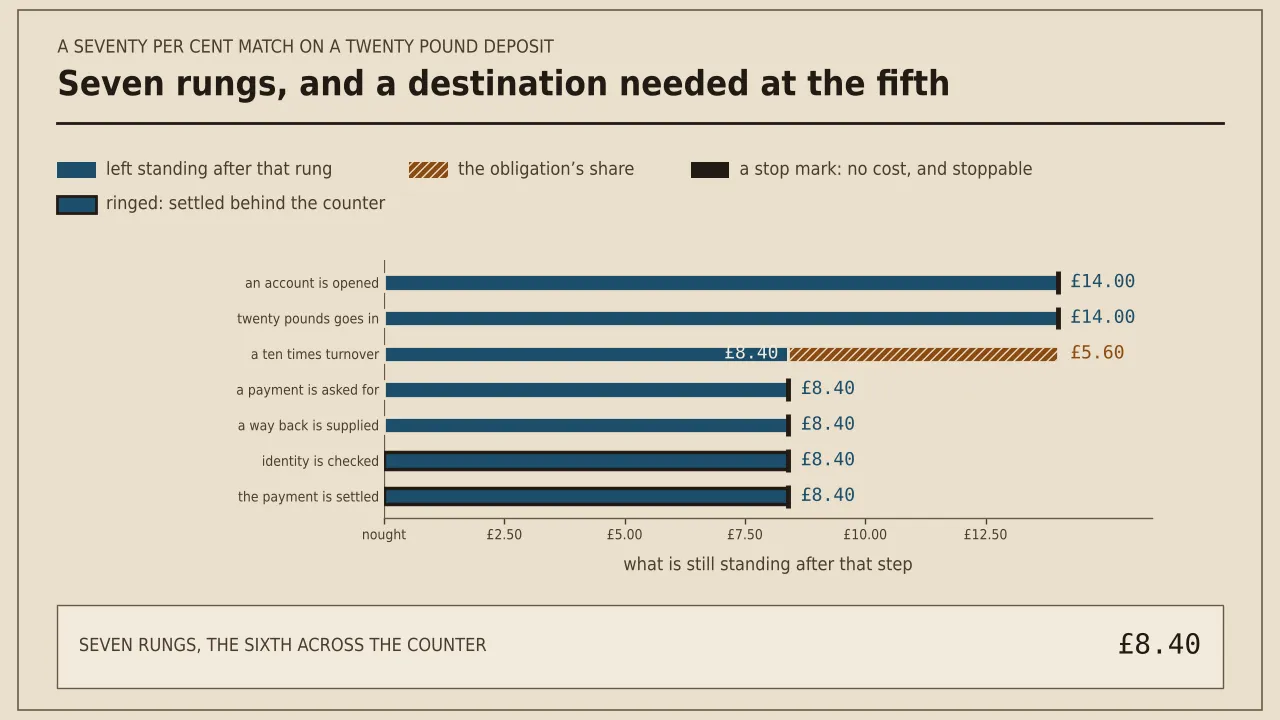
£5.60 is the obligation’s share of a £14.00 credit, two fifths of the credit and a quarter of what the reader put in and got matched
Put the £140.00 against the £20 and the proportion is the useful thing. A reader stakes seven times their own deposit in order to convert a £14.00 promise into an £8.40 one, and then the £8.40 waits at four rungs where no further money moves. Everything interesting about this chain happens after the arithmetic has finished.
Two ratios come out of this part and both are worth keeping. The obligation takes two fifths of the credit, which is the figure the expression produces. The staking it demands is seven times the deposit, which is the figure a reader feels. Neither appears in any headline, and it is the staking figure that settles whether a chain of this length gets walked at all.
3
Seven rungs, because being paid needs somewhere to be paid to
Six rungs would be the count on a chain where asking to be paid is enough. This chain has seven, and the extra one is the subject of the key.
A payment has to arrive somewhere. Asking for one and nominating a destination the cashier will actually send it to are two separate things that have to happen, and on this key the second is the one a reader came to ask about. So rung five carries it, with the fourth column saying that nothing published names a method.
That silence is the honest answer and exactness about it matters. What a cashier outside the British licence takes in, what it pays back to, and whether those two are one list at all are things this publisher’s sheet does not state off the rule sheet, claim 158. No rung above names a method, no part below names one, and a page supplying such a list would be inventing its most load-bearing fact.
What can be said is structural, and it is enough to put a rung on a ladder. Money coming in and money going out are different transactions. Where they travel by the same route the rung costs a reader nothing but a moment. Where they do not, the rung is a condition with a sum standing on it, and £8.40 is that sum.
A reader can find out which case they are in before reaching rung five rather than after, and the one published pointer on the subject is in part five. It comes out of an advertising rule rather than a gambling rule, which is itself worth knowing.
The rung is the reader’s own, and that matters to where this page’s finding falls. Supplying a destination is something a reader does, at whatever hour suits, and it will wait as long as it is left. So rung five is not the finding. Rung six is, and telling those two apart is the second column’s entire job.
A third reason for counting the rung rather than mentioning it in passing is what a rung is. It is a place the chain can stop. Of the seven here, five are places where the whole £8.40 either passes or does not, and rung five is one of the five. Leaving it off would have produced a shorter chain and a less honest one, which is the trade this section exists to refuse.
4
The one British rule written about a deposit balance
The £20 left the ladder in part one and here is where it returns, because exactly one published British rule is written about it, and that rule is about getting it back out.
Under that rule no term is available to a licensee that caps withdrawals out of a deposit balance off the rule sheet, claim 34. A ceiling by the day with a second by the week is the example the regulator gives of a term going wrong; beside it the page has money free to leave that balance whenever, winnings and all, with reasonableness required of any limit on how large a withdrawal is or how many there are off the rule sheet, claim 35.
Two things about the rule want stating exactly, since it gets stretched. Its subject is a deposit balance and not what a bonus wins, so a roof over the winnings from a bonus and an unroofed deposit balance can hold at the same time off the rule sheet, claim 105. And no date of any kind is printed on the page carrying it, so a page may cite the rule and may not attach a freshness to it off the rule sheet, claim 36.
A companion rule runs the reader’s way. Cancelling a withdrawal is not something a licensed system may offer once one has been requested; the funds are not meant to be depositable again after that; and smoothness is what the whole business of withdrawing is supposed to be given off the rule sheet, claim 37. Rung four above is where that would bite.
Price the pair against this page and the gap is plain. A British licence would keep the £20 clear of a ceiling and the £8.40 clear of an invitation to put it back. Neither protection reaches a cashier lacking that licence, so both appear here as measurements of what rung four and rung seven are short of rather than as things a reader may lean on.
No figure goes on the ladder for either, and a rule this site sets itself is why. No withdrawal ceiling for any cashier on this key is published anywhere citable off the rule sheet, claim 159, so a rung carrying a made-up one would be worse than no rung. The ladder names the silence in its fourth column instead.
5
What a payment method is allowed to hide, and where that was settled
The one published pointer a reader has at rung five comes from the advertising regulator and not the gambling one, and it is sharper than anything the gambling rules supply.
A promotion owes its significant conditions clarity and prominence wherever their absence would mislead off the rule sheet, claim 61. What counts as significant has a worked list behind it. Eligibility is on the list. So is the deposit, so is the wagering, so is the time there is for claiming an offer or spending it, and so are qualifying odds and bet types off the rule sheet, claim 62. Each of those appears on the offer this ladder came from.
A payment method has been ruled on by name as well. On 31 July 2024 an excluded method sat among the full terms in small print, and the regulator held that significant condition to be insufficiently prominent off the rule sheet, claim 66. That is the nearest thing on this publisher’s sheet to a ruling about rung five, and what it settles is narrow: a method an offer will not take is significant, and burying it breaches an advertising code.
Where terms have to sit is published too. One click from an online advertisement is the standard, and footers and small print are both named as places a link to them does not belong off the rule sheet, claim 63. The consequence is spelt out: prominence short of sufficient makes the advertisement a misleading one off the rule sheet, claim 79.
None of that is a gambling licence condition, which is the thing worth carrying away. Advertising codes reach a marketing communication, so on this key a reader has a published standard for what an offer’s terms have to show and none at all for what the cashier behind them has to do. The first is about a sentence. The second would have been about £8.40.
Two further rulings on the same sheet show the shape of the thing without helping at rung five. One concerned a free bet conditional on answering a message before a stated hour, where the advertisement left the condition out and the omission was likely to mislead off the rule sheet, claim 65. The other concerned a £5 voucher that was no good on a single day of the year, said nothing about it, and was found in breach off the rule sheet, claim 67.
6
What the regulator says can happen to a payment route
Rung five is a rung about a route, and the published facts about what can happen to a route are worth setting down before rung six arrives.
A business trading without the British licence is acting illegally, and two consequences get named. Action may be taken against the operator. And the big payment systems organisations, Mastercard among those listed, may pull such a business’s payment facilities off the rule sheet, claim 129.
Read that against the ladder rather than as a general warning. Rung five asks a reader to nominate a destination. Should the route a cashier uses stop working, the rung does not get harder; it becomes a rung with no answer to it, and the £8.40 standing there does not go anywhere at all. That is the difference between a rung that takes a share and a rung that is a gate, drawn at the one place on this chain where a gate is about plumbing.
Two failure modes on the official record sit lower still. Payouts halted outright is one, and a withdrawal ceiling set where nobody gets to it is the other off the rule sheet, claim 135; in its summary of what a player stands to lose the regulator names unfair play, money, and nowhere to turn when things go wrong off the rule sheet, claim 134. Both land on rung seven. Neither is priceable, there being no published figure for either.
Scale is something the regulator is careful about and this page follows suit. Its own assessment is that the revenue at stake makes complete dismantling of the unlicensed market unlikely to arrive at all, and against that it sets a 32 per cent fall in traffic, taken across 160 websites it had targeted off the rule sheet, claim 136. Quoting one half and not the other would be arguing a case instead of counting a chain.
One observation here belongs to this page and wants separating from the regulator’s figures. The 160 websites and the 32 per cent belong to the regulator. That both of them sit over rung seven rather than over rung three is this guide’s observation, and it follows from the ladder rather than from any source: a payment that gets stopped is stopped at the paying and not at the staking.
7
Rung six, and the reason nothing fixes its place
£8.40 travels four rungs on this ladder without altering, and the reason the page reports the sixth of the seven rather than the fourth or the fifth is a difference in who holds each.
Rung four and rung five are the reader’s. Asking for a payment and nominating a destination both happen when a reader decides, and both will wait. Rung six and rung seven are not the reader’s at all: both run at a pace set elsewhere on terms written elsewhere, and all a reader does at either is wait. Rung six is the first of those, so rung six is the finding.
Where it stands on the ladder is unfixed, and the fourth column says so instead of filling the gap in. Britain pins both ends down. Three items go in verified ahead of any gambling off the rule sheet, claim 10, and a late demand for paperwork may not be made a condition of a withdrawal where asking earlier was a fair option off the rule sheet, claim 11. Outside that licence this guide found nothing stating a cashier’s timing, its list of documents, or how long it may hold an answer.
The figure is indifferent to the position and the reader is not, which is the point worth keeping. A gate takes nothing from wherever it is set, so £8.40 is £8.40 with the check above rung one or below rung five. What changes is whether £140.00 of staking has already happened when the answer arrives.
One more property of the rung belongs here because it affects the count rather than the sum. No source found puts a limit of one on the asking. One rung is what the ladder gives the check, one being the number a chain needs to continue, and seven should therefore be read as a floor under the number of rungs rather than a measurement of it.
A closing note on the second column, which is where the finding actually comes from. Three answers are open to it and no fourth: the reader’s, the house’s arithmetic, or a named other party. Rung three is the second of those and takes £5.60. Rungs one, two, four and five are the first. Rungs six and seven are the third, and they take nothing whatever, which is exactly why they are the pair worth reporting.
8
Three duties priced off a £14.00 credit
Every protection named above comes from one place, and the cashier standing at the end of this chain is outside it. That is the single fact governing all seven rungs, and it has been held to the end so that the duties could be priced one at a time first.
Carrying no Great Britain licence is where a cashier of this kind stands, and three duties that licence would have imposed bear on the rungs above. The deposit first: a licensee has no term available that caps withdrawals out of a deposit balance off the rule sheet, claim 34, so the £20 on this page would be clear of a ceiling under that licence and is clear of nothing without it. The obligation second: £5.60 is the smallest share rung three can be made to take, ten being the published ceiling, and the multiple the regulator put on record as the thing that ceiling was aimed at is sixty times off the rule sheet, claim 94, which against a £14.00 credit drops the expression below nought and says the credit is not expected to last the course. The scheme third: a Gamstop registration will not end before its minimum term is served off the rule sheet, claim 185, and for seven years after a deactivation has gone through, operators go on being told that the person was once registered, without any duty in that window to keep them out off the rule sheet, claim 187. Those are consequences, and this guide prints no way round any of them.
Unregulated is the word to avoid here, because it throws away the two published standards this page does have. One is an advertising code that has ruled on a buried payment method. The other is a licence condition about a deposit balance that this cashier is not subject to. Naming both, and saying which of them reaches whom, tells a reader more than any adjective could.
The other direction has to be stated as well. The offence is providing the facilities unlicensed, and it belongs to the provider; the Act gave the customer nothing to answer for off the rule sheet, claim 3. Protection is what goes outside that licence and liberty is not, and this page has priced the going: a ceiling over the obligation, the deposit balance nobody may put a roof on, the bar on inviting a withdrawal back, the identity settled before the first rung, and a scheme membership no licensee may decline off the rule sheet, claim 168.
Seven rungs, two of which are somebody else’s, and £8.40 standing when the first of those two arrives. The deposit that bought the credit is £20, the staking the credit demanded is £140.00, and the destination the payment needs is the one rung on this ladder that no source would name.
Asked at the booth
- How many things does this chain actually ask for
- Seven. Opening, depositing, clearing the obligation, asking, giving a destination, being checked, and being paid.
- Which rung is the first one somebody else holds
- The sixth, the identity check, with £8.40 standing on it. Rung three takes more and decides nothing, being arithmetic.
- Why is the £20 deposit not on the ladder
- Because that £20 belonged to the reader before any offer did. The ladder follows the £14.00 of credit and the deposit is counted in prose.
- Does this page say which methods any cashier takes
- No, and it could not. What a cashier outside the British licence accepts, or pays back to, is not stated on this publisher’s sheet.
- What does the fifth rung actually ask for
- A destination the cashier will send money to. Paying in and being paid out are separate transactions, and the rung exists because of that.
- How much staking does the £14.00 credit demand
- £140.00, which is ten times the credit and seven times the deposit that was matched to get it.
- Has a payment method ever been ruled on
- Yes, in a decision dated 31 July 2024. An excluded method sat in the small print and was held insufficiently prominent.
- What does a British licence do for a deposit balance
- It leaves a licensee no term that would cap withdrawals out of one, with a daily and a weekly ceiling given as the example of a term going wrong.