Terms read 26 October 2026 Counted in 2026
Non Gamstop Paysafe casinos: seven rungs, and the sixth belongs to the cashier
A bigger percentage on a match does not buy a gentler obligation, and that is where this count starts. Two hundred per cent on a £10 deposit makes £20.00 of credit and £200.00 of staking, which leaves £12.00 once a ten times obligation has taken its share. Seven things then have to happen, and the sixth of them is answered on the far side of a counter.
How many steps seven Open, pay in, clear the obligation, give a destination, ask, be checked, be paid. The first gate somebody else holds the sixth Documents go one way and a verdict comes the other, at a pace set there. Standing when it is reached £12.00 Three fifths of the credit, held up at the first rung somebody else owns.
| What has to happen | Who takes this step | What it leaves standing | Printed where |
|---|---|---|---|
| An account is opened | the reader | £20.00, or nought unopened | the headline over the match |
| Ten pounds goes in | the reader | £20.00, or nought unmatched | the written terms |
| Ten times is turned over | the house’s arithmetic | £12.00 | a British ceiling, read across |
| A way back is supplied | the reader | £12.00, or nought unrouted | no source names a method |
| A payment is asked for | the reader | £12.00, or nought unasked | the cashier’s own form |
| Identity is checked | the cashier | £12.00, or nought unverified | unplaced, and unpublished |
| The payment is settled | the cashier | £12.00, or nought unsettled | nothing published behind it |
| What seven rungs leave | two gates the cashier holds | £12.00 | this page |
1
Ten pounds in, twenty of credit, and the sum the ladder follows
Two hundred per cent on £10 is the shape this count is drawn from, and it is a shape rather than a term. Which percentages a cashier beyond the British licence actually runs is nothing this publisher’s sheet reports, and a page that named one as though it had read it would be making the figure up off the rule sheet, claim 158. What the shape gives is £20.00 of credit, and the rest of the page is worked off that.
The £10 is the reader’s and the £20.00 is not, so the bars follow the second of the two. Moving money is not the same act as promising it, and a ladder opening at £30.00 would be describing a gift half again as large as the one on offer. Part five is where the £10 gets its own treatment.
Credit goes in at face. It has not been near a reel, so no reel has had a share of it, and running a return across it as well as across the obligation would shave something close to four per cent off every sum printed here. That mistake is the commonest one made with this expression anywhere on the network, and the arithmetic below avoids it by taking the credit flat.
One number does have to be declared and it is the return: 96 per cent, a figure the industry runs on broadly, used here as this publisher’s assumption and not as a reading taken off any title off the rule sheet, claim 120. It touches rung three alone. Nothing about the other six rungs depends on it, which is the first clue that the interesting part of this chain is not arithmetical.
Nor does anything published settle what a round costs on a key like this one, which is why no count of turns appears above off the rule sheet, claim 89. The obligation is priced in money rather than in spins, and £200.00 is the figure to hold on to while reading the rest.
2
What ten times takes off £20.00
£200.00 is what a ten times obligation wants staked out of £20.00 of credit. Twenty times the deposit, put another way, before any of the credit is anybody’s to take away.
£12.00 is the result E = B × (1 − W × (1 − RTP) ∕ g) gives from £20.00 of credit at ten times, with the qualifying share whole and no published rate standing anywhere that would lower it off the rule sheet, claim 105. £8.00 goes to the obligation, and no other rung among the seven takes a penny.
Why ten, when nothing on this key is bound by ten, is the question part eight answers properly. The short version is that ten is the gentlest figure anybody has published: a British licensee lost the use of anything above ten times bonus funds from 19 January 2026 off the rule sheet, claim 91, and the carve-out reaches technical and software licences and no further off the rule sheet, claim 93.
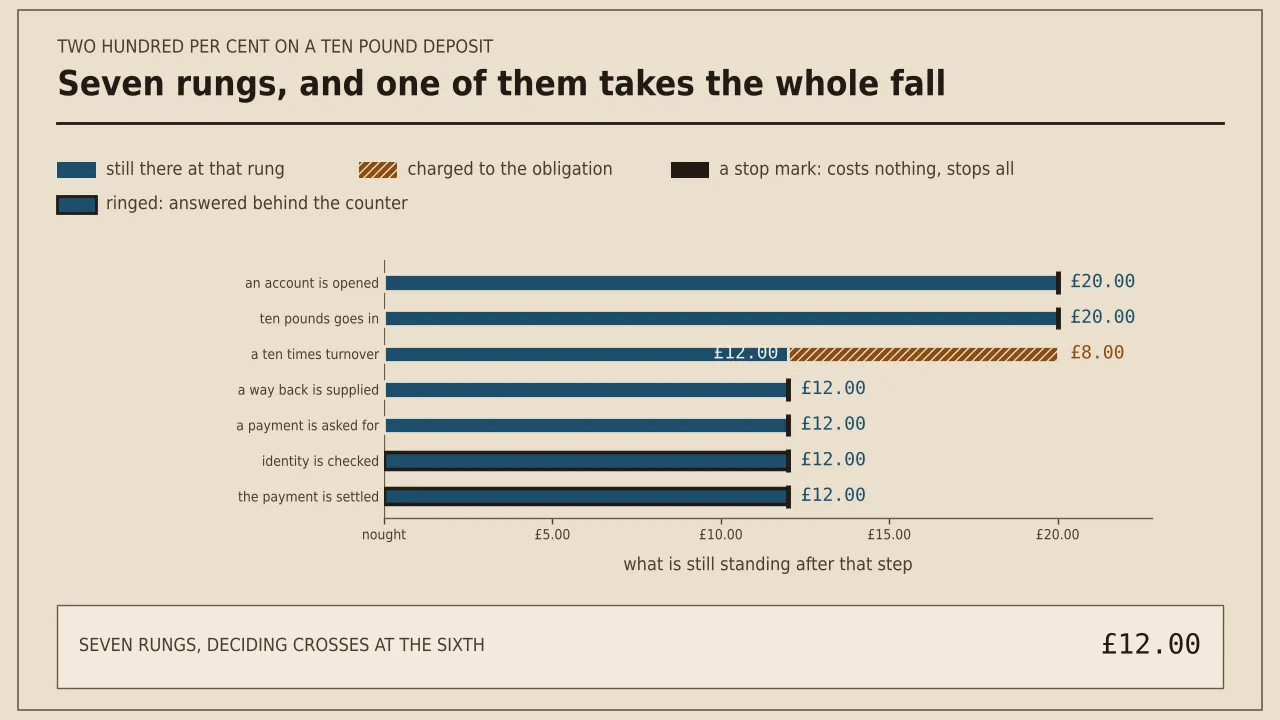
£8.00 of the £20.00 credit is the obligation’s share, which is two fifths of what was credited and four fifths of the deposit that earned it
Set the £200.00 beside the £8.00 and the shape of the bargain is visible. A reel has to see two hundred pounds pass through it before a twenty pound promise turns into a twelve pound one, and after that the £12.00 stands at four rungs in succession while nothing further is taken from it. The sums stop moving well before the chain does.
3
What a bigger percentage buys, and what it does not
A match is advertised as a percentage and read as generosity, so this part does the arithmetic that the percentage hides. What Britain publishes a ceiling on is the multiple, and the percentage is left alone, which has a consequence a reader can check in one line.
Hold the deposit at £10 and walk the percentages up. A hundred per cent makes £10 of credit, and £100 is the play-through ceiling over it. Two hundred makes £20 and £200. Three hundred makes £30 and £300. Four hundred makes £40 and £400 off the rule sheet, claim 103. Ten to one is the relation in all four rows, so a larger headline is a larger obligation in exactly that proportion.
Those four rows are this site’s own arithmetic sitting on a published ceiling, and they want labelling as such. The ten belongs to the regulator. The four rows belong to this page, and they would read the same at any deposit: the percentage scales the promise and the obligation together and changes neither one’s relation to the other.
One more consequence of the ratio bears on how a chain like this gets chosen rather than on what it costs. Put a hundred per cent on £20 beside two hundred per cent on £10 and the two are the same obligation: £20.00 of credit and £200.00 of staking in either case. What differs is only how much of the £20.00 came out of the reader’s own pocket.
What a bigger percentage does buy is a bigger sum surviving at the foot of the chain, and the expression says how much. At full weight and a ten times obligation the figure that survives is three fifths of the credit, so £10 of credit leaves £6.00 and the £20.00 drawn above leaves £12.00. Double the headline and the sum at rung seven doubles. Nothing else on the ladder moves at all.
That last sentence is the useful one on this key. Seven rungs are seven rungs at a hundred per cent and at four hundred. Rung six is held by a cashier in both cases. A percentage is a lever on one column of this instrument and on none of the others, and a reader who compares two offers by their headlines alone has compared the only thing that scales.
A caution belongs with the arithmetic. Terms that want the deposit staked alongside the credit have never been placed inside or outside the published ceiling by anybody in print off the rule sheet, claim 104, so the £200.00 above is the obligation on the credit and nothing more. Where terms want the deposit staked too, the staking rises and this page has no sourced figure to put against it.
4
The product rule, and three carve-outs that run against expectation
A second rule came in on the same day as the ten and it governs what may be bundled into one incentive. It gets a part to itself because what it allows is more surprising than what it stops.
What the rule bars is a licensee bundling gambling products of two kinds into one incentive, and it names four kinds: betting, casino, bingo, lottery. Its scope and its commencement match the ten exactly off the rule sheet, claim 99. The regulator states the target narrowly, as the mixing of products within a single incentive where the terms are linked and shared off the rule sheet, claim 101.
Three carve-outs follow, and all three cut against the assumption a reader brings. Products of a single kind may be put together inside one incentive. An email may carry two offers where both of them have been opted in to. And a credit that may be spent on whichever product a customer picks is left alone by the ban off the rule sheet, claim 100.
Apply the rule to the offer this ladder came from and it stays on the right side of it. Free rounds alongside a match keep the whole offer inside one kind, slots being casino; set bingo tickets beside that same match and two kinds have been crossed off the rule sheet, claim 102. So the shape drawn above is a shape a British licensee could lawfully run, which is precisely what makes the rest of this page about something other than the offer’s design.
None of the four rungs below rung three is affected by any of that, and saying so is the point of putting the rule here rather than leaving it out. A product rule governs what an incentive may contain. It has nothing to say about who decides whether the £12.00 gets paid, and on this key that is the question with a sum standing on it.
5
What a licence does about the money going in
The £10 came off the ladder in part one, and three published duties bear on it that have nothing to do with how it is spent. All three are about paying in, which makes them the duties nearest to the subject of this key.
Credit cards are out. Taking payment for gambling by credit card is closed to a licensee, and routing such a payment through a money service business is closed with it off the rule sheet, claim 21. 14 April 2020 is the date it bit, the remote licences are all covered along with the non-remote betting ones, and the technical, software and host licences sit outside off the rule sheet, claim 22.
Financial checks come with figures and dates. Once a customer’s net deposits run past a monthly figure a light-touch check is owed, and £500 a month was that figure from 30 August 2024, with £150 taking over on 28 February 2025 off the rule sheet, claim 48. Heavier assessments sit behind those as a pilot that is not running live against consumers, and a credit rating is untouched by either, which the regulator says in terms off the rule sheet, claim 49.
Consent is wanted before direct marketing for online gambling, and it is wanted for each product and each channel separately, with 1 May 2025 as the start; the release carrying it records a change of date and a page may not print the earlier one off the rule sheet, claim 50. A licensee has also had to show net spend and time spent as they happen since 17 January 2025 off the rule sheet, claim 51.
Price those three against the £10 on this page and the result is a short list of absences. Nothing in anything read for this guide states what a cashier beyond the British licence will accept as payment, whether it weighs a monthly figure before taking more, or whether a reader gets marketed to without having asked. The ladder carries none of it, because a rung needs a published condition and these are published for somebody else.
One of the three does bear on the ladder indirectly and the connection is worth drawing. A threshold of £150 a month is lower than the £200.00 of staking rung three demands. Under a licence, in other words, the staking this chain asks for would be enough to put a reader over the figure at which a check is owed; on this key the same staking triggers nothing anybody has written down.
6
Seven rungs, four of them level, and the two at the foot
£12.00 passes through four rungs on this ladder without changing. Supplying a destination changes nothing. Asking to be paid changes nothing. Being checked changes nothing. A cashier settling or refusing changes nothing. On each of the four the third column carries the figure forward with that rung’s condition written beside it.
A reader may ask why opening an account is a rung at all, coming first and costing nothing. It is a rung because the £20.00 does not exist until it is taken up: the third column opens at £20.00 and the condition beside the opening rung is that there be an account for credit to land in. Counting it also keeps both findings honest, since a chain reported as six rungs would have started in the middle of itself.
Two of the four belong to the reader and two do not, and that split is where the second finding comes from. A destination and a request are both things a reader does when it suits them, and both will keep. A check and a settlement happen on somebody else’s schedule, and the reader’s whole part in each is to wait. Rung six opens that stretch of the ladder and £12.00 is the sum on it.
Rung four is ordered before rung five here for a reason, and the reason is practical rather than formal. A payment cannot sensibly be requested without a place for it to land, so the destination comes first on this chain and the request follows it. Where the two sit in the other order the count does not change and neither does the finding, a request and a destination both being the reader’s.
The obligation is excluded from that company and the exclusion is the heart of this site’s method. Rung three takes £8.00, more than any other rung takes, and nobody decided that: ten times a 96 per cent return leaves £12.00 as a matter of sums, and sums hold no views. Where a share is taken the house’s arithmetic is simply working through, so the costliest rung is not the finding and a rung that costs nothing is.
Writing any of those four as a small deduction would tidy the column and tell a reader something false. Suppose being checked were shown as costing four per cent. A reader would then read that being checked costs about forty-eight pence. It costs nothing: the gap between its two outcomes is £12.00 and nought, which is neither forty-eight pence nor four per cent of anything. A column of falling figures looks the same whether the falls are real, so a share shortens a bar and a gate leaves it alone.
7
Rung six, and the nothing that is published about it
The fourth column against rung six reads that the rung is unplaced and unpublished, and both words are doing work. Unplaced means nothing fixes which rung it is. Unpublished means nothing states what it asks for or how long it takes.
Britain fixes the first of those at both ends of a chain. Identity goes in verified before a person gambles at all, three items at the floor of it off the rule sheet, claim 10, and the duty makes no exception for play that an incentive paid for off the rule sheet, claim 18. At the far end, paperwork a cashier could fairly have asked for sooner may not be made the condition on which a withdrawal turns off the rule sheet, claim 11, and a payment stalled for want of it can be the breach in its own right off the rule sheet, claim 16.
Beyond that licence the sheet behind this guide has nothing to put in either place. What documents are wanted, at what moment, and how long an answer may be sat on are all unstated, and this page will not supply any of the three from imagination. So the rung goes at the first point no published rule keeps it from, and column four says as much.
The sum is unmoved by the placing and the reader is not. £12.00 is £12.00 whether the check falls above the opening rung or down beside the asking, a gate costing nothing from any position. What the placing decides is whether £200.00 of staking is already done when the answer lands, and £200.00 is twenty times the deposit that started this.
Rung seven has even less behind it, and the comparison worth making is with a licensed chain rather than with nothing at all. There a clock sits over the decision to pay: eight weeks at the outside on a complaint about it off the rule sheet, claim 39, with a closing letter bound to set out the onward route to an adjudicator the regulator had approved off the rule sheet, claim 42. Here no such route turned up in anything read for this guide.
That is the finding stated plainly. Seven rungs, four of them costing nothing, and the first rung a reader does not hold is the sixth, with £12.00 standing on it and nothing published above the hand that decides.
8
Three duties priced off £20.00 of credit
Every duty named on this page came from one licence, and the cashier at the end of these seven rungs is not inside it. That is the fact governing all the generous readings above, and it has been kept until now so that each duty could be priced on its own first.
Operating outside the Great Britain licensing regime is this cashier’s position, and three duties that regime imposes price straight off the rungs above. The obligation first: £8.00 is the least rung three can be made to cost, ten being the published ceiling, while the multiple the regulator named as the thing it was fixing is sixty times off the rule sheet, claim 94, which against £20.00 of credit drops the expression below nought and reports credit not expected to outlive the condition. The paying in second: a credit card is unavailable to a licensee as a way of taking payment for gambling, that bar dating from 14 April 2020 off the rule sheet, claim 21 off the rule sheet, claim 22, so how the £10 on this page may lawfully arrive is settled in Britain and settled nowhere on this key. The scheme third: a Gamstop registration does not quietly expire, the scheme undertaking not to lift one when a minimum period ends, and left untouched it carries on for up to seven years beyond that off the rule sheet, claim 186. Each of those is a consequence, and no route round any of them is set out here.
Unregulated would be the lazy word for all this and it would cost a reader the detail. What the record actually supports is a list: a ceiling with a date on it, a payment bar with a date on it, a threshold with two dates on it, a product rule with three carve-outs, and an exclusion scheme that does not expire. Every one of those belongs to a licence, and the value of naming them is that a reader can see which rung each would have stood over.
One figure on this page has no source at all, and the close is the place to name it. What multiple actually sits behind an offer reachable on this key is unknown to this publisher. Ten was used because ten is published, sixty was quoted because the regulator quoted it, and the distance between a surviving £12.00 and a figure below nought is the distance between those two numbers. What a reader should take from that is a ladder drawn at the gentle end of a range nobody has measured.
The opposite direction belongs here as well, or this page would lean as far as the ones it answers. Unlicensed provision is the offence and the provider is the one who commits it, the Act having given a customer nothing to answer for off the rule sheet, claim 3. Protection goes outside that licence and liberty does not, and the going has been counted here item by item off the rule sheet, claim 168: the ten over the obligation, the bar on credit cards, the monthly threshold, the identity settled before play, the eight weeks and the adjudicator past them, and a membership nobody licensed may refuse.
Seven rungs, £200.00 of staking, and £12.00 left standing when the deciding crosses over at the sixth. The percentage on the headline moved one figure on this page and left the other six alone, which is as compact a statement of this site’s method as any key here allows.
Asked at the booth
- How many rungs are there in all
- Seven: opening, paying in, clearing the obligation, giving a destination, asking, being checked, and being paid.
- Which rung does a reader not hold
- The sixth, where identity is checked, with £12.00 standing. Rung three costs more and nobody decides it, arithmetic having no views.
- Does a bigger percentage mean a gentler obligation
- No. On a £10 deposit the staking runs £100, £200, £300 and £400 as the percentage climbs, and ten to one is the relation throughout.
- What does the £20.00 of credit demand in staking
- £200.00, which is twenty times the deposit that was matched. The obligation keeps £8.00 of the credit for itself.
- Why is the £10 deposit kept off the bars
- Because moving money is not promising it. The bars follow the credit, and the deposit is counted in the prose instead.
- Can an offer put two kinds of product together
- Not under a British licence, though three carve-outs apply: two products of one kind, two offers in one email, and a credit spendable anywhere.
- What are the published checks on money going in
- A credit-card bar from 14 April 2020, and a monthly net-deposit threshold that fell from £500 to £150 on 28 February 2025.
- Does a Gamstop registration lapse by itself
- No. Lifting one at the end of a minimum period is something the scheme undertakes not to do, and left alone it can run seven years beyond.