Terms read 26 October 2026 Counted in 2026
No verification casinos: seven rungs, and the sixth has no published condition
A condition that has not been published is not a condition that has gone. Ten pounds down releases forty-five rounds at the 40p assumed here, which is £18.00 at the face and £17.28 reaching a balance, and ten times over that balance brings the reckoning down to £10.37. Seven rungs carry this chain from a headline to a bank account, and against the sixth of them nothing printed anywhere could be found.
How many steps seven Join, deposit, spin the forty-five, work the turnover off, ask, be checked, be paid. The first gate somebody else holds the sixth A check whose terms no reader can read before the tenner goes in. Standing when it is reached £10.37 What the reels and the obligation left, and what the silence is about.
| What has to happen | Who takes this step | What it leaves standing | Printed where |
|---|---|---|---|
| An account is opened | the reader | £18.00, or nought unopened | the headline over the offer |
| Ten pounds is deposited | the reader | £18.00, or nought unreleased | the written terms |
| Forty-five rounds turn | the house’s arithmetic | £17.28 | nowhere, declared on this page |
| Ten times is turned over | the house’s arithmetic | £10.37 | a British ceiling, read across |
| A payment is asked for | the reader | £10.37, or nought unasked | the cashier’s own form |
| Identity is checked | the cashier | £10.37, or nought unverified | unprinted, and the subject here |
| The payment is settled | the cashier | £10.37, or nought unsettled | nothing published behind it |
| What seven rungs leave | two gates the cashier holds | £10.37 | this page |
1
Ten pounds down, forty-five rounds back, and what the pair come to
£18.00 is where this ladder opens, and it is a multiplication and not a quotation. Forty-five rounds are a tally of turns until somebody prices a turn, and 40p is the price put on one here. No source reached for this guide fixes the cash value of such a round, names whoever does fix it, or states what must be said about it off the rule sheet, claim 89. The 40p is therefore an assumption, and it carries that label wherever it turns up below.
The tenner is a separate matter and it is kept off the third column. A deposit is a reader’s own money arriving, not a sum any step of this chain has to produce, and the reckoning below works on the rounds alone. Rung two is on the ladder because the deposit has to happen before the rounds are released, which makes it a thing that has to happen rather than a sum that has to be found.
The share handed back over a long run is put at 96 per cent, declared here and read off nothing. On a licensed chain something readable about the chances is owed before a commitment, and four alternatives answer that duty rather than one. The disjunction is routinely misread: a margin, or a probability of winning events, discharges it as fully as a return percentage does off the rule sheet, claim 121. So a reader is owed a figure of some sort there and never this particular figure. Outside the licence neither is owed.
72p is what 96 per cent leaves with the reels out of £18.00, and £17.28 is what reaches a balance. The ladder puts the 72p against rung three, which is the rung that produced it, and no other rung on this chain is answerable for any part of it.
Since both figures were chosen here, what rests on them is stated here as well. At 20p a round the face is £9.00, the balance £8.64 and the foot £5.18, with every proportion between them preserved. At 94 per cent the balance becomes £16.92 and the foot £6.77, which is £3.60 of difference out of a two-point change to one assumption. The rung count survives both, and so does the number of the rung reported below.
That last point is worth settling before the key arrives. Counting proceeds from things that have to happen, and a promise about a chain does not qualify. A promise is a description, offered by whoever stands to gain from its being believed. The rungs below are therefore counted first and the key is put to them afterwards, which is the order that keeps a count honest.
2
£172.80 of staking, and the two fifths the obligation keeps
£172.80 is the staking standing between a £17.28 balance and any of it becoming withdrawable at ten times over, which is 432 further turns at 40p apiece. Add the forty-five that arrived with the deposit and the count reaches 477, every one of them in front of the first rung where asking becomes possible.
£10.37 is the figure E = B × (1 − W × (1 − RTP) ∕ g) gives back for £17.28 turned over ten times. The qualifying share stays whole inside it, because no published source yields a contribution table, a standard cap on bonus winnings or a rule converting winnings into credit, and not one of the three may be stated as a figure off the rule sheet, claim 105.
Ten sits on rung four because ten is the ceiling in print. On 19 January 2026 a multiple above ten times bonus funds became a thing no British licensee may apply off the rule sheet, claim 91, under a scope sparing only the technical and the software licences off the rule sheet, claim 93. The definition behind the cap is narrow too: a value of wagers to be reached before funds turn withdrawable, and a limit on the multiple alone off the rule sheet, claim 92. Ten binds one number and leaves untouched everything else that can be fastened to the same money.
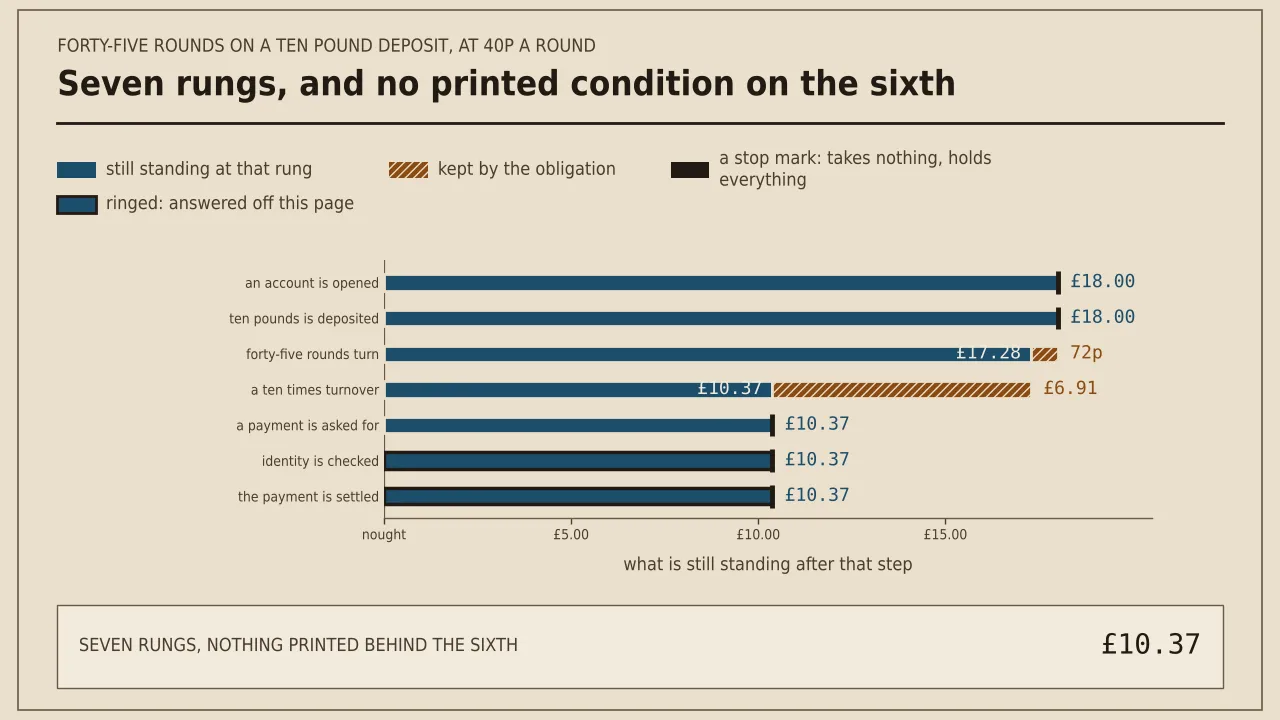
£6.91 of the £17.28 balance goes to the obligation, which is two fifths of it exactly and nine and a half times what the reels kept
Ten is also not a claim about what is usual, and this page declines to make one. The closest thing to a market figure in the published material came from a single business writing about its own offers, putting three quarters of them inside one to ten times, with a caution attached that the sentence belongs to a respondent rather than to the regulator off the rule sheet, claim 95. Where the multiples actually sit among the offers this key reaches is a thing no source reached for this guide puts a figure on. Ten is used above as a ceiling a licence drew, never as an average of anything.
One comparison belongs here because it is the plainest thing on the page. £10.37 standing at the foot is 37p more than the tenner that released the rounds. Four hundred and seventy-seven turns, two assumptions and one published ceiling come out at a deposit returned and 37p of expectation on top of it, and the last three rungs of the ladder are about whether any of that moves at all.
3
What a licence makes readable before a reader commits
The fourth column of the ladder above names a document against four of the seven rungs and names nothing against rung six. The shortest way to show what that absence amounts to is to set out what a licence makes readable, and the readable things all share a deadline rather than a subject.
The rules of a game come first. A reader meets them before committing or the duty has not been met: easily available by then, accurate, sufficient for every rule in play, and put in a form reasonable steps have been taken to make understandable off the rule sheet, claim 122.
The money comes second and the deadline is the same one. Either the prizes and payouts or the method standing behind them has to be there to read before a reader commits off the rule sheet, claim 123. The standard then stops, having a fourth paragraph and no fifth.
Access comes third, and that one is written in clicks. A financial limit has to be reachable by direct link from a home page, visible and usable there and again where a deposit is made, and the number of clicks and pages standing in the way of them kept to a minimum off the rule sheet, claim 28.
Three duties, one deadline. Each of them is owed before a commitment rather than after one, and the deadline is the part that matters for a ladder, because a rung is a thing a reader meets in an order. A duty owed before a deposit is a duty attached to rung two. A duty owed at no particular time is a duty attached to nothing.
What none of the three does is say what a check will ask for. They are about rules, prizes and limits, and the asking at rung six is none of those. So a reader on a licensed chain who wants to know about a check looks somewhere else, and the next part is where that somewhere else is.
4
Terms, and the duty to put them where a reader can reach them
One licence condition reaches the terms themselves rather than any particular subject within them. It runs to four limbs and a single thought holds them together: a term a reader cannot find, or cannot follow, is not a term a licensee is allowed to rely on off the rule sheet, claim 32. Two consumer statutes supply the standard for fairness and transparency, the condition adds the duty to keep contract terms accessible, and notice of a material change is owed before the change takes effect.
Its reach is wide and its date is missing. Two kinds of licence are left outside it, the machine technical one and the software one, with every other operating licence inside, and the page setting it out gives no effective date whatever off the rule sheet, claim 33. So a reader of a licensed cashier’s terms is reading something a duty put in front of them, whereas a reader of this page’s subject is reading what a business chose to print.
A condition on a check is exactly the sort of term that duty would catch. It states what a business may ask for, and when, and what happens to a balance while it waits for an answer. On a licensed chain such a term is accessible before a deposit and cannot be altered under a reader without notice. Rung six on the ladder above has no such term behind it that this guide could find.
Here is the distinction the fourth column is making, and it is the whole of the page. An unprinted condition is not a condition that does not exist. A cashier may hold a complete one, applied consistently, and a reader would have no way of knowing. What a reader cannot do is read it at rung two, which is the single moment every duty in the part above is written around.
Being exact about that is the difference between a count and a complaint. This guide does not report that a check has been abolished, because nothing supports that. It reports a rung with a condition on it, a sum standing on the rung, and a fourth column with nothing in it. Those three things are what a reader can act on before the tenner goes in.
And nothing here is a method. This guide sets out no way of discovering such a condition in advance, no way of satisfying one and no way round one. The consequence is stated and stops at the consequence, which is where it stops on every page of this section.
5
Two things a reader cannot learn at rung two, and what each costs
Two things about rung six are unavailable at rung two, and they cost a reader differently. The first is what will be asked for. The second is when the asking happens. Both can be put against the ladder rather than left as a grievance.
The first costs nothing at all until the rung arrives. £10.37 reaches rung six whatever the condition turns out to be, because the condition takes no money: the 72p and the £6.91 were gone four rungs earlier and arithmetic has finished. A reader who does not know what will be asked for is a reader who cannot prepare, and the whole of that cost falls at one point rather than across the chain.
The second costs something earlier, and of the two it is the graver. Every duty in part three is written around a single moment, the one before a reader commits, and the point of putting a duty there is that a decision taken at that moment can be an informed one. A timing nobody has published removes the moment rather than the check. What is lost is not information about rung six. It is the chance to decide at rung two with rung six in view.
A third thing is unavailable and it belongs to the second column rather than the fourth. That column has three possible answers on this site, and against rung six it gives neither the reader nor a piece of arithmetic. It gives a cashier, which is as far as anything published lets this page go. Nothing names the person, the hour or the standard applied.
Two outcomes follow from that and no third one does. In the first, the check lands at the payout, which puts it after 477 turns instead of in front of any of them, with £10.37 on the rung. In the second it never lands, no owner has been established for the account at all, and £10.37 goes nowhere. Which of the two is in play cannot be told at rung two, and a ladder cannot tell either, which is why a condition is set beside the figure in the third column rather than a likelihood.
None of this is advice and none of it is a route. The use of it falls at rung two, the one rung of the seven where the decision belongs wholly to a reader. Where a reader is on the national scheme already, the graver question is not this arithmetic at all, and the honest answer to that one is that the scheme describes its own reach as ending where its membership does off the rule sheet, claim 183. The helpline is printed in full at the foot of this page.
6
Rung seven, and the remit a licence draws round an adjudicator
A chain ends at rung seven and on a licensed one there is somebody to write to after it. The duty is published in one line: a licensed business is required to use one or more dispute body approved by the regulator, and the body it names is described there as deciding disputes that arise between customers and operators holding a licence off the rule sheet, claim 45.
Read the second half of that sentence slowly, because it is the finding of this part. The remit is drawn by the operator’s licence and not by the reader’s grievance. A route that exists for a licensed chain does not reappear in narrower form once the licence is gone. Its entry condition is a licence, and the cashier at rung seven does not hold one, which puts a reader outside the route rather than at the back of it.
Nor did this guide find a period inside which such a cashier has to answer, a form the answer has to take, or anybody the answer has to point a reader towards. The fourth column against rung seven says nothing published behind it, and that is the literal result of looking rather than a figure of speech.
So rung seven holds the figure exactly level and names its condition, as a settlement always does. Settling a payment moves money from one place to another without reducing it, which makes it a gate on this ladder and never a share. The same is true of rung five, where the asking happens, and of rung six between them.
The two bottom rungs are both the cashier’s and they are not equivalent. Rung six is a condition somebody applies, and rung seven is a decision somebody takes, and on a licensed chain the first has a published shape and the second has a published destination. Here the first has no shape a reader can read and the second has no destination, and £10.37 waits on both.
That is why the foot of the ladder reports two gates rather than one. Four rungs leave the figure where it was, three of those four being gates, and the two at the bottom are the pair nobody has to open. The count stands whatever the 40p and the 96 per cent turn out to be.
7
Seven rungs, and the £10.37 four of them leave untouched
£10.37 appears four times in the third column of the ladder. It arrives at rung four as the product of a return and a multiple, and then stands at rungs five, six and seven with a different condition printed beside it each time. After it arrives nothing comes off it again, and that is the most useful thing to know about the bottom half of the chain.
A reader owns one of those three conditions and neither of the other two. Rung five waits for nobody, since the asking happens the moment a reader decides to ask. Rungs six and seven answer to an hour and to terms that nobody has printed, and the part left to a reader at either one is waiting. That pair begins at rung six, which is why rung six is the rung this guide reports.
The expensive rungs are not the reported ones, and that is this site’s method in miniature rather than an oversight. 72p went to the reels and £6.91 to the obligation, £7.63 between them out of £18.00, and a return and a multiple produced both figures. Neither is capable of holding a view or making an exception. So the costly rungs belong to arithmetic, and the reported rung is one that costs nothing at all.
The fourth column is where this page does its least arithmetical and most useful work. Four of its seven entries name something a reader could in principle go and look at. One names this page, because the 40p and the 96 per cent are declared here and nowhere else. The last two name nothing, and a column that can print an absence is the only instrument on the page capable of carrying the finding.
A word on why the sixth is reported and not the seventh. Both are the cashier’s and both carry £10.37, so order breaks the tie, and the sixth is met first. A chain is a sequence before it is anything else. Once a step has stopped being a reader’s own, everything past it turns on somebody else’s decision, and the arithmetic underneath has been settled already.
Seven rungs, 477 turns, £10.37, and the sixth of the seven. Seven comes off the headline, and anybody is able to arrive at it. The sixth comes off the second column, as the answer to a question about whose step a step is, and off no sum whatever. Put the round at 20p and the return at 94 per cent and the third column fills up with different money while both findings hold.
8
What goes missing with the licence, costed against these figures
The duties in the three parts above come from one place, and the cashier at the bottom of this ladder is not in it. A published inventory sets out what a British licence imposes and a business without one therefore does not owe off the rule sheet, claim 168, and the thread running through its entries is that each was drafted against a named mechanism rather than against gambling in general. Three of them can be priced against the figures on this page.
A cashier of the sort this key reaches holds no Great Britain licence. What that licence would have carried can be priced against the figures above, and three of its duties are priced here. The readable ones come first: a reader on a licensed chain gets the rules and the payout method in advance off the rule sheet, claim 122off the rule sheet, claim 123, so the 40p and the 96 per cent in part one stand where something checkable would otherwise be standing. The obligation comes second: £6.91 is the smallest share rung four can be given, ten being what Britain prints off the rule sheet, claim 91. Put the sixty times the regulator named as the practice that ceiling was fixing against £17.28 and the expression lands £24.19 under nought off the rule sheet, claim 94. The adjudicator comes third: approval of a dispute body is laid on a licensee, and the remit printed for the body named runs to the customers of licence holders off the rule sheet, claim 45. All three are consequences. No method of any kind is described here, and none is available anywhere on this site.
The easy word for all of that is unregulated, and reaching for it would throw away the only usable part. A page that says a reader has no protection is as uninformative as one saying there is plenty, because neither can be put against a rung or a sum. A duty named, with a figure beside it and the rung it would have attached to, can be. That is the form the block above takes and the form the whole of this section takes.
It leans in both directions for the same reason. Providing facilities for gambling unlicensed is an offence committed by whoever provides them, and no equivalent offence was written for the customer at the other end off the rule sheet, claim 3. That is published and it belongs on the page. It is also not a licence to call this chain safe, because what parts three and four describe is the loss of a readable term before a deposit, which has nothing to do with anybody being prosecuted.
A closing figure, and it is the one to carry off. £7.63 of the £18.00 went at rungs three and four, after which arithmetic has nothing further to do. Everything after that is permission. £10.37 sits on the last three rungs of the ladder, one of which a reader opens and two of which they do not, and the sum reaching a bank account is £10.37 or nought with nothing in between.
If one thing leaves this page with a reader, let it be the order of the columns rather than a figure inside them. What has to happen is a count. Who takes the step is the finding. What it leaves standing is the stake a reader has in the answer. And printed where is the column that, at rung six, had nothing to print.
Asked at the booth
- What are the seven rungs here
- Seven: joining, the deposit, the forty-five rounds, the turnover, the asking, the check, the paying.
- Which rung is the first one answered by somebody else
- Rung six, the check, with £10.37 riding on it. Rung four costs a good deal more and no person settles that one: a return and a multiple do.
- What does the key mean by no verification
- This page takes it as a claim about the start of a chain. What it reports is a rung further down, and a condition on that rung that nobody has printed.
- Does this guide say what a check would ask for
- It sets out which things a licence makes readable ahead of a deposit. What a cashier outside one asks for, or when, is unpublished, and no description of it appears here.
- What does £17.28 owe at ten times
- £172.80 of staking, which is 432 further turns at 40p. The obligation keeps £6.91 of the balance, exactly two fifths of it.
- How much of the £18.00 survives the arithmetic
- £10.37, or 57.6 per cent. The reels account for 72p of the loss and the turnover for £6.91.
- What has to be readable on a licensed chain before a reader commits
- The rules of a game, and the prizes or the way they are worked out. Terms have to be accessible as well, with notice before a material change takes effect.
- Who adjudicates at the end of a licensed chain
- An approved dispute body. The guidance describes the body it names as adjudicating on disputes between licensed operators and their customers, which is a remit a licence draws.