Terms read 26 October 2026 Counted in 2026
Deposit 10 get 300 free spins, and the seven rungs standing between a tenner and a payment
Three hundred rounds at the ten pence this guide assumes are worth £30.00 of face, and the deposit standing behind them is the same £10.00 a hundred rounds would have asked for. Seven things then have to happen. Reels account for £1.20, the staking condition for £11.52, and the deposit for neither, so £27.28 reaches the fifth rung and waits there on somebody else’s decision. Tripling the headline tripled the obligation underneath it and left the money a reader brought exactly where it was.
How many steps seven An account, a deposit, three hundred rounds, a staking condition, and three more. The first gate somebody else holds the fifth A check settled on the counter’s own side, at a speed it picks for itself. Standing when it is reached £27.28 Ten pounds brought in, and £17.28 the three hundred rounds are expected to make.
| What has to happen | Who takes this step | What it leaves standing | Printed where |
|---|---|---|---|
| An account is opened | the reader | £40.00, or nought unopened | the headline, and a reader’s pocket |
| £10.00 of the reader’s own goes in | the reader | £40.00, or nought withheld | the deposit figure in the headline |
| Three hundred rounds turn | the house’s arithmetic | £38.80 | nowhere, assumed by this publisher |
| The staking condition is satisfied | the house’s arithmetic | £27.28 | a ceiling Britain publishes, not a term |
| Identity is checked | the cashier | £27.28, or nought unverified | a licence condition Britain imposes |
| A payment is asked for | the reader | £27.28, or nought unasked | the cashier’s own withdrawal form |
| The cashier settles | the cashier | £27.28, or nought unpaid | nothing published behind this rung |
| What seven steps leave | two of them the cashier’s | £27.28 | this page |
1
Forty pounds at the head, and thirty of them still a promise
Three hundred is the number doing the advertising and ten is the number doing the work. One of them counts future events and the other is a sum already sitting in a reader’s account, and the headline runs the two together as though a reader were trading like for like.
Turning the count into money takes two assumptions, both of them this publisher’s. Ten pence a round is the first, and it cannot be anything else, because no rule published anywhere says what a round is worth, who settles that, or what a customer is owed by way of explanation off the rule sheet, claim 89. Three hundred rounds at ten pence come to £30.00 of face. The second assumption puts a reel’s long-run return at 96 per cent, said of reels at large and of no machine in particular.
Nothing in British licensing would have supplied the second figure either. A reader is owed enough to weigh their chances before committing. Four items discharge that, separated by the word or: an account of the mechanism and of how prizes fall will do; so will a house edge; so will a share of stakes returned; so will the odds on a winning event off the rule sheet, claim 120. Printing the first and nothing else is compliance, so no percentage need ever appear anywhere off the rule sheet, claim 121.
Add the two sums and the ladder opens at £40.00. Thirty of those pounds are a promise about three hundred future events, worth nothing at all until reels have been through them. Ten are money. What became of each is reported the whole way down the column, and it is why chains under this heading begin one rung above everybody else’s: the deposit is the only sum in the chain that was certainly somebody’s before a word of advertising was written.
Three to one is how the two sums at the head stand to each other, and that ratio is the thing worth carrying from headline to headline. A reader comparing offers is usually comparing the count of rounds, which is the half of the arrangement that belongs to nobody yet. Promised face against required deposit is the half anybody can actually weigh, both of its terms being in pounds and one of them already in the reader’s possession.
2
What tripling the headline moves, and what it leaves where it was
Set this key beside the hundred-round version of itself and one number in four has changed. The deposit is ten pounds in both. Stake and return are declared identically on both. What moved is the face, from £10.00 to £30.00, and everything the face drags behind it moved in exact proportion.
That proportionality is the thing a bigger headline hides. A ceiling written on a multiple does not hold a total down, because the multiple attaches to whatever the bonus happens to be. The regulator sets the point out as arithmetic on a percentage match: at a fixed cap, a hundred per cent match on a ten pound deposit carries at most £100 of play-through and a four hundred per cent match carries £400, the ratio staying ten to one throughout and the larger headline being simply the larger obligation off the rule sheet, claim 103. Rounds behave the same way, and this page is the demonstration.
So the three hundred rounds are worth three times what a hundred would be worth, and they cost three times as much wagering to free. £17.28 is expected to survive where £5.76 would have, and £288.00 has to be staked where £96.00 would have done. The deposit is ten pounds either way. Measured against it, the wagering has gone from nine and a half times a reader’s own money to twenty-eight and four fifths times it.
A reader choosing between two headlines on that basis is choosing between two sizes of one shape rather than between a worse offer and a better one. The useful comparison is not which number is larger. It is how much wagering each headline fastens to every pound of the reader’s own that has to go in first, and the answer here is £28.80 of staking for each pound deposited.
One figure stays completely still while the headline grows, and it is the most revealing number on the page. Divide the expected survivor by the rounds that produced it and each round on this key is worth 5.76 pence. Do the same on the hundred-round version and each round is worth 5.76 pence there too. The worth of a round does not improve with the size of the headline, because the stake, the return and the multiple are identical on both and the only thing that changed was how many times the same arithmetic ran.
What does change is the worth of a pound of deposit. A hundred rounds return 57.6 pence of expected survivor for each pound a reader puts in; three hundred return £1.728 for each pound. That is a real difference and it is the one thing a bigger headline genuinely buys. The price of it is the wagering, which grows at exactly the same rate, and the time, which is the business of the fifth part of this guide.
3
A pound and twenty pence off the promised thirty
Three hundred rounds staked at ten pence put £30.00 through a reel and leave £28.80 behind on this page’s assumed return. That missing £1.20 is the earliest subtraction anywhere in the chain, and the rung responsible for it carries it.
The ten pounds are not touched by it, and the reason matters because getting it wrong would shave about four per cent off every figure that follows. Credit out of a count of rounds has been played for. What lands in a balance is the count of them, taken against the stake, and that product taken against the return. A deposit is a balance already. Putting a return across it as well would charge a reader for a game that was never played.
That leaves £38.80 at the third rung, holding two sums that behave quite differently from there on: £28.80 of credit the rounds produced, and ten pounds that came in from outside and are subject to no arithmetic at all.
Nobody decided the £1.20 either. It is a 96 per cent return arriving as expected, and it would have arrived at the same size whatever anybody on either side of the counter preferred.
Two proportions are worth taking off that rung before leaving it. Against the face the rounds carried, £1.20 is four per cent, which is simply the return read backwards. Against the ten pounds a reader actually produced it is twelve per cent, and the second proportion is the one this heading was created to print: the earliest subtraction in the chain has already cost more than a tenth of the reader’s own money, measured in the only currency a reader started with, before a single condition has been met.
The two subtractions on this ladder are also worth setting beside one another, because they are nothing like the same size. Reels take £1.20. The staking condition takes £11.52, which is nine and three fifths times as much. Better than nine tenths of what disappears on the way down this ladder disappears at a single rung, and it is not the rung that looks anything like gambling.
4
£288.00 of wagering against ten pounds of deposit
Wagers totalling a named value are what satisfy a condition of this sort, and nothing else does off the rule sheet, claim 92. The named value here is ten times the credit. Ten is at once the steepest multiple a British licensee may ask and the gentlest figure anybody publishes, a limit running from the nineteenth day of January 2026 off the rule sheet, claim 91 and sparing only the technical and the software licences off the rule sheet, claim 93.
Ten times £28.80 is £288.00. Run the credit through E = B × (1 − W × (1 − RTP) ∕ g) at that multiple, giving the qualifying share its full weight for want of any published contribution percentage to use instead, and £17.28 survives. Three fifths of the credit goes to the condition, which is the same proportion the hundred-round version of this key loses, because the multiple and the return are the same and only the size has changed.
The deposit appears nowhere in that expression, and its absence is published wording rather than generosity. What the obligation is drafted about is bonus funds. Ten pounds brought from a bank account are not bonus funds. A page running the two together would be drafting a term that nobody has issued. The fourth rung therefore leaves £27.28, being £17.28 of expected survivor from three hundred rounds and £10.00 that came to the counter from a bank account.
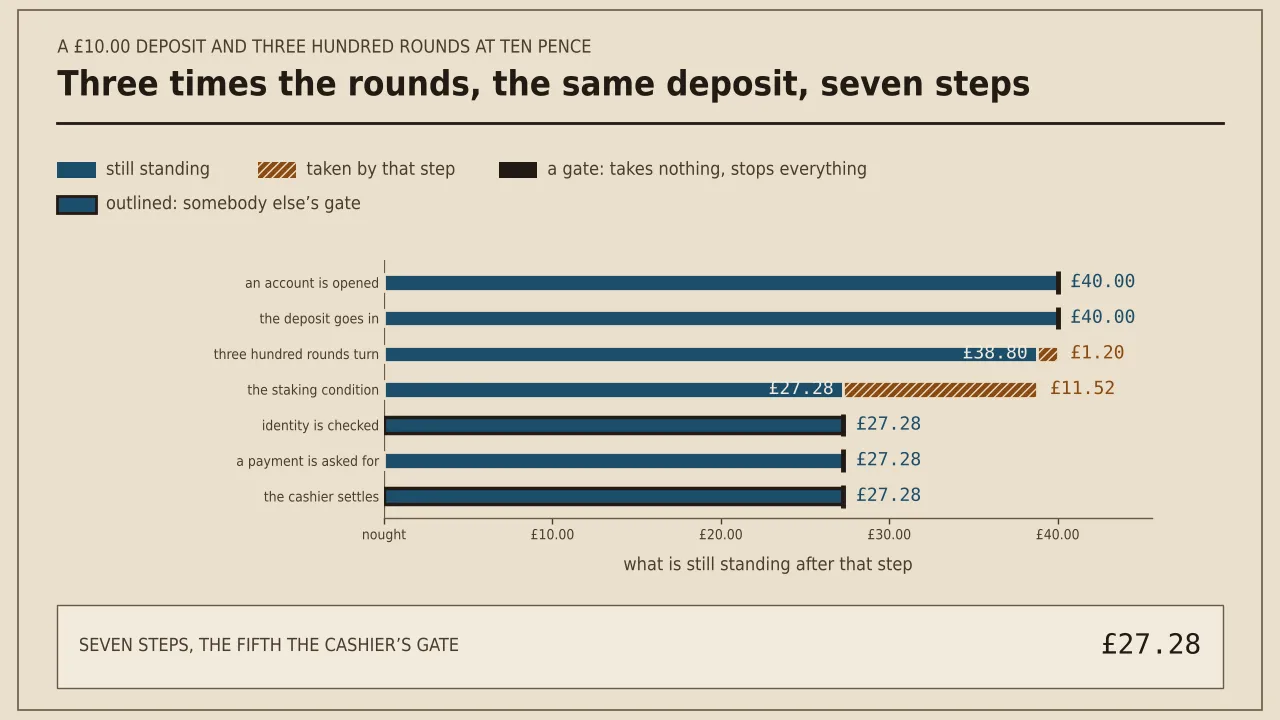
£11.52 of the £28.80 that three hundred rounds produced goes to the staking condition, which is two fifths of that credit and more than a quarter of the £40.00 the ladder opens at
Every figure here moves with the stake, and the method does not care which stake is chosen. Halve the round to five pence and the face falls to £15.00, the credit to £14.40, the survivor to £8.64 and the wagering to £144.00, with the deposit standing at ten pounds throughout and the closing figure at £18.64. Double the round to twenty pence and the face is £60.00, the credit £57.60, the survivor £34.56 and the wagering £576.00, closing at £44.56. The deposit is the one number in all three versions that refuses to move, which is what makes it the right place to measure everything else from.
Sixty times was what some licensees were asking before the ceiling came in, on the regulator’s own figure off the rule sheet, claim 94. Substitute sixty for ten here and the expression returns a number under nought, which nobody owes and no account is in deficit by. It reports that £28.80 would be exhausted well short of sixty turnovers, at which point the only money left would be the ten pounds that came in from outside, and the condition would still be open. There is a crossing point and it is exact: at this return the expectation hits nought at a multiple of twenty-five, so anything steeper describes an obligation the credit is not expected to outlive.
5
Two hours and twelve minutes, at the floor the rules set
A staking condition carries two numbers and only one of them is on the ladder. The chain is seven steps long. One of the seven is performed two thousand eight hundred and eighty times, because £288.00 of wagering at ten pence a round is that many rounds.
Add the three hundred that were given and the count between this headline and a request for payment reaches three thousand one hundred and eighty rounds. Each of them is one press of a control, and the headline mentions three hundred of them. Calling that three thousand steps would be counting rounds and giving them the name of conditions. Reporting seven and leaving it there would omit the one part of the chain that costs genuine time.
What the second count buys is time, and a floor sits under that in British licensing. 2.5 seconds is the floor British licensing lays under a game cycle, measured from the opening of one to the opening of the next off the rule sheet, claim 107. A control wants letting go of and pressing afresh for each, so holding anything down produces no cycles whatever. Automatic play is separately barred on licensed online gaming, each cycle needing a fresh commitment from the person playing off the rule sheet, claim 115.
Three thousand one hundred and eighty rounds at that floor come to seven thousand nine hundred and fifty seconds at the very least, which is two hours and twelve minutes of uninterrupted pressing. Nobody publishes that duration. It is this publisher’s sum laid over a figure of the regulator’s, a floor and not a forecast, no real sitting proceeding at a minimum.
Divide one of those figures by the other and a third appears. £17.28 of expected survivor over two hours and twelve minutes of pressing comes to £7.85 for each hour spent at the floor. That is arithmetic rather than a wage: nobody is paid for any of it, and the £17.28 is an expectation and not a sum that has been handed over. What the figure does is put both halves of the headline into one unit. Three hundred rounds is a quantity that sounds like generosity. £7.85 an hour, at the fastest the rules permit, is that same quantity priced.
Two things follow for anybody reading the headline. Of the two counts, the advertised one is smaller by better than tenfold. And three hundred rounds advertised as a quantity of fun are, measured honestly, a two-hour obligation attached to a ten pound deposit, with the obligation nowhere in the advertising and the deposit in the first two words of it.
6
Which of the five gates belong to the reader, and which do not
Five of the seven steps shift no money at all, and £27.28 is the sum any one of the last three is able to stop. Three of the five wait on the reader and will wait indefinitely. Two wait on the counter. The earlier of that pair is the fifth rung, and that rung is this guide’s finding.
A check placed above the money and a check placed below it expose a reader to quite different things, and British licensing puts it above. Establishing identity comes before any gambling whatever, on a floor of three published items off the rule sheet, claim 10, and notice of what may be asked for is owed before a deposit can be accepted at all off the rule sheet, claim 12. Under that ordering the ten pounds never cross the counter until the reader knows whether verification is going to be a problem.
The far end is shut too. Fresh paperwork may not be produced at a withdrawal where there was an earlier opportunity to ask off the rule sheet, claim 11, and a payment delayed for want of it can put a licensee in breach off the rule sheet, claim 16. Outside the licence the ordering is unfixed: one offshore rulebook read for this site lets a deposit through on an age confirmation and defers the document check to its money-laundering milestones off the rule sheet, claim 146. That is the ordering drawn here, and it is why £27.28 rather than a bare registration is what sits at the fifth rung.
The sixth and seventh rungs carry a duty of their own under a licence, and it is one a reader would not think to look for. A request once lodged is not to be handed back for cancelling, nor the money returned into play, and a licensee is told to keep that route clear of obstruction off the rule sheet, claim 37. The rule exists because a request that can be undone is a request that can be talked out of, and nothing of the sort governs the last two rungs here.
A ten pound deposit is also too small to trigger the one check a licensee would have owed on the money itself. Light-touch financial checks begin at a monthly net deposit figure that came down to £150 in February 2025, from £500 the year before off the rule sheet, claim 48, so a reader would have to walk this chain fifteen times in a month before the threshold was reached. Neither the enhanced assessments nor the light-touch checks affect anybody’s credit rating, and the enhanced ones remain a pilot rather than a live requirement off the rule sheet, claim 49.
Recourse is the last thing standing behind the figure, and it is shorter than a reader might assume even inside the licence. Eight weeks is the ceiling on a licensed complaints process off the rule sheet, claim 39, and the regulator describes itself as unable to settle a dispute, unable to get money back and unable to see into an account off the rule sheet, claim 46. What stands behind £27.28 at an unlicensed counter is whatever that counter has chosen to publish.
7
The four figures nobody has written down
Four quantities that would each move a number on this ladder are unpublished, and they are named here rather than filled in. A rung with no figure behind it is a rung this publisher invented.
The worth of a round is the first and has been dealt with: ten pence is a declaration off the rule sheet, claim 89. What a round’s winnings turn into is the second. If they land as bonus funds the ten applies to them, and whether a round is bonus funds in itself has never been settled either way off the rule sheet, claim 90.
Third, and sharpest on a key whose first word is deposit. Nobody has published whether a condition may reach the deposit too. Bonus funds are what the limit is drafted about, and no worked case has been issued off the rule sheet, claim 104. This guide goes as far as the published wording and halts. A reader meeting an arrangement that wants the deposit wagered too is meeting a larger obligation than the one drawn here, and £27.28 would be the wrong closing figure for it.
Fourth is a roof on what the credit may win, which no source supplies off the rule sheet, claim 105. Without one, £27.28 is where the arithmetic stops and not a sum any counter has undertaken to pay out. A deadline would have been a fifth, time limits being one of the four kinds of condition an advertising regulator calls significant off the rule sheet, claim 62, but no figure for one was read, so no rung carries it.
One published rule does bear on a deadline without supplying a number, and it is worth knowing on a key whose obligation runs to three thousand rounds. Finishing the qualifying activity early may not be used to cut what an incentive is worth to a licensee’s customer off the rule sheet, claim 58. Read against this chain, that would stop the value of three hundred rounds being cut for a reader who got through £288.00 of wagering quickly. Like everything else counted on this page it attaches to a licence, so it is a duty this arrangement is not under, and a reader has no published figure for how long the wagering may be left running either.
8
Three duties this headline would have met under a licence
Every figure here has been settled the way most favourable to whoever is fronting the offer. Ten was taken instead of a term. Full weight was given to the qualifying share. The deposit was held outside the obligation. All three generosities come from duties that attach to a licence, and the counter behind a headline of this shape does not hold one.
Three hundred rounds sold on a ten pound deposit reach readers in Great Britain without a Great Britain licence behind them. Three of the duties it would have brought are costed below, rung by rung. The first produced the ten at the fourth rung, a limit on licensed incentives running from the nineteenth day of January 2026 off the rule sheet, claim 91. Reaching licensed incentives alone, it leaves the £11.52 taken at that rung as the softest reading available and not a figure anything at all compels. The second governs what may be bundled: products may not be mixed inside a single incentive off the rule sheet, claim 99, though casino rounds alongside casino money stay within one product type and are untouched by it off the rule sheet, claim 102, so the shape of this offer would have survived while a version pairing rounds with bingo tickets would not. The third is pace. Automatic play is barred on licensed online gaming and every cycle needs its own commitment off the rule sheet, claim 115, which is what makes the two hours and twelve minutes counted here a floor. Nothing obliges an unlicensed counter to offer the same cycle, and a reader who has signed with Gamstop should know the scheme reaches the businesses Britain licenses off the rule sheet, claim 181 and says in its own terms that it cannot shut anybody out of what lies beyond its membership off the rule sheet, claim 183. No part of this site describes a route past any of the three.
The regulator has published what an unlicensed site may be running without, and the list is worth carrying in detail rather than compressing: controls against money laundering, controls on social responsibility, and a customer’s cover against fraud and against unfair practice, with self-excluded people recorded as a frequent target off the rule sheet, claim 130. The same notice makes a point about appearances. Work from suppliers that do hold licences has turned up on sites with no licence at all off the rule sheet, claim 131, so a familiar screen proves nothing about whose counter is holding the ten pounds.
What the regulator says about its own reach is worth setting beside that, because a page claiming the illegal market is being closed down would be overstating things in one direction and a page calling it untouched would be overstating them in the other. Given the revenue involved, full dismantling is described as unlikely ever to happen; traffic across a hundred and sixty websites targeted for enforcement fell by 32 per cent; and the market is described as sophisticated, digital and global off the rule sheet, claim 136.
A reader is owed one correction in the other direction. The offence of supplying gambling unlicensed belongs to whoever supplies it, and being the customer was never made an offence to match off the rule sheet, claim 3. The loss outside the licence is of cover and not of permission, and this guide has costed that loss item by item. Counted off here: a ceiling over the staking, a fixed place in the chain for the identity check, a bar on mixing products, a minimum cycle, an autoplay ban and compulsory membership of the exclusion scheme off the rule sheet, claim 168. Seven steps, the fifth of them somebody else’s, £27.28 waiting there, and ten pounds of it money the offer never gave anybody.
Asked at the booth
- Counted properly, how many steps is this
- Seven, in this order: account, deposit, three hundred rounds, staking condition, identity check, request, settlement.
- Which rung is the first that the counter decides
- The fifth. Identity is checked there, £27.28 waits on the outcome, and ten pounds of that sum came from the reader rather than the offer.
- Do three times the rounds mean three times the value
- Three times the value and three times the obligation. £17.28 is expected to survive where £5.76 would, and £288.00 has to be staked where £96.00 would.
- How much wagering does each pound of deposit carry
- £28.80 of staking for every pound that went in, because the condition attaches to the credit and the deposit is the price of getting the credit.
- What does the staking cost in time at the published floor
- Three thousand one hundred and eighty rounds in all. Pressed at the fastest pace British licensing permits, they fill two hours and twelve minutes.
- Where does the ten pence come from
- This guide declares it, and says so. The cash value of a round is fixed by no published rule at all, which leaves an assumption or nothing.
- Is the deposit caught by the staking condition
- Not on the published wording, which is drafted about bonus funds. Whether a condition may reach a deposit as well has never been answered either way.
- Would a British licence have changed this offer
- It would have capped the multiple, fixed the check above the deposit, barred automatic play and forced membership of the exclusion scheme. None of that is in force here.